
Research has always been one of the most time-consuming tasks in professional work. Whether you’re evaluating AI tools, studying market trends, preparing business reports, analyzing competitors, or learning a new technology, the process often involves reading dozens of websites, comparing information, verifying facts, and organizing findings.
Gemini Deep Research changes that workflow significantly.
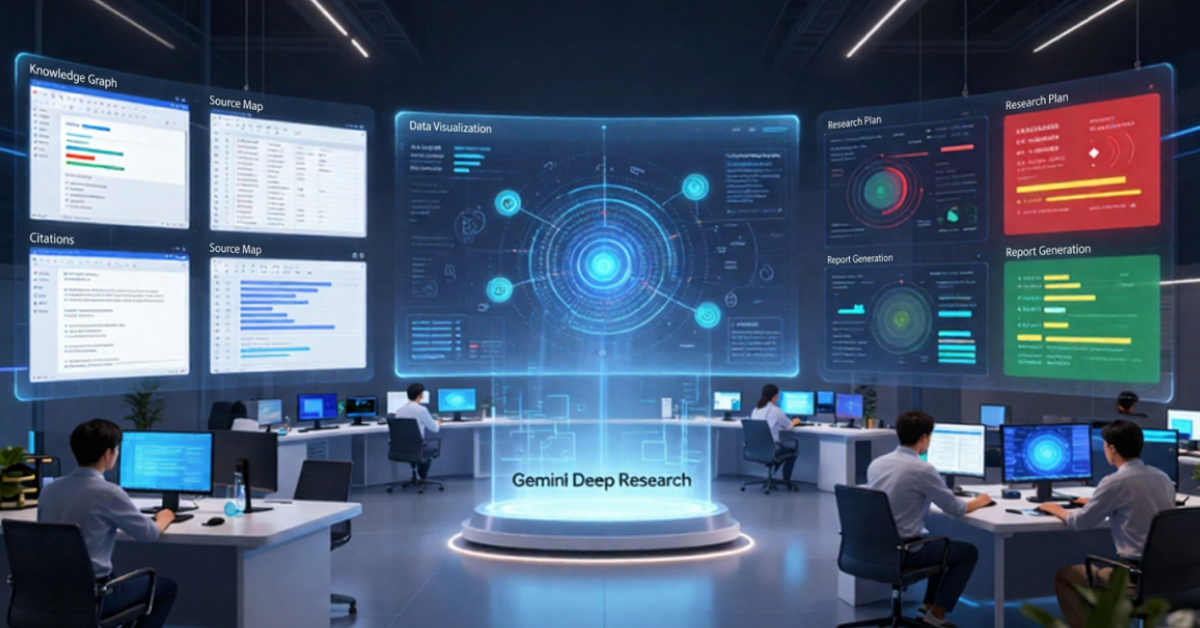
Instead of acting like a traditional chatbot that answers a single question, Gemini Deep Research functions more like an AI research assistant. It creates a research plan, gathers information from multiple sources, analyzes findings, and produces a structured report with citations. Google positions it as a tool for handling complex, multi-step research tasks rather than simple question-and-answer interactions.
For professionals, creators, developers, and business users, this represents one of the most practical applications of AI available today.
Table of Contents
What Is Gemini Deep Research?
Gemini Deep Research is a specialized research mode within Gemini that performs autonomous, multi-step investigations on a topic.
Instead of providing an immediate answer, the system:
- Understands the research objective
- Creates a research strategy
- Searches relevant sources
- Collects information
- Compares findings
- Synthesizes insights
- Generates a structured report with citations
Google describes it as an AI-powered research assistant capable of handling complex research workflows that would traditionally require significant manual effort.
Why Google Created Gemini Deep Research
Traditional AI assistants are excellent at answering questions but often struggle when a task requires:
- Multiple research steps
- Comparing many sources
- Long-form analysis
- Fact verification
- Report generation
Professionals increasingly need AI systems that can perform research rather than simply answer prompts.
Gemini Deep Research addresses this need by combining:
- Gemini reasoning capabilities
- Google Search access
- Source analysis
- Report generation
- Citation support
The goal is to reduce hours of manual research into minutes while maintaining transparency through source references.
How Gemini Deep Research Works
A typical Deep Research workflow looks like this:
Step 1: User Defines a Research Goal
Example:
“Research the best AI coding assistants for Angular developers in 2026.”
Step 2: Gemini Creates a Research Plan
Rather than immediately searching, Gemini builds a structured investigation plan.
This may include:
- Market analysis
- Feature comparison
- Pricing review
- User feedback
- Technical capabilities
Step 3: Source Discovery
Gemini explores multiple sources across the web and, when permitted, can incorporate information from connected services and user-provided content.
Step 4: Analysis and Synthesis
Instead of simply listing information, Gemini identifies:
- Patterns
- Contradictions
- Strengths
- Weaknesses
- Emerging trends
Step 5: Report Generation
The final output includes:
- Organized findings
- Summaries
- Recommendations
- Citations
- Supporting evidence
Key Features of Gemini Deep Research
Multi-Step Research Planning
The system breaks large problems into smaller research tasks before beginning analysis.
Source-Based Research
Unlike many chatbot responses, Deep Research is designed around source exploration and evidence gathering.
Citation Generation
Reports include references to supporting sources, improving transparency.
Google Workspace Integration
Deep Research can incorporate information from Gmail, Drive, and other Workspace-connected sources when enabled.
Report Creation
Users receive structured research outputs rather than fragmented answers.
Advanced Visual Reports
Some tiers support charts, diagrams, and interactive visualizations to explain findings more effectively.
Gemini Deep Research vs Traditional Research
| Factor | Traditional Research | Gemini Deep Research |
|---|---|---|
| Source Discovery | Manual | Automated |
| Information Collection | Manual | Automated |
| Report Drafting | Manual | Assisted |
| Citation Gathering | Time Consuming | Built In |
| Analysis Speed | Hours | Minutes |
| Cross-Source Comparison | Manual | Automated |
| Scalability | Limited | High |
The biggest advantage is not replacing human judgment but accelerating information gathering and organization.
Practical Workflow Example
Imagine you’re writing an article about AI agents.
Traditional process:
- Open 30 browser tabs
- Read documentation
- Compare sources
- Create notes
- Draft article
Time required:
4–8 hours.
With Gemini Deep Research:
Prompt:
Research the latest developments in AI agents, compare major platforms, identify practical business applications, and generate a structured report.
The system performs much of the groundwork automatically, allowing you to focus on analysis and publishing.
For Developers
Developers can use Gemini Deep Research for:
Technology Evaluation
Compare:
- AI frameworks
- APIs
- Development platforms
- Agent frameworks
Learning New Technologies
Research:
- Gemini API
- MCP implementations
- Agent orchestration
- Cloud AI services
Competitive Analysis
Analyze:
- Product capabilities
- Developer ecosystems
- Pricing models
- Adoption trends
If you’re already using the Gemini ecosystem, this works particularly well alongside articles like your Google AI Studio and Gemini API learning workflows.
For Designers
Designers often spend hours collecting information before starting a project.
Gemini Deep Research can help with:
UX Research
Research:
- Design patterns
- User expectations
- Industry benchmarks
Design Trends
Analyze:
- Visual trends
- Interface patterns
- Accessibility practices
Product Discovery
Study:
- Competitors
- User reviews
- Feature gaps
As a UI/UX professional, I see this as one of the strongest applications of AI-assisted research because it reduces information gathering time significantly.
For Creators
Content creators can use Deep Research for:
Content Planning
Research:
- Audience interests
- Industry trends
- Emerging topics
Video Research
Collect:
- Statistics
- Supporting sources
- Expert viewpoints
Newsletter Creation
Generate research summaries before writing.
Instead of searching dozens of websites manually, creators can begin with a structured research report.
Business and Professional Applications
Gemini Deep Research is especially useful for:
Market Research
Analyze:
- Industry trends
- Market opportunities
- Competitor strategies
Vendor Evaluation
Compare:
- Software platforms
- SaaS products
- AI tools
Strategic Planning
Research:
- Emerging technologies
- Industry changes
- Business opportunities
Advantages of Gemini Deep Research
Significant Time Savings
Tasks that previously required hours can often be completed much faster.
Better Research Coverage
AI can evaluate more sources than most individuals can review manually within the same timeframe.
Structured Output
Reports arrive organized rather than scattered.
Reduced Information Overload
The system synthesizes information into actionable findings.
Integration with Google’s Ecosystem
Deep Research becomes even more valuable for users already invested in:
- Gemini
- Google Workspace
- Google Drive
- NotebookLM
Limitations and Things to Watch
No AI research tool is perfect.
Important limitations include:
Source Quality Still Matters
AI can only work with available information.
Human Verification Remains Essential
Critical decisions should always include manual review.
Potential Hallucinations
Even advanced AI systems can occasionally misinterpret or synthesize information incorrectly.
Not a Replacement for Expertise
Deep Research accelerates research but does not replace domain knowledge.
Common Mistakes to Avoid
Mistake #1: Trusting Every Conclusion
Always verify important findings.
Mistake #2: Using Vague Prompts
Poor:
Research AI.
Better:
Research the best AI design tools for UI/UX professionals in 2026 and compare pricing, strengths, and limitations.
Mistake #3: Ignoring Sources
Always review cited references.
Mistake #4: Treating AI as the Final Authority
Use it as a research assistant, not a replacement for critical thinking.
How I Would Use Gemini Deep Research
For AmitGuptaBlogs.com, I would use Gemini Deep Research for:
Article Preparation
Research:
- Google AI announcements
- Gemini ecosystem updates
- AI productivity tools
Product Comparisons
Compare:
- AI coding tools
- AI design platforms
- AI productivity software
Industry Monitoring
Track:
- AI trends
- Developer tooling
- Design automation
- Agent-based workflows
The output would become the starting point for original analysis rather than the final published content.
Future of AI-Powered Research
The evolution of AI research tools is moving beyond simple chat interfaces.
Recent developments suggest that research systems are becoming increasingly agentic, capable of planning investigations, working across multiple sources, generating visualizations, and producing structured deliverables.
Future versions will likely include:
- More autonomous research
- Better visual reporting
- Deeper workspace integration
- Personalized knowledge bases
- Multi-agent research workflows
For professionals, this could fundamentally change how knowledge work is performed.
Conclusion
Gemini Deep Research represents one of the most practical uses of AI in 2026.
Rather than acting as another chatbot, it functions as an AI-powered research assistant that can plan investigations, analyze sources, generate reports, and provide cited findings.
For developers, designers, creators, students, and business professionals, Gemini Deep Research can dramatically reduce the time required to gather and organize information.
The biggest value is not replacing human expertise. The real value comes from eliminating repetitive research work so that people can spend more time making decisions, creating content, solving problems, and building products.
Key Takeaways
- Gemini Deep Research is an AI-powered research assistant inside Gemini.
- It performs multi-step research rather than simple Q&A.
- It creates research plans before gathering information.
- Reports include citations and structured findings.
- Workspace integrations can improve research quality.
- Developers, designers, creators, and businesses can all benefit.
- Human review remains essential for important decisions.
- AI-powered research workflows are becoming a major productivity category.
FAQs
1. What is Gemini Deep Research?
Gemini Deep Research is an AI-powered research mode that performs multi-step investigations and generates structured reports with citations.
2. Is Gemini Deep Research different from normal Gemini chat?
Yes. Normal Gemini chat answers questions directly, while Deep Research creates a research plan, gathers information, and produces a detailed report.
3. Can Gemini Deep Research access Google Workspace data?
When enabled, it can incorporate information from supported Workspace sources such as Gmail and Google Drive.
4. Is Gemini Deep Research useful for content creators?
Yes. It can accelerate topic research, trend analysis, competitor research, and information gathering.
5. Can developers use Gemini Deep Research?
Absolutely. Developers can use it for technology evaluations, framework comparisons, API research, and learning workflows.
6. Does Gemini Deep Research replace human researchers?
No. It accelerates research but still requires human verification, interpretation, and decision-making.
References
- Gemini Deep Research Overview
- Gemini Deep Research Agent Documentation
- Gemini Deep Research Agent Guide
- Deep Research in Gemini Apps
- Deep Research Developer Guide
- Deep Research Workspace Integration
- Deep Research Updates from Google I/O
Author Bio

Amit Gupta is a UI/UX Designer and Frontend Specialist with more than 20 years of experience in product design, design systems, Angular development, frontend architecture, and emerging technologies. Through AmitGuptaBlogs.com, he shares practical insights on AI, Google technologies, design workflows, development tools, and future technology trends.