Artificial Intelligence assistants have evolved dramatically over the past few years. What started as simple chatbots has now become a powerful ecosystem of research assistants, coding partners, productivity tools, content creators, and business copilots.
In 2026, two names dominate this space:
- Google Gemini
- ChatGPT
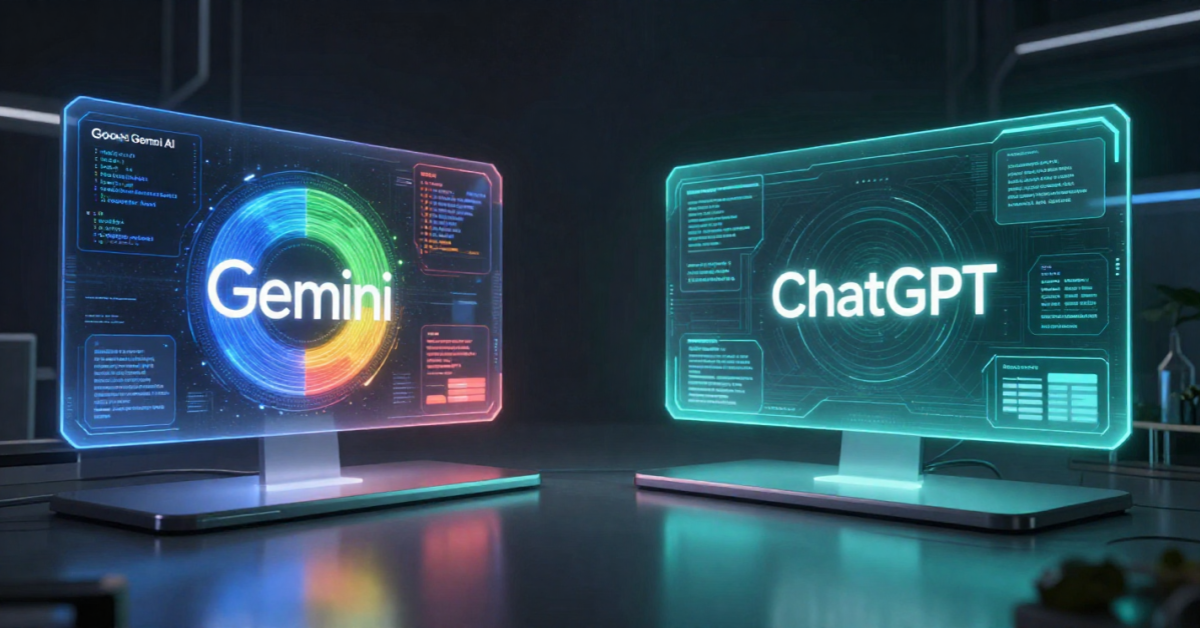
Both platforms have introduced major upgrades, deeper reasoning capabilities, multimodal intelligence, autonomous research workflows, and advanced productivity features. The question most users are asking today is simple:
Which AI assistant is actually better in 2026?
The answer depends on how you use AI.
As someone working in product design, frontend development, design systems, and emerging technologies, I have tested both platforms extensively across research, coding, writing, productivity, and creative workflows.
This guide breaks down where each platform excels and where it still falls short.
Table of Contents
The AI Assistant Landscape in 2026
The competition is no longer just about generating text.
Modern AI assistants now help users:
- Write articles
- Build applications
- Analyze spreadsheets
- Generate images
- Conduct deep research
- Create presentations
- Manage projects
- Automate workflows
- Understand videos and documents
Google and OpenAI have taken different approaches to solving these problems. Google focuses heavily on ecosystem integration. Whereas OpenAI focuses heavily on reasoning, workflows, customization, and conversational intelligence.
What Is Google Gemini?
Google Gemini is Google’s flagship AI ecosystem. Over the last year, Gemini has expanded beyond a chatbot into a complete AI productivity platform. The ecosystem now includes:
- Gemini App
- Gemini Live
- NotebookLM
- Google AI Studio
- Gemini Enterprise Agent Platform
- Google Workspace AI
- Deep Research
Google has deeply integrated Gemini into Gmail, Docs, Drive, Sheets, Search, Android, and Chrome.
One of Gemini’s biggest advantages is its extremely large context window, allowing it to process huge amounts of information simultaneously. Google highlights a 1 million token context window for advanced workflows and research tasks.
What Is ChatGPT?
ChatGPT remains the most recognizable AI assistant in the world.
Powered by GPT-5 and GPT-5.5, ChatGPT has evolved into a comprehensive AI workspace featuring:
- Deep Research
- Projects
- Memory
- Custom GPTs
- Advanced coding capabilities
- Agent-style workflows
- Multimodal understanding
OpenAI describes GPT-5 as a major leap in intelligence, reasoning, coding, writing, and visual understanding. While GPT-5.5 further improved multi-step reasoning, consistency, and long-form workflows.
Gemini vs ChatGPT: Quick Comparison Table
| Feature | Gemini | ChatGPT |
|---|---|---|
| Writing Quality | Very Good | Excellent |
| Coding | Excellent | Excellent |
| Google Workspace Integration | Excellent | Limited |
| Research | Excellent | Excellent |
| Custom AI Assistants | Gems | Custom GPTs |
| Context Window | Strong Advantage | Strong |
| Android Integration | Excellent | Limited |
| Creativity | Good | Excellent |
| Search Grounding | Excellent | Very Good |
| Ecosystem | OpenAI |
Writing Quality Comparison
For long-form blogging, storytelling, marketing copy, and content creation, ChatGPT generally produces more natural and engaging outputs. Many writers prefer ChatGPT because it feels more conversational and creative.
Gemini tends to be:
- More structured
- More factual
- More analytical
This difference is frequently noted by users comparing both systems.
Winner for Writing
ChatGPT
Coding Comparison
For developers, both platforms have become remarkably capable. Tasks tested:
- Angular development
- CSS architecture
- SCSS optimization
- JavaScript debugging
- API integrations
- Design system workflows
ChatGPT often produces cleaner first-pass code and better explanations.
Gemini performs exceptionally well when handling large repositories because of its huge context window.
Winner for Coding
Tie
Choose:
- ChatGPT for cleaner implementation guidance
- Gemini for large-scale codebase analysis
Research Comparison
This is one of the most competitive areas. Google has invested heavily in Deep Research. Its research agents can autonomously explore sources, synthesize information, and create detailed reports.
On the other hand, ChatGPT has also expanded Deep Research capabilities with authenticated sources, structured reports, and user-controlled workflows.
Winner for Research
Slight Edge: Gemini
Especially when research involves:
- Search-heavy tasks
- Large datasets
- Multiple documents
- Google ecosystem data
Productivity Comparison
If you already live inside:
- Gmail
- Google Docs
- Google Sheets
- Google Drive
- Android
Gemini feels almost native. Google continues expanding AI integration throughout Workspace and Search.
ChatGPT is excellent for standalone productivity but lacks Google’s native ecosystem advantage.
Winner for Productivity
Gemini
Multimodal AI Comparison
Modern AI is no longer text-only.
Both platforms now understand:
- Images
- Documents
- Audio
- Video
- Screenshots
Gemini was designed from the beginning as a multimodal model and continues expanding these capabilities. But ChatGPT remains one of the strongest multimodal platforms, particularly for visual reasoning and image generation workflows.
Winner
Tie
Context Window Comparison
One of Gemini’s most important advantages is context size. Google’s advanced models support approximately 1 million tokens, with some enterprise workflows extending even further.
This makes Gemini particularly useful for:
- Entire codebases
- Long research reports
- Large PDFs
- Multi-document analysis
Winner
Gemini
Pricing Comparison
As of 2026:
| Plan | Gemini | ChatGPT |
|---|---|---|
| Free | Available | Available |
| Main Paid Plan | ~$20/month | ~$20/month |
| Enterprise Options | Available | Available |
Which AI Is Better for Students?
Students should choose Gemini if they:
- Use Google Workspace daily
- Need research assistance
- Manage large study materials
Students should choose ChatGPT if they:
- Need explanations
- Want tutoring-style conversations
- Create essays and presentations
Which AI Is Better for Developers?
As a frontend specialist and Angular developer, my recommendation is:
Choose Gemini if:
- You work inside Google’s ecosystem
- You analyze large repositories
- You use Google Cloud
Choose ChatGPT if:
- You want implementation guidance
- You need debugging assistance
- You need architectural explanations
Which AI Is Better for Content Creators?
For bloggers, YouTubers, marketers, and social media creators:
ChatGPT Advantages
- Better storytelling
- Better tone adaptation
- Better content ideation
- Better long-form writing
Gemini Advantages
- Better research workflows
- Better integration with Workspace
- Better fact gathering
Winner
ChatGPT
Pros and Cons
Gemini Pros
- Massive context window
- Excellent Workspace integration
- Strong research capabilities
- Strong multimodal workflows
- Powerful Google ecosystem
Gemini Cons
- Writing can feel more formal
- Less flexible personality customization
ChatGPT Pros
- Outstanding writing quality
- Excellent coding support
- Strong reasoning
- Custom GPT ecosystem
- Better conversational experience
ChatGPT Cons
- Less native productivity integration
- Smaller ecosystem advantage compared to Google
Future Outlook
The AI assistant battle is becoming an ecosystem battle.
Google is embedding Gemini across:
- Search
- Android
- Workspace
- Chrome
- Enterprise products
OpenAI is focusing on:
- Agentic workflows
- Research
- Coding
- Personalized AI experiences
Both companies are rapidly moving toward proactive AI assistants that can perform tasks rather than simply answer questions.
Final Verdict
If I had to summarize the comparison in one sentence:
Choose Gemini if you live inside Google’s ecosystem. Choose ChatGPT if you want the most versatile AI assistant overall.
For most professionals, developers, creators, and bloggers in 2026:
Overall Winner: ChatGPT
For Workspace users and research-heavy workflows:
Best Productivity AI: Gemini
The reality is that many power users now use both together. Gemini handles research and ecosystem workflows.
ChatGPT handles reasoning, writing, coding, and content creation.That combination currently offers one of the most productive AI workflows available.
Key Takeaways
- Gemini dominates ecosystem integration and Workspace productivity.
- ChatGPT remains stronger for writing and conversational workflows.
- Both platforms are excellent for coding.
- Gemini offers a larger context window for large-scale analysis.
- ChatGPT delivers a more polished content creation experience.
- Research capabilities are becoming highly competitive.
- Most advanced users benefit from using both platforms strategically.
FAQs
1. Is Gemini better than ChatGPT in 2026?
It depends on your workflow. Gemini is stronger for Google ecosystem productivity, while ChatGPT generally excels in writing and versatile AI assistance.
2. Which AI is better for coding?
Both are excellent. Gemini handles large codebases well, while ChatGPT often provides cleaner implementation guidance.
3. Is Gemini free?
Yes. Google offers a free Gemini tier along with premium plans.
4. Is ChatGPT worth paying for?
For professionals, developers, writers, and creators, ChatGPT Plus remains one of the most valuable AI subscriptions available.
5. Which AI is better for research?
Gemini currently has a slight edge due to Google’s search infrastructure and Deep Research capabilities.
6. Which AI is better for blogging?
ChatGPT generally produces more natural long-form content and stronger content ideation.
References
- Google Gemini Deep Research
- Google Gemini Release Notes
- Gemini Deep Research Agent Documentation
- OpenAI GPT-5 Overview
- OpenAI GPT-5.5 Announcement
- ChatGPT Deep Research
- Google Gemini 3 Announcement
Author Bio

Amit Gupta is a UI/UX Designer and Frontend Specialist with more than 20 years of experience in product design, design systems, Angular development, frontend architecture, and emerging technologies. Through AmitGuptaBlogs.com, he shares practical insights on AI, Google technologies, design workflows, development tools, and future technology trends.
Related Articles
- Complete Guide to Google Gemini in 2026
- Google AI Studio Explained for Beginners
- NotebookLM vs ChatGPT: Which Research Tool Is Better?
- Gemini for Developers: Real-World Coding Workflows
- Best AI Tools for Content Creators in 2026