
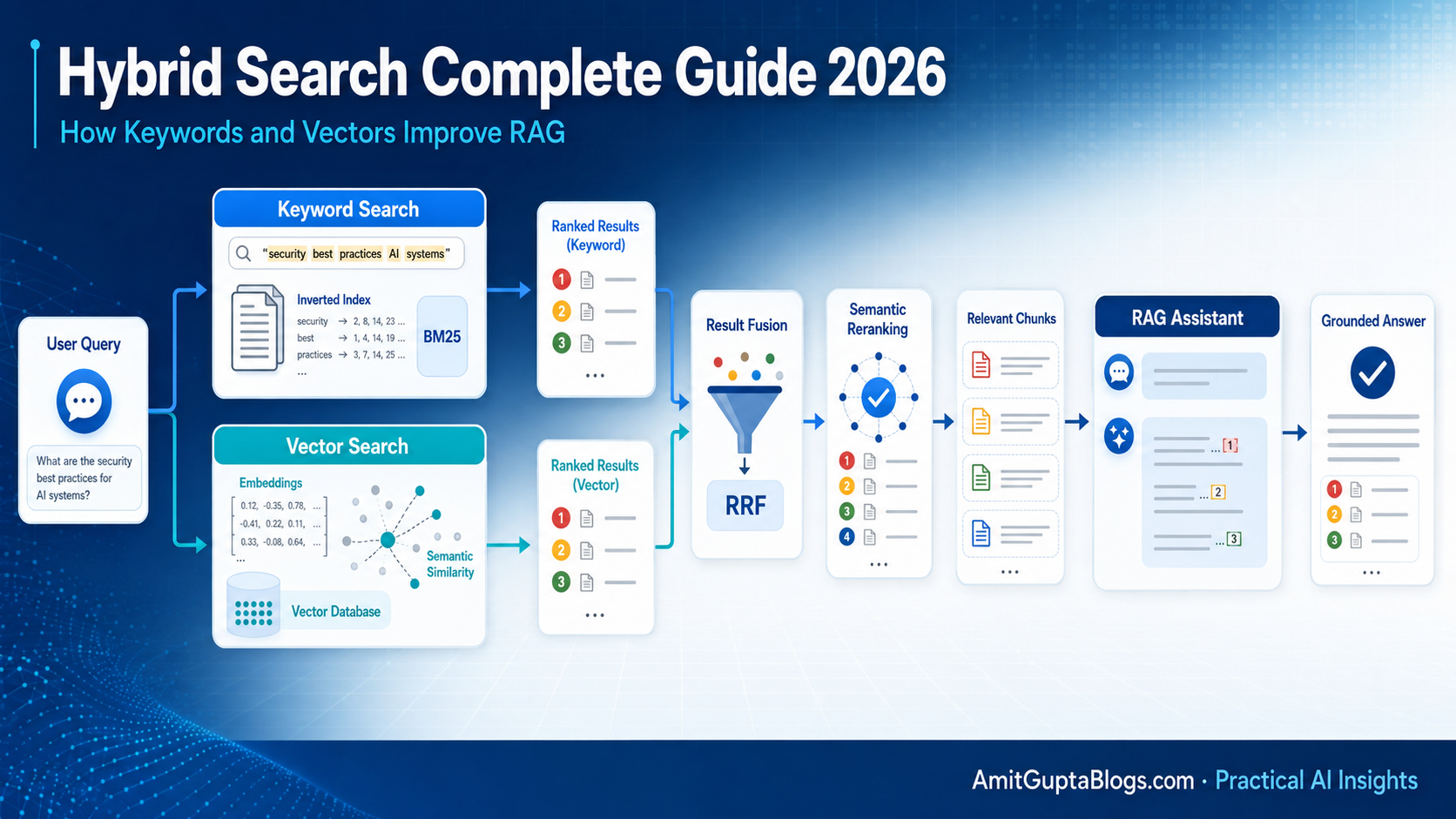
An employee types “POL-HR-1042 remote-work allowance” into a company AI assistant.
Keyword search immediately recognises the exact policy number. Semantic search understands that the employee may be asking about home-office reimbursement, even though those words are different.
Hybrid Search uses both signals. It preserves the precision of the policy ID while understanding the meaning behind the request. This gives the assistant a much better chance of retrieving the correct policy instead of a document that merely sounds relevant.
This is why Hybrid Search has become increasingly useful in enterprise search and Retrieval-Augmented Generation (RAG). Users rarely phrase every question exactly as the source document does—but they still expect product codes, names, dates, error messages and policy numbers to be matched precisely.
This guide explains how Hybrid Search works, where keyword and vector retrieval fit, how fusion and reranking improve results, and how these components strengthen modern RAG systems.
Table of Contents
What Is Hybrid Search?
Hybrid Search combines two or more retrieval methods in a single search experience. The most common architecture brings together:
- Keyword or lexical search, based on exact words, phrases and term statistics.
- Semantic or vector search, which compares the meaning represented by embeddings.
Each retrieval method produces its own list of potentially relevant results. A fusion method combines those lists, while an optional reranker examines the strongest candidates more carefully.
The important point is that keyword and semantic search recognise different kinds of relevance.
Keyword search asks:
Does this document contain the terms used in the query?
Semantic search asks:
Does this document express the meaning or intention behind the query?
Hybrid Search allows both signals to contribute.
Why Keyword Search Alone Is Not Enough
Keyword search is highly effective when the query and document use the same terminology.
It works particularly well when a user searches for:
- a policy number;
- an error code;
- a legal phrase;
- a product name;
- an employee ID;
- a technical command;
- a software version; or
- an exact quotation.
Suppose a customer searches for:
Change delivery location
However, the relevant help article is titled the following:
Edit the shipping address after ordering
The article may contain the correct answer without using the customer’s exact words. A strictly lexical system could miss or undervalue it unless synonyms, stemming or manually designed query rules cover the variation.
Synonym lists can help, but they become difficult to maintain across large product catalogues, specialist terminology and multiple languages.
Keyword search can therefore be precise without always understanding intent.
Why Semantic Search Alone Is Not Enough
Semantic search approaches the problem from the opposite direction. It is good at meaning, but meaning is not always the only thing that matters.
An embedding model may understand that:
working from home costs
is related to:
remote-work reimbursement
However, it may be less reliable when the query contains:
- POL-HR-1042
- E_CONN_417
- an uncommon product SKU;
- a newly introduced internal codename;
- a precise date;
- a person’s name; or
- a specialist abbreviation.
These values may not carry enough semantic meaning for the embedding model, even though they are critically important to the user.
Numbers, codes, names and quoted phrases can lose prominence inside the broader semantic representation of a query. This becomes frustrating when the user clearly expects an exact match.
Semantic search understands flexible human language, but it should not be expected to replace every capability of lexical retrieval.
Keyword Search vs Semantic Search vs Hybrid Search
| Approach | Best at | Common weakness | Suitable use cases |
|---|---|---|---|
| Keyword search | Exact terms, phrases, IDs, numbers and rare vocabulary | May miss paraphrases, synonyms and broader intent | Logs, catalogues, codes and compliance documents |
| Semantic search | Meaning, natural-language questions and related concepts | Can underweight exact identifiers or unfamiliar terminology | Discovery, FAQs and conversational search |
| Hybrid Search | Combining exactness with meaning | Requires fusion, tuning and evaluation | Enterprise search, RAG, support and product search |
Hybrid Search does not replace these two approaches. It creates a controlled way for them to work together.
How Hybrid Search Works
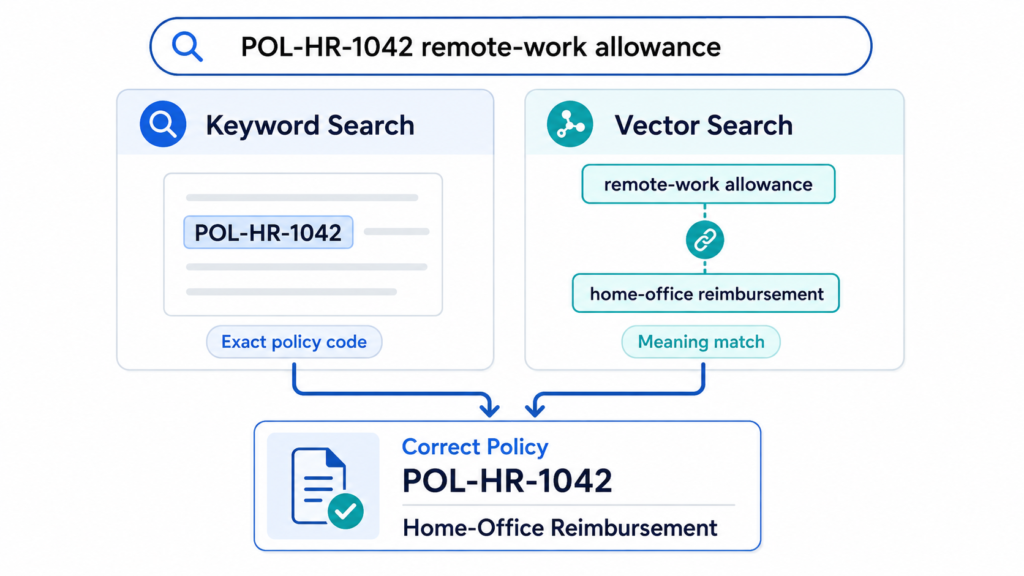
A typical Hybrid Search workflow contains five stages:
- The user submits a query.
- Keyword and vector searches run in parallel.
- Each retriever produces a ranked candidate list.
- A fusion method combines the lists.
- A reranker optionally improves the final result order.
The basic architecture looks like this:
User Query → Keyword Search + Vector Search → Result Fusion → Reranking → Final Results
Keyword retrieval identifies strong term matches. Vector retrieval finds documents whose embeddings are semantically close to the query embedding.
However, their raw scores are not naturally comparable. A BM25 score and a vector similarity score represent different types of measurement.
The fusion stage therefore needs a deliberate method instead of simply adding the two numbers together.
Microsoft’s Azure AI Search Hybrid Search overview describes parallel full-text and vector queries merged through Reciprocal Rank Fusion. Elastic’s Hybrid Search documentation also recommends Reciprocal Rank Fusion as a practical approach.
Hybrid search should not be considered better simply because it combines keyword and vector retrieval. The real question is whether the combination retrieves more of the required evidence and ranks that evidence more effectively than either method alone. You can test the approach with retrieval metrics such as Recall@K, Precision@K, MRR and nDCG, then evaluate whether those improvements translate into better grounded answers. I explain the complete testing approach in my RAG Evaluation Complete Guide 2026.
BM25 Explained Simply
BM25 is a widely used keyword-ranking method.
It examines signals like:
- how often a query term appears in a document;
- how rare that term is across the entire collection; and
- whether the document’s length makes that occurrence meaningful.
Suppose someone searches for POL-HR-1042. Because this policy number is rare, a document containing the exact identifier can receive a strong lexical relevance score.
BM25 also prevents a document from ranking highly merely because it repeats a common keyword many times. Additional repetitions do not increase the score indefinitely.
This makes BM25 more useful than basic word counting.
Good BM25 performance still depends on:
- clean text fields;
- appropriate tokenisation;
- suitable language analysers;
- searchable titles and headings;
- correct treatment of identifiers; and
- testing with genuine user queries.
Teams should examine real retrieval failures before adding complex boosts or rewriting large parts of their search configuration.
Vector Search Explained Briefly
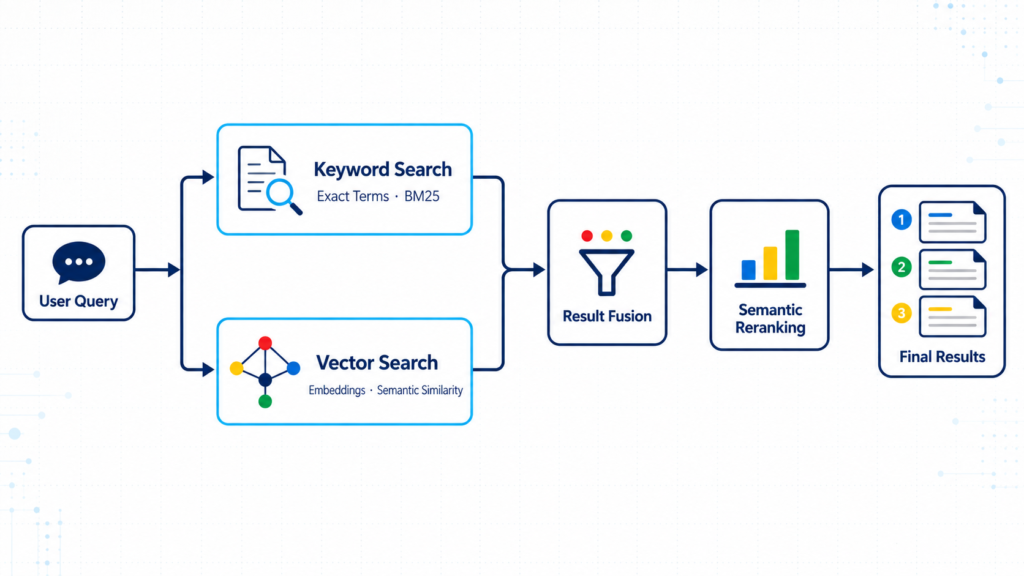
Vector search converts queries and content into embeddings – numerical representations of their meaning.
Content with related meaning is positioned closer together in the vector space. The search system retrieves the vectors closest to the query vector, often using an approximate nearest-neighbour index.
This allows:
home-office reimbursement
to match:
remote-work allowance
even when both phrases do not appear in the same document.
Embeddings give retrieval systems much more flexibility when users ask conversational questions or use unfamiliar wording.
For a deeper understanding, read the AI Embeddings Complete Guide 2026 and the Vector Databases Complete Guide 2026.
What Is Reciprocal Rank Fusion?
Reciprocal Rank Fusion, commonly called RRF, combines ranked lists by considering where each document appears rather than directly comparing incompatible raw scores.
Imagine two documents:
- Document A ranks first in keyword search and fourth in vector search.
- Document B ranks sixth in keyword search and second in vector search.
RRF assigns greater value to higher positions in each list and combines that ranking evidence into a final order.
A document appearing near the top of both lists receives a strong combined signal. A result can also survive by performing exceptionally well in one list, which is useful for exact identifiers and rare terms.
RRF is popular because:
- keyword and vector scores do not need to use the same scale;
- it is relatively straightforward to implement;
- it does not require training another model; and
- it provides a dependable starting point for hybrid retrieval.
RRF is not the only fusion method. Weighted and normalised score combinations can be useful when teams need more direct control over the contribution of each retriever.
Weaviate’s Hybrid Search concepts explain both rank-based fusion and relative-score fusion approaches.
Hybrid Search Inside a RAG System
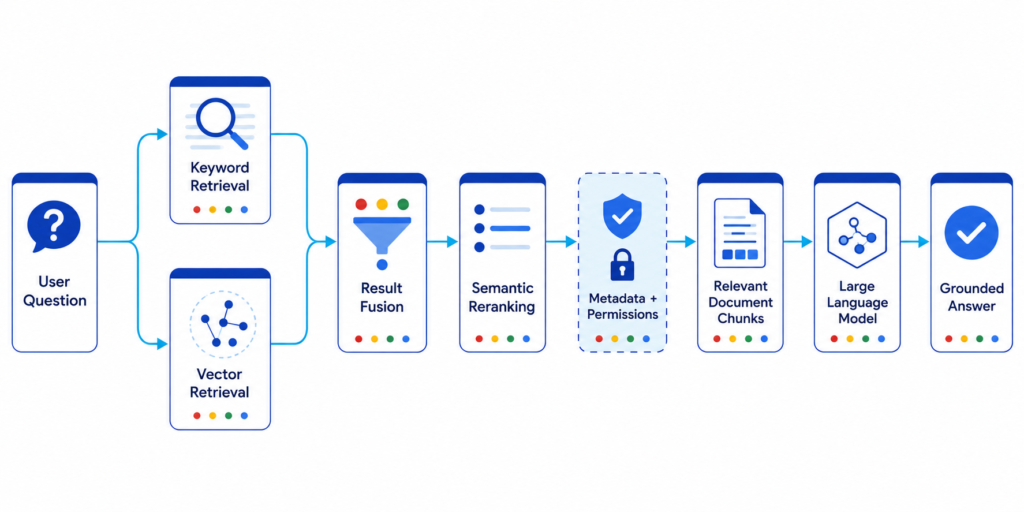
Retrieval is one of the most important parts of a RAG system because it determines which evidence reaches the language model.
A language model cannot reliably cite a policy, product specification or internal procedure that was never included in its context.
A Hybrid Search RAG workflow generally follows this path:
User Question → Keyword and Vector Retrieval → Result Fusion → Reranking → Relevant Chunks → Large Language Model → Grounded Answer
Hybrid Search increases the likelihood that the initial candidate set contains the following:
- documents with the correct identifiers;
- passages that match the user’s intent;
- related terminology and paraphrases;
- relevant product or policy versions; and
- authoritative supporting evidence.
The system can then pass a smaller, higher-quality group of document chunks into the prompt, along with appropriate source information.
The complete RAG process—including ingestion, chunking, embeddings, retrieval, prompt augmentation and generation—is explained in the Retrieval-Augmented Generation Complete Guide 2026.
Retrieval quality ultimately becomes visible through the answer.
If an assistant cites an outdated policy, mixes two products or ignores a ticket number, the user experiences it as an AI failure—even if the real problem occurred before the generation stage.
Why Reranking Matters
Initial retrieval is designed to search a large collection quickly. It is not always the best final judge of relevance.
A multi-stage retrieval system separates speed from deeper evaluation:
- Initial retrieval searches a large collection using keyword and vector signals.
- Candidate selection preserves the strongest merged results within a manageable window.
- Reranking examines the query and candidates more carefully.
- Final selection sends only the most useful passages to the language model.
A semantic reranker can compare the complete query with candidate text more deeply than the first-stage similarity calculation.
For example, the initial retrieval stage might return 50 candidates. The reranker can reorder those candidates and select the strongest five or ten passages for the RAG prompt.
Reranking adds latency and computational cost, so it is normally applied only to a limited candidate set.
Azure Semantic Ranker, for example, works as a secondary ranking layer and can be used after hybrid retrieval.
The practical principle is:
Retrieve broadly enough to preserve recall, then rerank a controlled candidate set to improve precision.
Metadata Filters and Access Control
Textual relevance is only one part of correct retrieval.
A result may also need to be:
- valid in the user’s region;
- associated with the selected product version;
- effective on the current date;
- approved rather than marked as a draft;
- owned by the appropriate department;
- available in the user’s language; and
- permitted under the user’s access rights.
A document can be semantically relevant and still be wrong for the current user.
Metadata filters reduce the search space and prevent invalid content from reaching the model. They can restrict results using fields as mentioned below:
- date;
- location;
- department;
- status;
- category;
- language;
- price;
- version; and
- permission group.
Google Cloud’s Vector Search filtering documentation describes categorical and numeric restrictions that can exclude results outside the required properties.
Security filtering deserves particular attention. Access rules should be enforced during retrieval rather than relying on a prompt instruction to hide restricted information later.
Practical Hybrid Search Examples
1. Company Policy Search
An employee enters a policy code and informally describes the benefit they need.
Keyword search finds the exact policy number. Semantic retrieval understands the employee’s broader question. Metadata filtering ensures that the selected policy applies to the employee’s location and department.
2. Customer-Support Knowledge Base
A customer describes a problem in everyday language while also including an error message, device model or software version.
Vector search recognises similar symptoms. Keyword search preserves the exact technical details.
3. E-Commerce Product Search
A shopper searches for:
Lightweight shoes for rainy runs
Semantic search understands the intended use. Lexical signals preserve the requested brand, size, waterproof material or product code. Metadata filters apply availability, price and delivery region.
4. Developer Documentation
A developer asks a natural-language question about an API concept while including a function name, command-line flag or error code.
Semantic search finds conceptually related explanations. Keyword search ensures that the exact function or error remains prominent.
5. Enterprise RAG Assistant
The system combines conversational intent with policy titles, internal terminology and document identifiers. It then restricts results according to department, date, region and user permissions.
6. AI-Agent Knowledge Retrieval
An AI agent needs to retrieve procedures before using a tool.
Vector search finds relevant instructions, while keyword retrieval preserves tool names, object IDs and exact configuration values.
When Should You Use Hybrid Search?
Hybrid Search is a strong candidate when a collection contains both natural-language content and exact entities.
It is particularly valuable when:
- users alternate between short keywords and complete questions;
- documents contain codes, names, dates or product versions;
- users may describe the same problem using different language;
- search results support an enterprise RAG assistant;
- exact-document retrieval has a high business value;
- keyword-only and vector-only testing reveals different weaknesses; or
- the collection combines technical and conversational content.
Hybrid Search should not be adopted only because it sounds more advanced. It should improve real search tasks within an acceptable level of latency, operational complexity and cost.
When Is Semantic Search Alone Enough?
Semantic search alone can be sufficient when:
- the collection is small and carefully curated;
- users mainly explore broad concepts;
- exact identifiers are not important;
- terminology is reasonably consistent;
- metadata filtering already handles major constraints; and
- evaluation shows that vector retrieval meets the product’s success threshold.
A curated FAQ collection or idea-discovery tool may perform well using vector search and metadata filters without maintaining a separate lexical retrieval layer.
Semantic retrieval can also be a sensible first version when operational simplicity matters. If testing shows that it already solves the intended problem, additional hybrid infrastructure may not yet be justified.
Common Hybrid Search Mistakes
| Mistake | Why it fails | Practical improvement |
|---|---|---|
| Poor keyword analysis | Tokenisation or field configuration hides exact matches | Test analysers with real identifiers, phrases and domain terms |
| Weak embeddings | Semantic candidates become noisy or miss domain meaning | Evaluate embedding models using representative content |
| Missing metadata | Outdated, draft or wrong-region content appears | Store structured fields and apply filters intentionally |
| Poor fusion settings | One retrieval method overwhelms the other | Begin with RRF or a simple baseline and tune using evidence |
| No reranking | Strong candidates remain in an unhelpful order | Rerank a controlled top set when the quality gain justifies it |
| No evaluation dataset | Decisions rely on demonstrations and anecdotes | Maintain judged queries, expected sources and failure labels |
| Ignoring identifiers | Codes and names lose importance in semantic similarity | Preserve lexical fields and use identifier-aware processing |
| Retrieving too many chunks | The prompt becomes noisy, expensive and contradictory | Improve chunking, filtering and reranking |
| Ignoring permissions | Restricted content may enter the generation context | Enforce access constraints during retrieval |
| Tuning only the final answer | Retrieval problems remain hidden behind model behaviour | Evaluate retrieval separately from generation |
How to Evaluate Hybrid Search Quality
A convincing demonstration is not the same as a reliable search system.
Teams need a representative evaluation dataset containing real or realistic user queries. The dataset should include:
- exact product codes;
- policy and document IDs;
- common natural-language questions;
- paraphrased requests;
- misspellings;
- abbreviations;
- multi-part questions;
- region- or date-sensitive requests; and
- queries that previously produced weak results.
For every query, define which sources or passages should be considered relevant.
Useful retrieval measurements include:
- Recall at K: Did the correct result appear within the top K candidates?
- Precision at K: How many top results were genuinely useful?
- Mean Reciprocal Rank: How high did the first correct result appear?
- nDCG: Did the system place more relevant results above weaker ones?
- Answer groundedness: Did the final answer accurately use the retrieved evidence?
- Source correctness: Did the assistant cite the right document and version?
- Latency: Did the additional retrieval and reranking remain fast enough?
Keyword-only, vector-only and hybrid results should be compared using the same queries. This shows whether Hybrid Search is solving genuine failures or simply adding complexity.
What Is Changing in Hybrid Search in 2026?
Hybrid retrieval is becoming less of an experimental architecture and more of a supported platform pattern.
Google Cloud, Azure AI Search, Elastic and Weaviate document ways to combine lexical and vector signals, although their indexing, fusion, filtering and tuning controls differ.
The more important developments are appearing around the first retrieval stage.
Semantic Reranking
Fast retrieval supplies the initial candidates. A stronger model then refines the final order by examining the relationship between the query and candidate content more carefully.
Query Decomposition
A complex question may contain several separate information needs. Retrieval systems can divide it into focused subqueries instead of forcing the complete question through a single search operation.
Agentic Retrieval
More advanced retrieval systems can plan and execute multiple searches across different knowledge sources. An AI agent might decide which source to search, rewrite the query, compare results and perform another retrieval step when evidence is incomplete.
Some advanced planning and reasoning capabilities remain in preview or vary significantly between platforms. Production teams should verify current service status, limits and support commitments before depending on them.
Metadata- and Permission-Aware Retrieval
Freshness, region, product version, document status and user access increasingly determine whether a result is usable—not merely whether it is textually relevant.
Multimodal Retrieval
Enterprise knowledge collections increasingly include diagrams, screenshots, audio, video and scanned documents alongside text.
Multimodal embeddings can expand semantic retrieval across these formats, while lexical and metadata signals continue to provide control and exactness.
Better Retrieval Observability
Search teams need to understand:
- which retriever found a document;
- how fusion changed its ranking;
- why the reranker promoted a result;
- whether metadata removed another candidate; and
- which evidence ultimately reached the language model.
The practical direction is therefore a multi-stage, observable retrieval system – not a single “magic” relevance score.
Practical Hybrid Search Implementation Checklist
Before deploying Hybrid Search, teams should:
- collect real user queries;
- include exact identifiers and conversational requests;
- define what constitutes a relevant result;
- preserve clean text fields for lexical retrieval;
- generate embeddings for appropriate content fields;
- store metadata such as status, date, region, version and access scope;
- establish keyword-only and vector-only baselines;
- begin with a clear fusion method such as RRF;
- tune only when evaluation evidence supports a change;
- rerank a limited candidate set when the gain justifies the cost;
- test retrieval independently from answer generation;
- track failed searches and missing sources;
- monitor stale results and permission errors;
- measure latency and infrastructure cost; and
- re-evaluate after changing content, chunking or embedding models.
Final Thoughts
The purpose of Hybrid Search is not to settle an argument between keywords and meaning. Its purpose is to help people find the correct information reliably.
Keywords protect exactness. Vectors handle the flexibility of human language. Fusion combines their different signals. Reranking improves the final order. Metadata and permissions make sure the evidence is valid for the user’s context.
When these layers are designed and evaluated together, RAG systems become more dependable – not because the language model suddenly knows more, but because it receives better evidence.
Frequently Asked Questions (FAQs)
What is Hybrid Search?
Hybrid Search combines multiple retrieval methods—usually keyword search and semantic vector search—and merges their results into one ranked list.
How is Hybrid Search different from semantic search?
Semantic search retrieves content according to meaning. Hybrid Search adds lexical matching, preserving exact words, identifiers, phrases and rare terminology alongside semantic similarity.
Does Hybrid Search use embeddings?
Usually, yes. Dense embeddings commonly power the semantic side, while an inverted index with a ranking method such as BM25 supports the lexical side.
What is BM25?
BM25 is a keyword-ranking method that considers term frequency, term rarity and document length to rank textual matches.
What is Reciprocal Rank Fusion?
Reciprocal Rank Fusion combines multiple ranked result lists using their positions. It avoids directly comparing incompatible raw scores such as BM25 relevance and vector similarity.
Why is Hybrid Search useful for RAG?
RAG depends on retrieving the correct evidence before generation. Hybrid Search finds both exact references and meaning-based matches, giving the language model stronger grounding context.
Is Hybrid Search better than vector search?
Not in every situation. It is often more reliable when exact identifiers and natural-language meaning both matter. Semantic search alone may be sufficient for a small, concept-focused collection.
Which Hybrid Search platform is best in 2026?
There is no universally best platform. The right choice depends on existing infrastructure, scale, data type, latency, cost, security, governance, tuning requirements and team expertise. Platforms should be evaluated using the organisation’s own queries and content.
Disclaimer
This article is intended for educational and informational purposes. Search quality, platform features, pricing, service availability and production readiness can change over time. Evaluate retrieval architectures and vendor capabilities using your own data, security requirements and application needs before production deployment.
Author Bio

Amit Gupta is a UI/UX Designer and Frontend Specialist with more than 20 years of experience in product design, design systems, Angular development, frontend architecture, and emerging technologies. Through AmitGuptaBlogs.com, he shares practical insights on AI, Google technologies, design workflows, development tools, and future technology trends.