
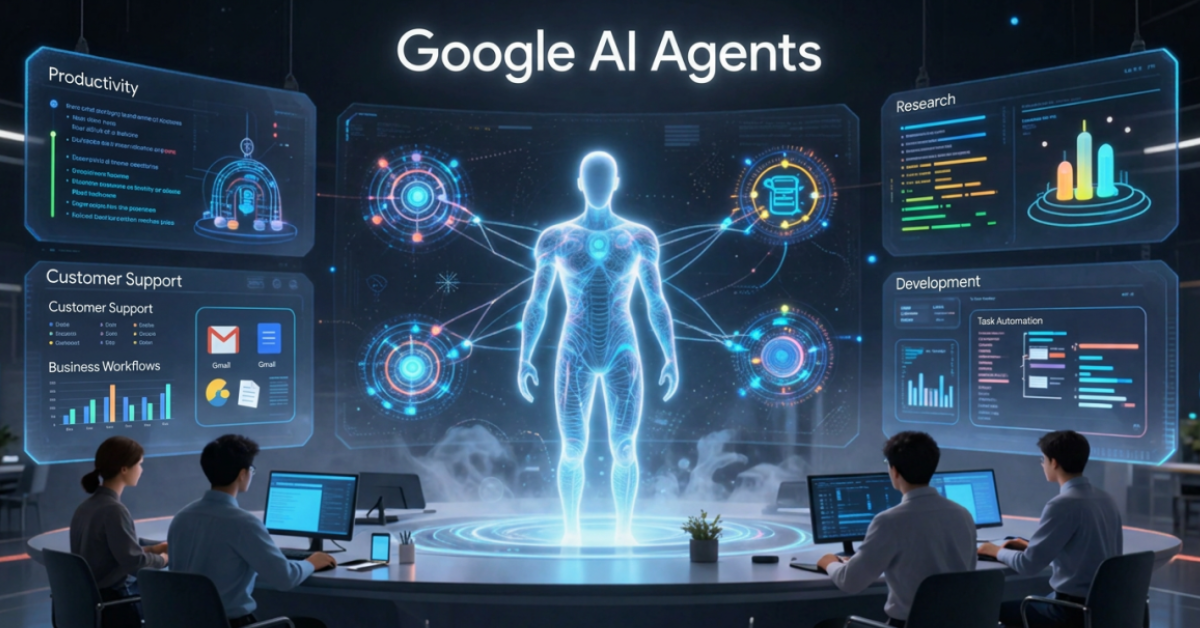
Artificial intelligence has evolved far beyond simple chatbots. The biggest shift happening in 2026 is the rise of Google AI Agents—intelligent systems capable of planning, reasoning, using tools, accessing information, and completing multi-step tasks on behalf of users.
If 2023 was the year of generative AI and 2024–2025 focused on AI assistants, then 2026 is increasingly becoming the year of agentic AI. Google itself has repeatedly emphasized the transition toward an agent-driven future across its AI ecosystem.
This guide explains what Google AI Agents are, how they work, where they fit into Google’s AI ecosystem, and why they may become one of the most important technology trends of the decade.
Table of Contents
What Are Google AI Agents?
A Google AI Agent is an AI-powered system that can:
- Understand goals
- Break tasks into steps
- Use tools
- Access information
- Make decisions
- Execute actions
- Monitor outcomes
Unlike traditional AI chatbots that simply respond to prompts, AI agents are designed to achieve objectives.
For example:
Instead of asking, “Write an email.”
You might tell an AI agent: “Organise next week’s client meeting.”
The agent could:
- Check your calendar
- Find available slots
- Draft invitations
- Create meeting notes
- Prepare summaries
- Send follow-up emails
All with minimal supervision.
This shift from answering questions to completing tasks is what makes agentic AI so powerful.
AI agents can use embeddings to retrieve relevant memories, match tasks with tools and identify information related to the current goal.
AI Agents vs Traditional AI Chatbots
| Feature | Traditional Chatbot | AI Agent |
|---|---|---|
| Answers Questions | Yes | Yes |
| Multi-Step Reasoning | Limited | Advanced |
| Uses External Tools | Sometimes | Frequently |
| Takes Actions | Rarely | Yes |
| Goal-Oriented | No | Yes |
| Autonomous Workflow Execution | No | Yes |
| Monitors Progress | No | Often |
Think of it this way:
A chatbot acts like an assistant waiting for instructions.
An AI agent behaves more like a digital employee working toward a goal.
Why AI Agents Matter in 2026
Several trends have pushed AI agents into the spotlight:
Increasing AI Capability
Modern Gemini models can reason through complex problems, maintain context, and interact with tools more effectively than earlier AI systems.
Workflow Automation
Businesses want outcomes rather than conversations.
Instead of generating content manually, companies want AI to:
- Research
- Draft
- Analyze
- Coordinate
- Execute
Google’s Agent-First Vision
Google has publicly described the industry transition into an “era of agents” where AI systems move from assistants to autonomous collaborators.
How Google AI Agents Work
At a high level, most AI agents follow a simple loop:
Step 1: Receive a Goal
Example: Create a weekly market research report.
Step 2: Plan
The agent determines:
- What information is required
- Which tools to use
- What sequence of actions is needed
Step 3: Execute
The agent may:
- Search documents
- Access databases
- Analyze spreadsheets
- Generate reports
Step 4: Evaluate
The agent checks:
- Is the task complete?
- Is additional information required?
Step 5: Deliver Results
The final output is presented to the user.
This planning → execution → evaluation cycle is a defining characteristic of modern AI agents.
Key Components of the Google AI Agent Ecosystem
Google is building an increasingly comprehensive agent ecosystem.
Gemini Models
Gemini serves as the reasoning engine behind many Google AI experiences.
These models provide:
- Reasoning
- Planning
- Tool usage
- Multimodal understanding
Gemini App and Agent Experiences
Google is expanding Gemini beyond chat interactions toward more autonomous task execution through agent-based capabilities.
Google AI Studio
Developers can prototype and experiment with Gemini-powered applications using Google AI Studio.
Google ADK (Agent Development Kit)
Google ADK provides developers with an open framework for building AI agents.
It helps developers:
- Create workflows
- Manage tools
- Build multi-agent systems
- Connect external services
Gemini Enterprise Agent Platform
For organizations, Google now offers a dedicated platform for building, governing, deploying, and optimizing AI agents at scale.
NotebookLM
Research agents often require knowledge retrieval and document understanding.
NotebookLM complements this workflow by helping users analyze and synthesize information from large knowledge sources.
Real-World Use Cases of Google AI Agents
Research Agent
Tasks:
- Gather information
- Analyze sources
- Create summaries
- Generate reports
Customer Support Agent
Tasks:
- Answer customer questions
- Retrieve account information
- Escalate issues
Marketing Agent
Tasks:
- Monitor trends
- Create campaign drafts
- Generate content ideas
Productivity Agent
Tasks:
- Manage meetings
- Organize documents
- Track action items
Coding Agent
Tasks:
- Generate code
- Debug issues
- Create documentation
- Run tests
Google AI Agents for Developers
Developers may be among the biggest beneficiaries of AI agents.
Potential applications include:
Code Generation
Agents can:
- Create components
- Generate APIs
- Produce documentation
Testing
Agents can:
- Write test cases
- Identify edge cases
- Review outputs
DevOps Automation
Agents may assist with:
- Deployment workflows
- Monitoring
- Infrastructure tasks
As someone working with Angular and frontend technologies, I see AI agents becoming valuable teammates rather than replacements.
They reduce repetitive work while allowing developers to focus on architecture and problem-solving.
Google AI Agents for Designers and Creators
AI agents are not limited to engineering teams.
Designers can use agents for:
- UX research
- Competitor analysis
- Content planning
- Design documentation
Creators can use agents for:
- Script creation
- Research
- Content repurposing
- Workflow automation
The biggest advantage is reducing operational overhead.
Benefits of Google AI Agents
Increased Productivity
Agents can automate repetitive work.
Better Decision Making
Agents can gather and organize large amounts of information.
Faster Execution
Multi-step workflows become significantly faster.
Scalability
Businesses can handle larger workloads without proportional increases in manual effort.
Improved Consistency
Agents follow predefined workflows more consistently than humans.
Limitations and Challenges
AI agents are powerful but not perfect.
Accuracy Issues
Agents can still make mistakes.
Oversight Requirements
Human review remains important.
Security Concerns
Agents often access sensitive systems and data.
Privacy Considerations
Organizations must carefully manage permissions and data access.
Cost
Advanced agent platforms may involve infrastructure and subscription costs.
These challenges explain why human supervision remains a critical component of agent-based systems.
Common Mistakes Beginners Make
Expecting Full Autonomy
AI agents are not magic.
They still require guidance and validation.
Giving Vague Objectives
Bad: Help my business.
Good: Generate a weekly customer feedback report.
Ignoring Security
Never grant unrestricted access to important systems.
Over-Automating Too Early
Start with simple workflows before creating complex multi-agent systems.
How I Would Use Google AI Agents
If I were building practical workflows for AmitGuptaBlogs.com, I would start with:
Research Agent
Collect information from multiple sources.
Content Planning Agent
Organize outlines and content structures.
SEO Review Agent
Check headings, metadata, and readability.
Publishing Assistant
- Prepare drafts for final human review.
- Notice that humans remain involved.
- The goal is not replacing expertise.
- The goal is amplifying productivity.
Future of Google AI Agents
Google’s recent announcements strongly suggest that AI agents will become a foundational layer across Search, Workspace, Cloud, Gemini, and enterprise products.
Over the next few years we can expect:
- More autonomous workflows
- Multi-agent collaboration
- Deeper Google Workspace integration
- Agent-to-agent communication
- Personalized digital assistants
- Enterprise-scale agent ecosystems
For developers, designers, creators, and businesses, understanding AI agents today may provide a significant advantage tomorrow.
Final Thoughts
Google AI Agents represent one of the most important developments in artificial intelligence in 2026.
They move beyond simple conversations and toward accomplishing real objectives through planning, reasoning, tool usage, and workflow automation.
Whether you are a developer building applications, a designer improving workflows, a creator producing content, or a business exploring automation, AI agents are becoming an increasingly important part of Google’s AI ecosystem.
The technology is still evolving, but the direction is clear: AI is moving from assistant to collaborator, and Google AI Agents are helping drive that transformation.
Key Takeaways
- Google AI Agents focus on accomplishing goals rather than answering prompts.
- AI agents differ significantly from traditional chatbots.
- Gemini is becoming a core reasoning layer for agentic workflows.
- Google ADK helps developers build AI agents.
- Gemini Enterprise Agent Platform targets enterprise-scale deployments.
- AI agents can improve productivity across development, design, research, and business workflows.
- Human oversight remains essential despite growing autonomy.
- The future of AI is increasingly agent-driven.
FAQs
What are Google AI Agents?
Google AI Agents are AI-powered systems that can plan, reason, use tools, and perform multi-step tasks to achieve specific goals.
How are AI agents different from chatbots?
Chatbots primarily answer questions, while AI agents can take actions, execute workflows, and complete objectives.
Does Google offer tools for building AI agents?
Yes. Google provides technologies such as Gemini models, Google AI Studio, Google ADK, and Gemini Enterprise Agent Platform for agent development and deployment.
Can beginners use AI agents?
Yes. Many AI agent platforms offer low-code or no-code options, making them accessible to non-developers.
Are AI agents fully autonomous?
Not yet. Most AI agents still benefit from human supervision, validation, and governance.
Will AI agents replace jobs?
AI agents are more likely to automate repetitive tasks and augment human capabilities rather than completely replace skilled professionals.
References
- Google AI Agent Overview
- Google AI Agent Trends Report
- Google Cloud AI Agent Trends Blog
- Gemini Enterprise Agent Platform
- Agent Designer Documentation
- Google Developer GEAR Program
- Building AI Agents with Gemini and Open Source Frameworks
Author Bio

Amit Gupta is a UI/UX Designer and Frontend Specialist with more than 20 years of experience in product design, design systems, Angular development, frontend architecture, and emerging technologies. Through AmitGuptaBlogs.com, he shares practical insights on AI, Google technologies, design workflows, development tools, and future technology trends.