
Artificial intelligence models have become remarkably capable over the last few years. However, many AI systems still struggle when a task requires deep analysis, complex reasoning, multiple assumptions, or long chains of logical thinking.
This is where Gemini Deep Think enters the picture.
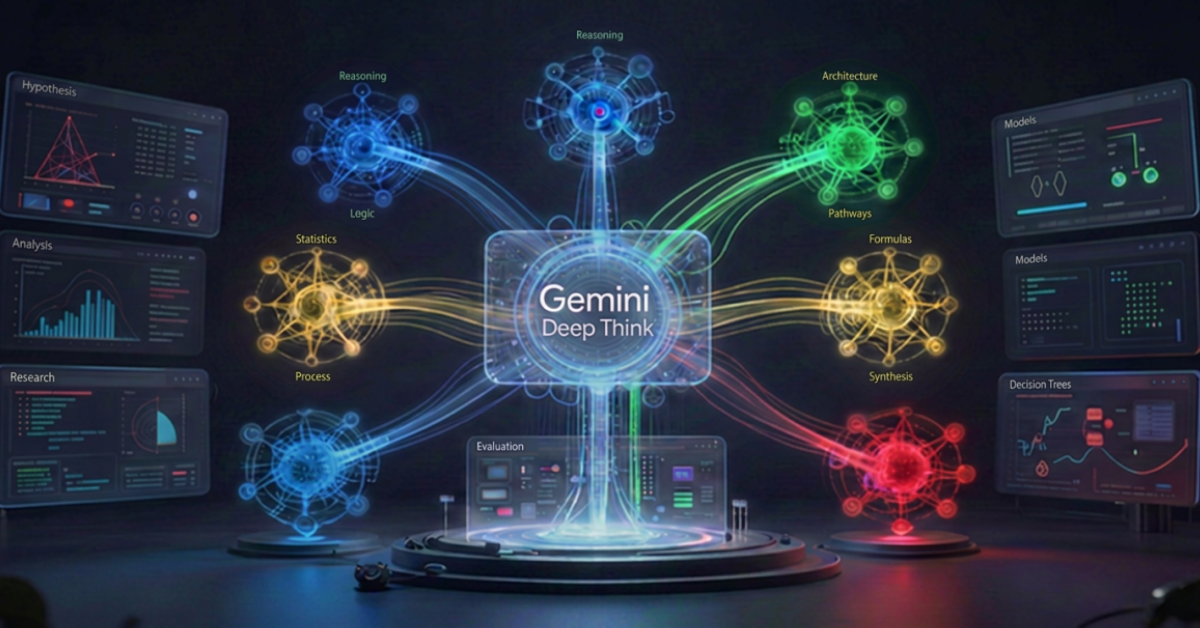
Gemini Deep Think is Google’s advanced reasoning mode designed to tackle difficult problems that require more than simple question answering. Instead of generating the first reasonable response, Deep Think spends additional computational effort evaluating multiple possibilities before producing an answer. Google describes it as an enhanced reasoning system that can explore multiple hypotheses and reasoning paths before reaching a conclusion.
For developers, researchers, business professionals, and AI enthusiasts, Gemini Deep Think represents an important step toward more capable AI-assisted problem solving.
Table of Contents
What Is Gemini Deep Think?
Gemini Deep Think is an advanced reasoning mode built on Google’s Gemini models.
Unlike traditional AI interactions where a model generates an answer immediately, Deep Think allows the system to perform deeper internal reasoning before responding. Google has described Deep Think as using research techniques that enable the model to consider multiple hypotheses and reasoning approaches before producing an answer.
Think of it like the difference between:
Standard Response
Someone answers immediately.
Deep Think Response
Someone analyzes several possible solutions, checks assumptions, evaluates trade-offs, and then responds.
That extra reasoning effort is what makes Deep Think valuable.
Why Google Created Gemini Deep Think
As AI models improved, researchers discovered that many failures were not caused by lack of knowledge.
Instead, failures often happened because the model:
- Jumped to conclusions too quickly
- Missed alternative solutions
- Failed multi-step reasoning
- Lost track of complex dependencies
- Struggled with difficult mathematical or coding problems
Google developed Deep Think to address these limitations. The goal is not simply to make AI smarter, but to make it reason more effectively on difficult tasks.
How Gemini Deep Think Works
At a high level, Deep Think expands the reasoning process.
Instead of following a single path toward an answer, the system can explore multiple reasoning directions in parallel before deciding which path appears strongest. Google has publicly described Deep Think as incorporating parallel thinking and hypothesis evaluation techniques.
Simplified Example
Imagine asking:
Design a scalable AI-powered customer support platform for a SaaS company.
A normal AI might produce a solution immediately.
Deep Think may internally evaluate:
- Architecture Option A
- Architecture Option B
- Cost-optimized approach
- Enterprise approach
- Security-focused approach
- Hybrid approach
Then it synthesizes the strongest answer.
This additional reasoning often improves:
- Accuracy
- Logic
- Consistency
- Problem solving
- Strategic recommendations
Deep Think vs Standard Gemini
| Feature | Standard Gemini | Gemini Deep Think |
|---|---|---|
| Speed | Faster | Slower |
| Cost Efficiency | Higher | Lower |
| Simple Questions | Excellent | Overkill |
| Coding Tasks | Good | Excellent |
| Complex Reasoning | Good | Superior |
| Research Work | Good | Excellent |
| Strategic Planning | Moderate | Strong |
| Scientific Analysis | Limited | Stronger |
The key takeaway is simple:
- Use standard Gemini for everyday tasks.
- Use Deep Think when the problem is genuinely difficult.
Key Features of Gemini Deep Think
1. Multi-Hypothesis Reasoning
Deep Think can evaluate several possible solutions before generating a final response.
This reduces the chance of selecting an incorrect reasoning path early.
2. Advanced Coding Assistance
Google highlighted strong performance in coding benchmarks and competition-level programming tasks.
Potential applications include:
- Architecture planning
- Debugging
- Refactoring
- Algorithm design
- Complex code generation
3. Mathematical Problem Solving
Deep Think has demonstrated strong performance on advanced mathematics benchmarks and Olympiad-style challenges.
This makes it particularly valuable for:
- Engineers
- Researchers
- Students
- Data scientists
4. Scientific Reasoning
Google positions newer Deep Think models as especially useful for science, engineering, and research challenges.
Applications include:
- Experimental analysis
- Research planning
- Hypothesis generation
- Scientific interpretation
5. Long-Term Planning
Deep Think is especially useful when solving problems that require:
- Multiple stages
- Trade-off analysis
- Risk evaluation
- Strategic decision-making
Real-World Use Cases
Software Development
A team is designing a large enterprise platform.
Instead of asking:
Write authentication code.
They ask:
Design the most scalable authentication architecture for a multi-tenant SaaS platform with compliance requirements.
This is where Deep Think shines.
Business Strategy
Business leaders can evaluate:
- Market entry plans
- Product launches
- Competitive positioning
- Process automation
Because Deep Think can evaluate multiple scenarios before making recommendations.
Research Projects
Researchers can use Deep Think to:
- Review findings
- Explore hypotheses
- Analyze conflicting evidence
- Generate research directions
Education
Students can use Deep Think for:
- Complex concepts
- Mathematics
- Scientific explanations
- Project planning
However, it should supplement learning, not replace it.
Gemini Deep Think for Developers
As someone with a development background, this is one of the most exciting applications.
Practical Uses
- Large-scale architecture reviews
- Angular application planning
- API strategy design
- System decomposition
- Performance optimization
Instead of asking:
Build a login page.
Ask:
Design a scalable authentication workflow for an Angular application supporting SSO, MFA, role-based access, and enterprise compliance.
The quality difference can be substantial.
Gemini Deep Think for Designers
Many people associate reasoning models with coding.
That is a mistake.
Design problems often require extensive reasoning.
Examples
- Design system planning
- UX decision analysis
- User journey optimization
- Information architecture
- Product strategy
A designer could ask:
Compare three onboarding approaches for a fintech mobile application and evaluate usability, trust, and conversion trade-offs.
This is exactly the kind of multi-variable problem where Deep Think can help.
Gemini Deep Think for Creators
Content creators can use Deep Think for:
Content Strategy
- Audience analysis
- Topic prioritization
- Content structure planning
Research
- Deep topic exploration
- Contradictory source analysis
- Educational content creation
Long-Form Content
Complex guides often benefit from stronger reasoning before drafting.
Practical Workflow Example
Here is how I would use Gemini Deep Think when creating a technical article.
Step 1
Research a topic.
Example:
Future of AI agents in software development.
Step 2
Ask Deep Think:
Identify the five most important trends, risks, and opportunities over the next three years.
Step 3
Request trade-off analysis.
Step 4
Request real-world implementation examples.
Step 5
Convert findings into article structure.
This approach produces more thoughtful output than traditional prompting.
Common Mistakes to Avoid
Using Deep Think for Everything
- Not every task requires advanced reasoning.
- Simple tasks are often better handled by standard Gemini.
Expecting Instant Responses
- Deep Think intentionally spends more time reasoning.
- Slower responses are often part of the process.
Treating AI as Always Correct
Even advanced reasoning systems can make mistakes.
Always verify:
- Facts
- Statistics
- Technical recommendations
Ignoring Domain Expertise
AI should enhance expertise, not replace it.
The best results come when human experience and AI reasoning work together.
Pros and Cons
| Pros | Cons |
|---|---|
| Better reasoning | Slower responses |
| Stronger coding support | Higher computational cost |
| Better strategic thinking | Not needed for simple tasks |
| Improved scientific analysis | May still produce errors |
| More reliable complex problem solving | Limited availability depending on plan |
Future of Advanced AI Reasoning
The launch of Deep Think signals an important shift in AI development.
For years, model improvements focused primarily on:
- Bigger models
- More training data
- Larger context windows
Now the focus is increasingly moving toward reasoning quality.
Google’s broader strategy also shows this direction through thinking models, reasoning modes, agentic workflows, and advanced planning systems.
Future reasoning systems will likely:
- Plan more effectively
- Use tools autonomously
- Evaluate alternatives
- Collaborate across multiple agents
- Assist in scientific discovery
Deep Think appears to be an early step toward that future.
Final Thoughts
Gemini Deep Think is not simply another AI feature.
It represents Google’s effort to improve how AI reasons rather than just how much information it knows.
For developers, designers, creators, researchers, and business professionals, Deep Think introduces a more thoughtful way of interacting with AI. Instead of rushing to an answer, the system can explore multiple possibilities, evaluate alternatives, and generate more robust solutions.
As reasoning becomes one of the most important frontiers in artificial intelligence, Gemini Deep Think is positioned to become a significant part of the Google AI ecosystem in 2026 and beyond.
Key Takeaways
- Gemini Deep Think is Google’s advanced reasoning mode.
- It evaluates multiple hypotheses before responding.
- It is designed for complex coding, math, research, and planning tasks.
- Deep Think is best used when problems require multi-step reasoning.
- Developers, designers, creators, and researchers can all benefit from it.
- It represents a major evolution beyond simple AI chat interactions.
- Advanced reasoning is becoming a key competitive area in modern AI systems.
FAQs
1. What is Gemini Deep Think?
Gemini Deep Think is Google’s advanced AI reasoning mode that spends additional computational effort evaluating multiple reasoning paths before producing an answer.
2. How is Gemini Deep Think different from standard Gemini?
Standard Gemini focuses on fast responses, while Deep Think prioritizes deeper reasoning and problem solving.
3. Is Gemini Deep Think useful for coding?
Yes. Deep Think is particularly useful for architecture planning, debugging, algorithm design, and complex software engineering challenges.
4. Can designers use Gemini Deep Think?
Absolutely. UX strategy, design systems, information architecture, and product design decisions often benefit from advanced reasoning.
5. Does Deep Think replace human expertise?
No. It works best when combined with human judgment, domain knowledge, and critical thinking.
6. Is Gemini Deep Think part of the Google AI ecosystem?
Yes. It is one of Google’s advanced reasoning capabilities within the broader Gemini ecosystem.
References
- Google Gemini 2.5 Updates (Deep Think Introduction)
- Gemini 3 Deep Think
- Gemini Thinking Documentation
- Gemini Release Notes
- Gemini Deep Think Support Documentation
- DeepMind Deep Think Overview
Author Bio

Amit Gupta is a UI/UX Designer and Frontend Specialist with more than 20 years of experience in product design, design systems, Angular development, frontend architecture, and emerging technologies. Through AmitGuptaBlogs.com, he shares practical insights on AI, Google technologies, design workflows, development tools, and future technology trends.