Artificial Intelligence is rapidly moving beyond chatbots. In 2026, the industry focus has shifted toward AI agents—systems that can reason, plan, use tools, access external data, collaborate with other agents, and execute tasks autonomously.
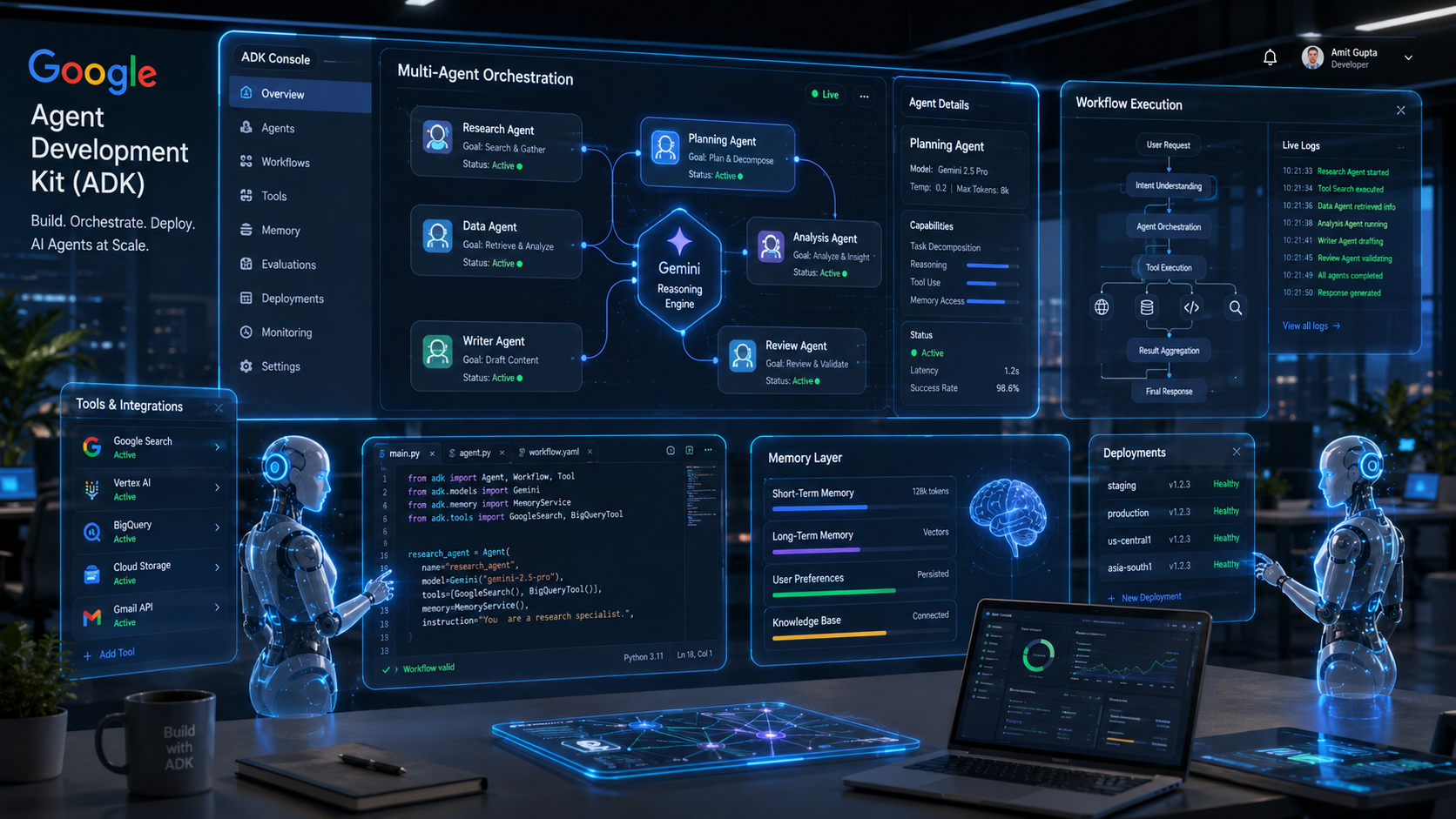
To support this shift, Google introduced the Google Agent Development Kit (ADK), an open-source framework designed for building production-ready AI agents and multi-agent systems. ADK provides developers with a structured way to create intelligent applications that behave more like software teammates than simple AI assistants.
If you’ve already explored Gemini, Google AI Studio, or the Gemini API, Google ADK represents the next step in the evolution of AI application development.
Table of Contents
What Is Google Agent Development Kit (ADK)?
Google Agent Development Kit (ADK) is Google’s open-source framework for developing, testing, orchestrating, evaluating, and deploying AI agents at scale. It supports building both single-agent and multi-agent systems while integrating with Gemini models and other AI ecosystems.
Unlike traditional AI applications that simply respond to prompts, ADK enables agents to:
- Reason through tasks
- Use tools
- Maintain context
- Work with APIs
- Collaborate with other agents
- Execute multi-step workflows
Google describes ADK as a software-engineering-oriented approach to agent development rather than a prompt-engineering-only solution.
Why AI Agents Matter in 2026
Most AI applications built between 2023 and 2025 followed a simple pattern:
Input → LLM → Output
Modern business workflows require much more.
For example:
A customer-support agent may need to:
- Understand a user query
- Search company knowledge
- Access CRM data
- Create a ticket
- Draft a response
- Escalate complex cases
This is no longer a single prompt.
It is an orchestrated workflow involving reasoning, memory, tools, and decision-making.
That is where AI agents become valuable.
What Makes Google ADK Different?
Several frameworks exist for building AI agents, but ADK was designed using Google’s experience in deploying large-scale AI systems.
Key differentiators include:
| Capability | Google ADK |
|---|---|
| Open Source | Yes |
| Multi-Agent Support | Yes |
| Gemini Integration | Native |
| Tool Calling | Built-in |
| Workflow Orchestration | Yes |
| Evaluation Framework | Yes |
| Enterprise Deployment | Supported |
| Local Development | Supported |
The framework is also designed to support multiple programming languages including Python, TypeScript, Go, Java, and Kotlin.
Core Components of Google Agent Development Kit
1. Agents
An agent represents an intelligent worker responsible for achieving a goal.
Examples:
- Research Agent
- Customer Support Agent
- Code Review Agent
- Marketing Agent
Each agent contains:
- Instructions
- Reasoning capability
- Tools
- Memory
- Execution logic
2. Tools
Tools allow agents to interact with the outside world.
Examples include:
- APIs
- Databases
- Search engines
- Email systems
- Cloud services
- Internal applications
Without tools, agents can only generate text.
With tools, they can perform actions.
3. Memory
Memory enables agents to retain context across tasks.
Examples:
- Customer preferences
- Project history
- Previous conversations
- Workflow state
This is critical for long-running tasks.
4. Workflows
Workflows coordinate how agents operate.
Common patterns include:
- Sequential execution
- Parallel execution
- Conditional branching
- Hierarchical delegation
ADK provides mechanisms for orchestrating these workflows.
How ADK Works
A simplified flow looks like this:
User Request
↓
Coordinator Agent
↓
Task Planning
↓
Specialized Agents
↓
Tool Execution
↓
Result Aggregation
↓
Final Response
This architecture allows systems to solve significantly more complex problems than traditional chatbot implementations.
Single-Agent vs Multi-Agent Systems
Single-Agent System
One agent performs all tasks.
Example:
A travel assistant that:
- Searches flights
- Recommends hotels
- Creates itineraries
Advantages:
- Simpler
- Easier to maintain
Disadvantages:
- Less scalable
- Limited specialization
Multi-Agent System
Multiple agents collaborate.
Example:
Travel Planner Agent
├– Flight Agent
├– Hotel Agent
├– Budget Agent
└– Itinerary Agent
Advantages:
- Better specialization
- Higher scalability
- Improved performance
This is one of the primary use cases ADK was designed to support.
For deeper understanding of multi-agent systems, read: Multi-Agent Systems Complete Guide 2026
Key Features of Google ADK
Native Multi-Agent Architecture
Developers can create specialized agents and coordinate them through orchestrated workflows.
Tool Integration
Agents can access:
- APIs
- Databases
- Enterprise systems
- Cloud services
Evaluation Framework
Testing and measuring agent quality is critical.
ADK includes mechanisms for evaluation and validation.
Local Development Environment
Developers can build and debug agents locally before deployment.
Enterprise Scalability
ADK is designed for production environments and enterprise-scale deployments.
Real-World Use Cases
Customer Support Automation
Agents can:
- Understand customer issues
- Retrieve account information
- Generate responses
- Escalate when necessary
Software Development
AI agents can:
- Review code
- Generate documentation
- Create test cases
- Detect bugs
Marketing Operations
Agents can:
- Research competitors
- Generate campaign ideas
- Analyze performance data
- Create content drafts
Enterprise Knowledge Management
Agents can combine:
- Internal documents
- Knowledge bases
- Meeting notes
- Databases
to provide accurate answers.
This is especially powerful when combined with tools such as NotebookLM Guide.
Google ADK Architecture Overview
A typical production architecture may include:
| Layer | Purpose |
|---|---|
| User Interface | User interaction |
| Coordinator Agent | Task routing |
| Specialist Agents | Domain-specific work |
| Tool Layer | External integrations |
| Memory Layer | Context retention |
| Model Layer | Gemini or other LLMs |
| Monitoring Layer | Evaluation and observability |
This layered design improves maintainability and scalability.
ADK vs Traditional AI Applications
| Traditional AI Apps | ADK-Based Agents |
|---|---|
| Single prompt | Multi-step reasoning |
| One response | Goal-oriented execution |
| No planning | Dynamic planning |
| Limited actions | Tool execution |
| Minimal memory | Persistent memory |
| Reactive | Autonomous |
ADK vs Other Agent Frameworks
| Feature | Google ADK | Typical Frameworks |
|---|---|---|
| Open Source | Yes | Usually |
| Gemini Integration | Native | External |
| Multi-Agent Support | Strong | Varies |
| Enterprise Focus | Strong | Varies |
| Google Cloud Integration | Native | Limited |
| Agent Evaluation | Built-in | Often separate |
The choice ultimately depends on your ecosystem and deployment requirements.
For Developers
As a frontend developer and UI/UX professional, this is how I would evaluate ADK.
Most developers already understand:
- APIs
- Components
- Services
- State management
ADK introduces a similar mental model.
Instead of coordinating UI components, you coordinate intelligent agents.
This makes adoption easier for developers familiar with modern software architecture.
Agents created with development frameworks may use AI embeddings to retrieve relevant knowledge, examples, memories and tool descriptions.
For Designers and Product Teams
AI agents introduce a new UX challenge.
Designers are no longer designing screens alone.
They are designing:
- Human-agent interactions
- Agent feedback loops
- Approval workflows
- Trust mechanisms
This shift will create entirely new opportunities for UX professionals.
Practical Workflow Example
Imagine building a content publishing assistant.
Research Agent
Collects information.
SEO Agent
Optimizes keywords and structure.
Writing Agent
Creates article drafts.
Review Agent
Checks accuracy and quality.
Publishing Agent
Pushes content to CMS.
Each agent specializes in a single responsibility while working together as a coordinated system.
Common Mistakes to Avoid
Treating Agents Like Chatbots
Agents should have goals and workflows, not just conversations.
Creating One Giant Agent
Specialized agents are often easier to maintain.
Ignoring Evaluation
Agent behavior must be tested continuously.
Giving Excessive Tool Access
Security and permissions matter.
Skipping Observability
Monitor:
- Failures
- Hallucinations
- Tool usage
- Latency
Production systems require visibility.
Future of Google ADK
Google’s broader AI ecosystem is increasingly centered around agent-based architectures.
The relationship is becoming clearer:
- Gemini → Models
- Google AI Studio → Experimentation
- Gemini API → Application Development
- Gemini Enterprise Agent Platform → Enterprise Agent Operations
- Google Agent Development Kit → Agent Engineering Framework
As businesses move from AI assistants to AI coworkers, frameworks like ADK are likely to become foundational components of modern software development.
Final Thoughts
The Google Agent Development Kit represents one of the most important developments in AI engineering today.
Rather than focusing solely on prompts, ADK encourages developers to think in terms of intelligent systems, workflows, tools, memory, and orchestration.
For developers already exploring Gemini, Google AI Studio, or the Gemini API, learning Google Agent Development Kit is a logical next step toward building production-ready AI agents in 2026.
Key Takeaways
- Google ADK is Google’s open-source framework for building AI agents.
- It supports single-agent and multi-agent architectures.
- ADK enables tool use, memory, orchestration, and evaluation.
- It integrates naturally with Gemini and Google Cloud services.
- Developers can build locally and deploy to enterprise environments.
- Multi-agent systems are becoming a major trend in AI application development.
- ADK helps transform AI from chat interfaces into autonomous workflows.
FAQs
What is Google Agent Development Kit (ADK)?
Google ADK is an open-source framework for building, testing, orchestrating, and deploying AI agents and multi-agent systems.
Is Google ADK free?
Yes. Google ADK is available as an open-source framework. Some deployment or model usage costs may apply depending on the services used.
Does Google ADK only work with Gemini?
No. While optimized for Gemini and Google’s ecosystem, ADK is designed to be flexible and interoperable.
What programming languages does ADK support?
ADK supports multiple languages including Python, TypeScript, Go, Java, and Kotlin.
What is a multi-agent system?
A multi-agent system uses multiple specialized AI agents that collaborate to solve complex tasks.
Is ADK suitable for enterprise applications?
Yes. ADK was designed with enterprise-scale deployment and orchestration in mind.
References
- Google Agent Development Kit Official Website
- Google ADK Documentation
- Google Developers Blog: Agent Development Kit Introduction
- Google ADK GitHub Repository
- Google Skills Boost: Agent Development Kit
Author Bio

Amit Gupta is a UI/UX Designer and Frontend Specialist with more than 20 years of experience in product design, design systems, Angular development, frontend architecture, and emerging technologies. Through AmitGuptaBlogs.com, he shares practical insights on AI, Google technologies, design workflows, development tools, and future technology trends.