
Introduction
The AI industry is rapidly moving beyond individual chatbots toward interconnected networks of intelligent agents capable of working together. In 2026, one of the most important technologies enabling this shift is the Agent2Agent (A2A) Protocol.
As organizations deploy specialized AI agents for research, planning, coding, customer support, data analysis, and workflow automation, a new challenge emerges:
How can these agents communicate with one another efficiently, securely, and in a standardized way?
The answer is the Agent2Agent Protocol, commonly known as A2A.
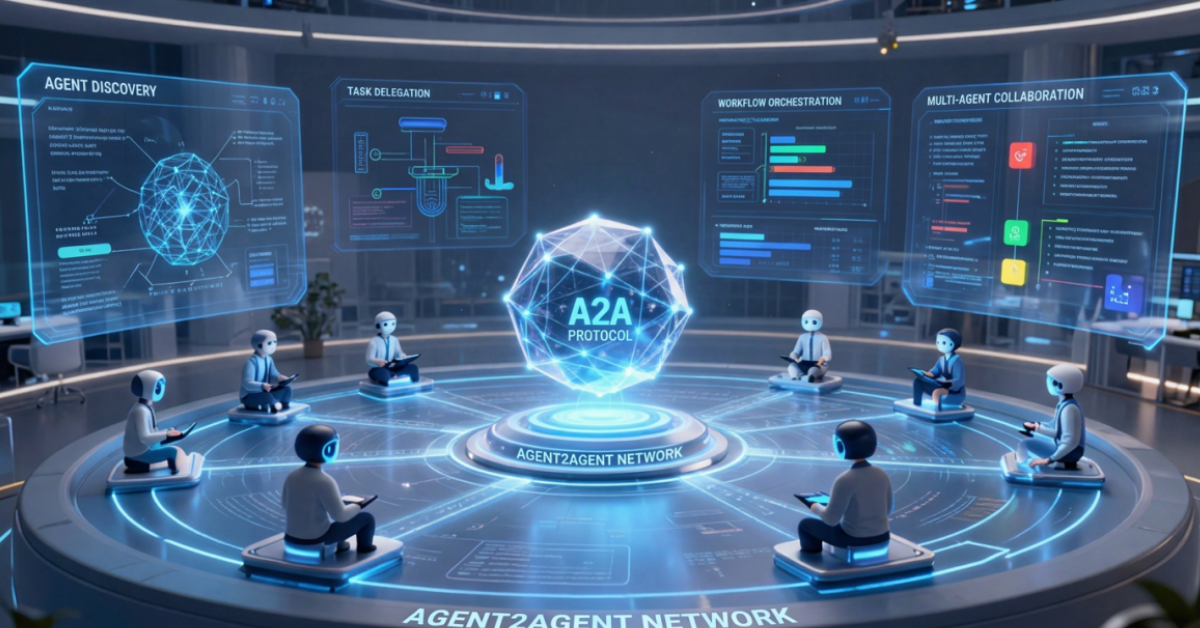
A2A provides a common communication framework that allows AI agents developed by different companies, platforms, and frameworks to exchange information, delegate tasks, share context, and collaborate toward a common goal.
This Agent2Agent Protocol Guide 2026 explains what A2A is, how it works, why it matters, and how it is shaping the future of autonomous AI systems.
Table of Contents
What Is the Agent2Agent (A2A) Protocol?
The Agent2Agent Protocol is an open communication standard designed to enable interoperability between AI agents.
Instead of operating as isolated systems, agents can use A2A to:
- Discover other agents
- Exchange capabilities
- Delegate work
- Request services
- Share progress
- Return results
- Coordinate workflows
Think of A2A as a communication layer for AI agents, similar to how HTTP enabled communication between websites and browsers.
Without a standard protocol, every AI platform would require custom integrations.
With A2A, agents can communicate using a common language.
Why AI Agents Need A2A
Today’s AI ecosystem includes many specialized agents:
- Research agents
- Coding agents
- Scheduling agents
- Data analysis agents
- Customer support agents
- Productivity agents
- Business workflow agents
Each agent may excel in a specific domain.
However, real-world business workflows often require multiple capabilities simultaneously.
For example:
A marketing campaign request might require:
- Market research agent
- Content creation agent
- Design agent
- Analytics agent
- Publishing agent
Without A2A, each integration becomes complex.
With A2A, agents collaborate automatically.
The Evolution from Single Agents to Multi-Agent Systems
Phase 1: AI Assistants
Examples:
- Gemini
- ChatGPT
- Claude
These systems primarily interacted with humans.
Phase 2: Tool-Using Agents
Agents gained the ability to:
- Browse websites
- Execute code
- Access databases
- Use APIs
Phase 3: Agent Collaboration
Agents started delegating tasks.
Multiple agents could participate in a workflow.
Phase 4: Agent Networks
This is where A2A becomes critical.
Entire ecosystems of agents cooperate to solve complex problems.
For deeper understanding of multi-agent systems, read: Multi-Agent Systems Complete Guide 2026
How the A2A Protocol Works
A typical A2A workflow follows several stages.
1. Agent Discovery
An agent first identifies available agents within a network.
Example:
A research agent discovers:
- Data analysis agent
- Reporting agent
- Visualization agent
Each agent advertises its capabilities.
2. Capability Exchange
Agents communicate:
- What they can do
- Supported tasks
- Available tools
- Authentication methods
- Context requirements
This enables intelligent task routing.
3. Task Delegation
An originating agent sends a task request.
Example:
“Analyze this dataset and identify customer trends.”
The receiving agent accepts the task.
4. Context Sharing
Agents exchange relevant information:
- User goals
- Prior decisions
- Supporting documents
- Workflow status
Context continuity is critical for successful collaboration.
5. Execution
The delegated agent performs its assigned task.
This may involve:
- Reasoning
- API calls
- Database queries
- External tool usage
6. Response Delivery
Results are returned to the requesting agent.
The original agent can:
- Present findings
- Combine multiple outputs
- Continue workflow execution
Core Components of A2A
Agent Identity
Each agent requires a unique identity.
Identity helps establish:
- Trust
- Permissions
- Routing
- Authentication
Capability Registry
A registry describes:
- Available skills
- Supported actions
- Service endpoints
- Agent metadata
Messaging Layer
Agents exchange:
- Requests
- Responses
- Events
- Notifications
The messaging layer acts as the backbone of communication.
Security Framework
Enterprise-grade deployments require:
- Authentication
- Authorization
- Encryption
- Audit logging
Security is essential when agents exchange sensitive business information.
Task Management
A2A defines how agents:
- Create tasks
- Track progress
- Report completion
- Handle failures
A2A vs MCP
Many people confuse A2A with MCP.
They solve different problems.
| Feature | A2A | MCP |
| Purpose | Agent-to-Agent Communication | Agent-to-Tool Communication |
| Focus | Collaboration | Resource Access |
| Participants | Multiple Agents | Agent + Tools |
| Use Case | Delegation & Coordination | Data & Tool Integration |
| Workflow | Multi-Agent | Single-Agent |
MCP Example
A coding agent, using MCP, accesses:
- GitHub
- Databases
- Documentation
A2A Example
A coding agent, using A2A, collaborates with:
- Testing agent
- Security agent
- Deployment agent
MCP and A2A are complementary technologies.
Real-World Example
Imagine an enterprise sales workflow.
Sales Agent
Receives:
“Generate a proposal for Company X.”
The Sales Agent then contacts:
Research Agent
Collects:
- Industry trends
- Competitor analysis
Financial Agent
Creates:
- Pricing recommendations
Content Agent
Produces:
- Proposal draft
Presentation Agent
Creates:
- Executive presentation
Using A2A, these agents coordinate seamlessly.
The user experiences a single workflow while multiple agents collaborate behind the scenes.
A2A and Google’s Agent Ecosystem
Google is heavily investing in agent-based AI systems.
Several technologies naturally align with A2A concepts:
Gemini Enterprise Agent Platform
Enables enterprise-grade agent deployment.
Agent Development Kit (ADK)
Provides frameworks for building agents.
Project Mariner
Explores browser-operating agents capable of performing complex tasks.
Project Astra
Focuses on real-time multimodal AI assistance.
Gemini Models
Provide the reasoning capabilities powering many future agents.
As these systems evolve, A2A-style communication becomes increasingly important.
Enterprise Benefits of A2A
Organizations gain several advantages.
Scalability
New agents can be added without redesigning workflows.
Specialization
Each agent focuses on its area of expertise.
Flexibility
Organizations can mix agents from different vendors.
Reusability
The same agent can participate in multiple workflows.
Efficiency
Tasks are distributed automatically.
Challenges and Limitations
Despite its promise, A2A introduces challenges.
Security Risks
Compromised agents could spread incorrect information.
Context Management
Maintaining consistent context across many agents is difficult.
Governance
Organizations need visibility into agent behavior.
Cost Control
More agents can increase computational expenses.
Reliability
Failures must be handled gracefully.
Future of Agent2Agent Protocol
By 2030, AI systems may operate as vast agent ecosystems.
Possible developments include:
- Cross-company agent collaboration
- Autonomous business workflows
- Agent marketplaces
- Dynamic agent hiring
- Distributed AI workforces
- Industry-wide interoperability standards
A2A represents one of the foundational building blocks required to achieve this vision.
Why A2A Matters for Developers
Developers building AI applications should understand A2A because future systems will increasingly involve multiple cooperating agents.
Knowledge of A2A helps developers:
- Build scalable architectures
- Design collaborative workflows
- Improve automation
- Reduce integration complexity
- Create enterprise-grade AI systems
Understanding A2A today prepares developers for the next generation of AI infrastructure.
FAQs
What is Agent2Agent (A2A)?
A2A is a communication protocol that allows AI agents to exchange information, delegate tasks, and collaborate using standardized interactions.
What problem does A2A solve?
It solves interoperability challenges between AI agents developed using different frameworks and platforms.
Is A2A the same as MCP?
No. MCP connects agents to tools and data sources, while A2A enables communication between agents.
Why is A2A important?
A2A makes it possible to build scalable multi-agent systems where specialized agents cooperate efficiently.
Will A2A become an industry standard?
Many AI companies are moving toward interoperable agent ecosystems, making standardized protocols like A2A increasingly important.
Conclusion
The Agent2Agent Protocol is emerging as one of the most significant developments in the evolution of AI systems. As organizations move from single assistants to collaborative networks of specialized agents, standardized communication becomes essential.
The Agent2Agent Protocol Guide 2026 demonstrates how A2A enables discovery, coordination, task delegation, and collaboration across diverse AI agents. Combined with technologies such as MCP, Gemini, ADK, Project Mariner, and enterprise agent platforms, A2A is helping create the foundation for the next generation of intelligent autonomous systems.
For developers, creators, enterprises, and AI enthusiasts, understanding A2A is no longer optional—it is becoming a core skill for navigating the future of agentic AI.
Author Bio

Amit Gupta is a UI/UX Designer and Frontend Specialist with more than 20 years of experience in product design, design systems, Angular development, frontend architecture, and emerging technologies. Through AmitGuptaBlogs.com, he shares practical insights on AI, Google technologies, design workflows, development tools, and future technology trends.