
Artificial Intelligence is rapidly moving beyond simple chatbots. Modern AI systems are becoming autonomous agents capable of interacting with tools, databases, business applications, development environments, and enterprise platforms.
However, one major challenge has emerged:
How can AI agents connect to external tools and data sources using a consistent and standardized approach?
This is exactly the problem that the Model Context Protocol (MCP) was designed to solve.
Model Context Protocol is quickly becoming one of the most important standards in the AI industry because it enables AI models and agents to communicate with tools, APIs, databases, file systems, and applications through a common interface.
Whether you are building AI agents, enterprise automation workflows, coding assistants, research systems, or multi-agent platforms, understanding MCP is becoming essential.
In this complete guide, we will explore what Model Context Protocol is, how it works, why it matters, its architecture, practical use cases, benefits, limitations, and how MCP is shaping the future of agentic AI.
Table of Contents
What Is Model Context Protocol (MCP)?
Model Context Protocol (MCP) is an open standard that allows AI models and AI agents to securely connect with external tools, services, applications, and data sources using a standardized communication framework.
Think of MCP as:
“The USB-C standard for AI agents.”
Just as USB-C allows different devices to communicate through a universal interface, MCP allows different AI systems to access tools and data through a common protocol.
Without MCP:
- Every AI application requires custom integrations
- Tool connections become difficult to maintain
- Agents cannot easily share capabilities
- Enterprise deployment becomes complex
With MCP:
- Tools become reusable
- Integrations become standardized
- Agents gain access to external systems more easily
- Development becomes faster and more scalable
Why MCP Matters in 2026
The AI industry is entering the Agent Era.
Modern agents need access to:
- Databases
- File systems
- Cloud services
- Email systems
- Calendars
- Enterprise applications
- Development environments
- Business intelligence platforms
Traditional API integrations create massive complexity.
A single AI platform might require connections to:
- CRM systems
- HR software
- Documentation platforms
- Code repositories
- Analytics tools
- Internal databases
MCP provides a unified framework for these interactions.
This dramatically simplifies AI application development.
The Core Problem MCP Solves
Imagine an AI agent that needs to:
- Read a document
- Query a database
- Check a calendar
- Send an email
- Update a project management tool
Without MCP:
Every integration requires:
- Custom APIs
- Custom authentication
- Custom logic
- Custom maintenance
With MCP:
The agent communicates through a standardised protocol.
The complexity is abstracted away.
Developers focus on business logic instead of integration plumbing.
MCP Architecture Explained
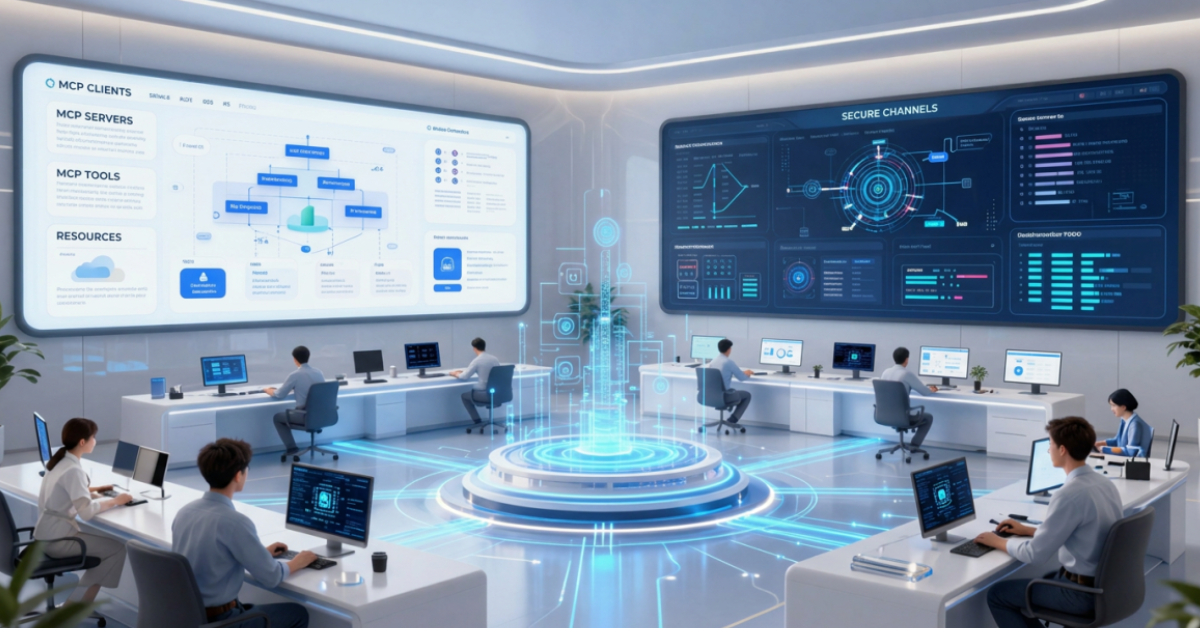
The Model Context Protocol consists of three major components:
1. MCP Client
The client is the AI application or agent.
Examples include:
- AI assistants
- Coding agents
- Enterprise AI platforms
- Research agents
- Productivity agents
The client requests access to tools and information.
2. MCP Server
The server exposes capabilities to the AI system.
Examples:
- Database servers
- GitHub servers
- File system servers
- CRM servers
- Cloud platform servers
The server defines:
- Available tools
- Available resources
- Access permissions
3. External Resources
Resources include:
- Documents
- Databases
- APIs
- Applications
- Enterprise systems
The MCP server acts as the bridge between resources and AI agents.
How MCP Works
A typical workflow looks like this:
Step 1
The AI agent discovers available tools.
Step 2
The MCP server advertises capabilities.
Step 3
The AI chooses a tool.
Step 4
The request is sent.
Step 5
The server executes the action.
Step 6
Results return to the AI.
Step 7
The AI continues reasoning using the new information.
This creates a dynamic and powerful agent workflow.
MCP vs Traditional API Integrations
| Traditional APIs | MCP |
| Custom integration for every tool | Standardized protocol |
| High maintenance | Reusable architecture |
| Difficult scaling | Easy scalability |
| Tool-specific logic | Unified interaction model |
| Fragmented ecosystem | Consistent ecosystem |
This is why MCP adoption is accelerating rapidly.
MCP and AI Agents
MCP is especially important for AI agents because agents must interact with the outside world.
An agent without tools is limited to its training data.
An MCP-enabled agent can:
- Search repositories
- Read files
- Execute workflows
- Query business systems
- Access live information
- Automate processes
This transforms AI from a chatbot into a capable digital worker.
MCP Tools
Tools are actions that an AI agent can perform.
Examples include:
Database Tool
Allows querying databases.
Search Tool
Allows retrieving information.
Email Tool
Allows sending messages.
GitHub Tool
Allows interacting with repositories.
Calendar Tool
Allows scheduling events.
CRM Tool
Allows updating customer records.
Each tool is exposed through the MCP server.
MCP Resources
Resources provide information rather than actions.
Examples include:
- PDFs
- Documents
- Source code
- Knowledge bases
- Internal wikis
- Research papers
The AI agent can read these resources when required.
MCP Prompts
Another important concept in MCP is prompt templates.
Organisations can define the following:
- Standard workflows
- Business procedures
- Reusable prompts
- Structured tasks
This ensures consistency across AI systems.
Real-World MCP Use Cases
Software Development
AI coding agents can:
- Read repositories
- Analyze code
- Create pull requests
- Review changes
This significantly improves developer productivity.
Enterprise Knowledge Management
AI assistants can access:
- Internal documents
- Policies
- Procedures
- Knowledge bases
This improves information retrieval.
Customer Support
Agents can:
- Access CRM systems
- Read customer histories
- Update records
- Generate responses
Support operations become more efficient.
Research Automation
Research agents can:
- Gather information
- Analyze documents
- Generate reports
- Monitor updates
This accelerates research workflows.
Business Operations
Agents with MCP support can automate:
- Reporting
- Scheduling
- Workflow management
- Data analysis
MCP and Multi-Agent Systems
Multi-agent architectures are becoming increasingly popular.
Various agents may be experts in:
- Research
- Coding
- Planning
- Analysis
- Execution
MCP allows these agents to share tool access through a consistent framework, while AI embeddings can help the system identify which information or capability is most relevant to a request.
This improves interoperability.
For deeper understanding, read Multi-Agent Systems: Complete Guide 2026.
MCP and Agent2Agent (A2A)
Many people confuse MCP and A2A.
They solve different problems.
MCP
Focuses on:
- Agent-to-tool communication
- Agent-to-data communication
A2A
Focuses on:
- Agent-to-agent communication
Simple explanation:
MCP helps agents talk to tools.
A2A helps agents talk to other agents.
Together they create a complete ecosystem for agentic AI.
For deeper understanding, read Agent2Agent (A2A) Protocol Complete Guide 2026
MCP and Google’s AI Ecosystem
Although MCP originated outside Google’s ecosystem, it is becoming increasingly relevant for:
- Gemini-powered agents
- Agent Development Kit (ADK)
- Enterprise agent platforms
- AI automation systems
As AI ecosystems mature, protocol standards become increasingly important.
Developers building agentic applications around Gemini should understand MCP fundamentals because interoperability will become a key requirement.
Benefits of MCP
Faster Development
Reduces integration effort.
Reusability
Tools can be shared across multiple agents.
Scalability
Supports large AI deployments.
Better Security
Controlled access through standardized interfaces.
Vendor Flexibility
Reduces dependency on custom integrations.
Ecosystem Growth
Encourages interoperability.
Challenges and Limitations
MCP is powerful but not perfect.
Current challenges include:
Ecosystem Maturity
The ecosystem is still evolving.
Security Complexity
Enterprise-grade permissions require careful planning.
Tool Quality
Poorly designed tools can create reliability issues.
Governance
Organizations need policies for tool access and auditing.
Future of MCP
The future of agentic AI depends heavily on interoperability.
Over the next few years we can expect:
- Wider enterprise adoption
- More MCP-compatible tools
- Standardized security models
- Better multi-agent workflows
- Integration with enterprise software ecosystems
- Increased support from AI platforms
MCP may become one of the foundational standards that power the next generation of AI applications.
FAQs
What is Model Context Protocol (MCP)?
Model Context Protocol is an open standard that enables AI agents and models to connect with external tools, applications, and data sources through a consistent communication framework.
Why is MCP important?
MCP simplifies integrations between AI systems and external tools, making AI applications easier to build, scale, and maintain.
Is MCP only for developers?
No. While developers benefit most directly, MCP also impacts enterprises, researchers, product teams, and organizations deploying AI agents.
What is the difference between MCP and APIs?
APIs define specific service interactions, while MCP provides a standardized framework that allows AI agents to discover and use many tools consistently.
What is the difference between MCP and A2A?
MCP enables agent-to-tool communication, while A2A enables agent-to-agent communication.
Will MCP become an industry standard?
Many experts believe MCP has strong potential to become a foundational interoperability standard for agentic AI systems.
Conclusion
The Model Context Protocol is emerging as one of the most important standards in the AI industry because it addresses a critical challenge: connecting AI agents to tools and data in a scalable, secure, and standardized way.
As organizations move toward autonomous agents, multi-agent systems, and enterprise AI automation, protocols like MCP will become increasingly important. Just as APIs transformed software development, MCP has the potential to transform how AI systems interact with the digital world.
For developers, creators, researchers, and businesses building AI-powered solutions, understanding MCP today will provide a significant advantage as the next generation of AI infrastructure continues to evolve.
Author Bio

Amit Gupta is a UI/UX Designer and Frontend Specialist with more than 20 years of experience in product design, design systems, Angular development, frontend architecture, and emerging technologies. Through AmitGuptaBlogs.com, he shares practical insights on AI, Google technologies, design workflows, development tools, and future technology trends.