
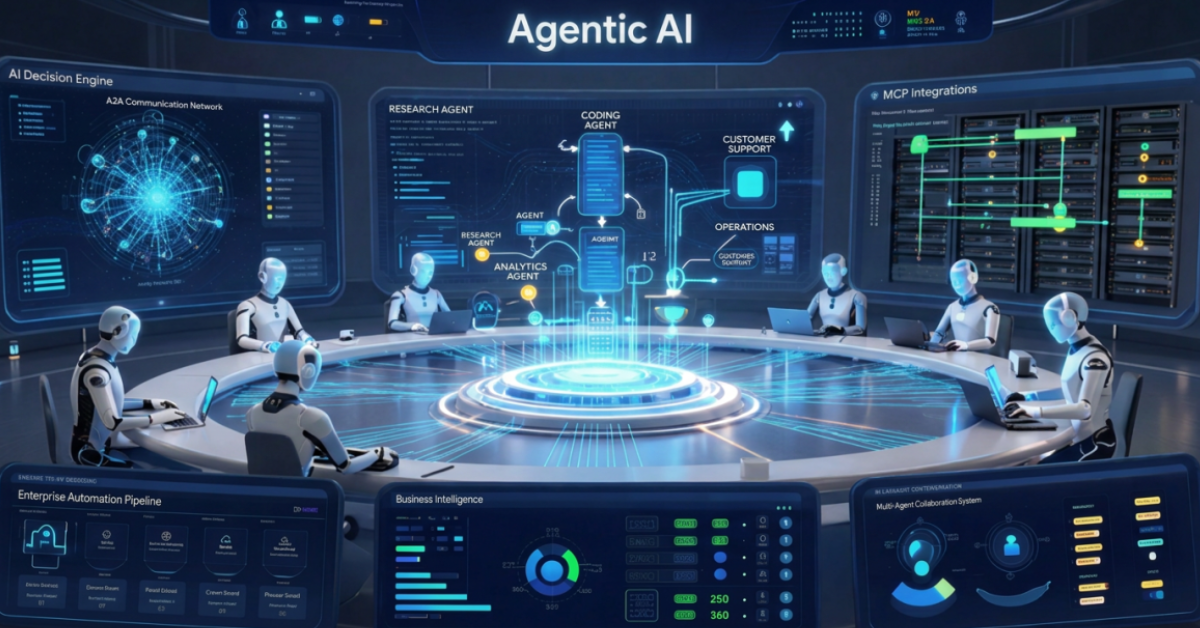
Artificial Intelligence is entering a new era.
For the past few years, AI assistants have primarily helped users answer questions, generate content, write code, and summarize information. However, the next major evolution is already underway.
Instead of merely responding to prompts, AI systems are beginning to understand goals, plan actions, use tools, make decisions, and complete tasks autonomously.
This new paradigm is known as Agentic AI.
Many industry experts consider Agentic AI to be the most important AI trend of 2026 because it transforms AI from a passive assistant into an active digital worker capable of performing real business operations. Enterprises are increasingly exploring AI agents that can manage workflows, coordinate with software systems, and execute complex multi-step processes with minimal human supervision.
In this comprehensive guide, we will explore what Agentic AI is, how it works, why it matters, the technologies enabling it, real-world use cases, challenges, and how it could reshape the future of work.
Table of Contents
What Is Agentic AI?
Agentic AI refers to AI systems that can pursue goals autonomously by:
- Understanding objectives
- Planning actions
- Using tools and software
- Making decisions
- Executing tasks
- Monitoring outcomes
- Adapting based on results
Unlike traditional AI assistants that wait for instructions, Agentic AI systems can proactively take actions to achieve desired outcomes.
Many agentic AI systems use embedding-based retrieval to find relevant memories, instructions and knowledge during multi-step workflows.
A simple way to understand the difference is:
| Traditional AI Assistant | Agentic AI |
| Answers questions | Completes tasks |
| Waits for prompts | Acts on goals |
| Generates content | Executes workflows |
| Single interaction | Multi-step reasoning |
| Human-driven | Semi-autonomous |
From AI Assistant to AI Agent
The AI industry is moving through several stages of evolution.
Stage 1: Search Engines
Users searched for information manually.
Stage 2: Generative AI
Users asked questions and received answers.
Examples:
- ChatGPT
- Gemini
- Claude
Stage 3: AI Agents
Users provide objectives rather than detailed instructions.
Example:
“Research competitors, create a report, prepare presentation slides, and email me the summary.”
The AI agent coordinates multiple actions automatically.
Stage 4: Autonomous Digital Workforces
Multiple AI agents collaborate together to perform entire business workflows.
This is the direction many enterprises are now exploring.
For deep understanding, read: Google AI Agents Guide 2026
Why Agentic AI Matters in 2026
The biggest limitation of current AI assistants is that humans still perform most of the operational work.
A typical workflow today might involve:
- Asking AI for research
- Copying results
- Opening spreadsheets
- Creating presentations
- Sending emails
- Tracking progress
Agentic AI aims to automate the entire workflow.
Instead of generating outputs, agents generate outcomes.
This shift could significantly improve:
- Productivity
- Automation
- Operational efficiency
- Customer service
- Software development
- Business intelligence
Organizations are increasingly viewing AI agents as a new layer of enterprise automation that extends beyond traditional workflows.
Core Components of Agentic AI
Most Agentic AI systems consist of several key capabilities.
1. Perception
The AI gathers information from:
- Documents
- Databases
- APIs
- Websites
- Enterprise systems
2. Reasoning
The agent evaluates information and determines what actions are needed.
3. Planning
The AI creates a sequence of steps to accomplish a goal.
4. Tool Usage
Agents can interact with:
- Browsers
- Email systems
- CRMs
- Databases
- Cloud platforms
- APIs
5. Execution
The AI performs actions rather than simply recommending them.
6. Memory
Agents maintain context across longer workflows.
7. Feedback Loops
Results are monitored and plans are adjusted dynamically.
These architectural components are increasingly becoming the foundation of modern AI agent frameworks.
What Makes Agentic AI Different From Generative AI?
Generative AI creates content.
Agentic AI creates outcomes.
Generative AI Example
Prompt:
Write a project proposal.
Output:
A proposal document.
Agentic AI Example
Goal:
Launch a new project.
Actions:
- Research competitors
- Create proposal
- Schedule meetings
- Track approvals
- Update project systems
Result:
The project advances without requiring manual coordination at every step.
Single-Agent vs Multi-Agent Systems
One of the biggest trends in 2026 is the move from single agents to multi-agent systems.
Single Agent
One AI handles everything.
Example:
A coding assistant helping developers.
Multi-Agent System
Multiple specialized agents collaborate.
Example:
Research Agent
Collects information.
Analyst Agent
Processes findings.
Writing Agent
Creates reports.
Review Agent
Validates quality.
Delivery Agent
Sends final outputs.
This mirrors how human teams operate.
For deeper understanding, read: Multi-Agent Systems Complete Guide 2026
Agentic AI and Multi-Agent Systems
As organizations scale AI deployments, they are increasingly adopting agent teams instead of individual agents.
Benefits include:
- Better specialization
- Higher accuracy
- Improved scalability
- Faster execution
- Easier governance
Many experts describe multi-agent architecture as the next evolution of enterprise AI systems.
Technologies Powering Agentic AI
Several emerging technologies make Agentic AI possible.
Large Language Models (LLMs)
Examples:
- Gemini
- GPT
- Claude
These provide reasoning capabilities.
Memory Systems
Allow agents to maintain context.
Tool Calling
Lets agents interact with external systems.
Retrieval Systems
Provide access to organizational knowledge.
Workflow Engines
Coordinate complex actions.
AI Agent Frameworks
Help developers build agentic applications.
MCP: The Foundation of Agent Connectivity
One of the most important developments in 2026 is the rise of the Model Context Protocol (MCP).
MCP provides a standardized way for AI agents to connect with:
- Databases
- Applications
- APIs
- Enterprise systems
Think of MCP as:
USB-C for AI agents
It allows agents to securely access tools and data without requiring custom integrations for every application.
For deeper understanding, read: Model Context Protocol (MCP) Complete Guide 2026
A2A Protocol: How AI Agents Communicate
Another major advancement is the Agent2Agent (A2A) Protocol.
A2A enables:
- Agent-to-agent communication
- Task delegation
- Workflow coordination
- Multi-agent collaboration
Without A2A, agents operate independently.
With A2A, agents can work together like digital teams.
For deeper understanding, read: Agent2Agent (A2A) Protocol Complete Guide 2026
Real-World Agentic AI Use Cases
Software Development
AI agents can:
- Generate code
- Test applications
- Debug issues
- Create documentation
- Deploy updates
Customer Support
Agents can:
- Resolve tickets
- Escalate issues
- Update records
- Follow up automatically
Marketing Operations
Agents can:
- Research keywords
- Create content
- Publish updates
- Monitor performance
Finance
Agentic systems are increasingly being explored for:
- Risk monitoring
- Compliance workflows
- Reporting
- Portfolio analysis
Researchers identify agentic AI as a significant evolution in financial operations because of its ability to reason, plan, and adapt autonomously.
Human Resources
Agents can:
- Screen resumes
- Schedule interviews
- Coordinate onboarding
Enterprise Operations
AI agents can orchestrate workflows across departments, reducing manual coordination and operational overhead.
The Rise of Digital Workforces
A major concept emerging in 2026 is the digital workforce.
Instead of hiring a single AI assistant, organizations may deploy:
- Research agents
- Support agents
- Operations agents
- Compliance agents
- Analytics agents
Together, these agents function like a virtual workforce operating 24/7.
Industry leaders increasingly describe the future as a blend of human workers and AI-powered digital workers collaborating within enterprise processes.
Benefits of Agentic AI
Increased Productivity
Agents eliminate repetitive tasks.
Faster Decision Making
Information gathering and analysis become automated.
Lower Operational Costs
Routine workflows require less manual effort.
Continuous Operations
AI agents can operate around the clock.
Better Scalability
Organizations can expand operations without proportionally increasing headcount.
Challenges and Risks
Agentic AI also introduces new challenges.
Governance
Organizations need clear oversight frameworks.
Security
Autonomous systems may access sensitive information.
Hallucinations
Incorrect decisions can have real-world consequences.
Compliance
Regulated industries require strict controls.
Cost Management
As AI usage scales, organizations must manage compute and token costs carefully.
Human Oversight
Most enterprises still rely on human-in-the-loop validation for critical workflows.
Agentic AI Trends to Watch in 2026
1. Multi-Agent Systems
Specialized agents working together.
2. MCP Adoption
Standardized tool integration.
3. A2A Communication
Agent collaboration ecosystems.
4. Industry-Specific Agents
Domain-focused AI workers.
5. Governance Frameworks
Enterprise-grade controls and monitoring.
6. Autonomous Business Workflows
Entire processes becoming AI-driven.
7. AI-Native Organizations
Businesses redesigning operations around AI agents rather than simply adding AI to existing workflows.
Will Agentic AI Replace Human Jobs?
The more realistic answer is:
Agentic AI will change jobs before it replaces them.
Many roles will evolve toward:
- AI supervision
- Workflow design
- Agent orchestration
- Quality assurance
- Strategic decision-making
Humans will increasingly become managers of digital workers rather than executors of routine tasks.
The Future of Agentic AI
The future is moving toward:
- Autonomous agents
- Multi-agent ecosystems
- AI-native enterprises
- Digital workforces
- Human-AI collaboration
Organizations are rapidly investing in this direction, although adoption remains in the early stages. Surveys show strong enterprise interest in deploying AI agents over the next few years, making Agentic AI one of the fastest-growing areas in enterprise technology.
By the end of this decade, interacting with teams of AI agents may become as common as using email or cloud software today.
Frequently Asked Questions (FAQs)
What is Agentic AI?
Agentic AI refers to autonomous AI systems capable of understanding goals, planning actions, using tools, and completing tasks with minimal human supervision.
How is Agentic AI different from Generative AI?
Generative AI creates content, while Agentic AI takes actions and completes workflows to achieve specific objectives.
What are AI agents?
AI agents are software entities that can perceive information, reason, make decisions, and execute tasks autonomously.
What is a Multi-Agent System?
A Multi-Agent System consists of multiple specialized AI agents collaborating to accomplish complex objectives.
What is MCP in Agentic AI?
Model Context Protocol (MCP) is an open standard that helps AI agents securely connect with tools, applications, and data sources.
What is the A2A Protocol?
Agent2Agent (A2A) is a protocol that allows AI agents to communicate, coordinate tasks, and collaborate with each other.
Will Agentic AI replace humans?
Most experts expect Agentic AI to augment human workers rather than completely replace them, creating new roles focused on oversight and orchestration.
Related Articles
Conclusion
Agentic AI represents one of the most significant shifts in artificial intelligence since the emergence of generative AI.
Instead of merely answering questions, AI systems are beginning to understand goals, plan actions, use tools, and execute workflows autonomously.
Powered by technologies such as Large Language Models, Multi-Agent Systems, MCP, and A2A protocols, Agentic AI is transforming AI from an assistant into a digital workforce.
While challenges around governance, security, and reliability remain, the trajectory is clear.
The future of AI is not just conversational.
The future of AI is agentic.
Author Bio

Amit Gupta is a UI/UX Designer and Frontend Specialist with more than 20 years of experience in product design, design systems, Angular development, frontend architecture, and emerging technologies. Through AmitGuptaBlogs.com, he shares practical insights on AI, Google technologies, design workflows, development tools, and future technology trends.