
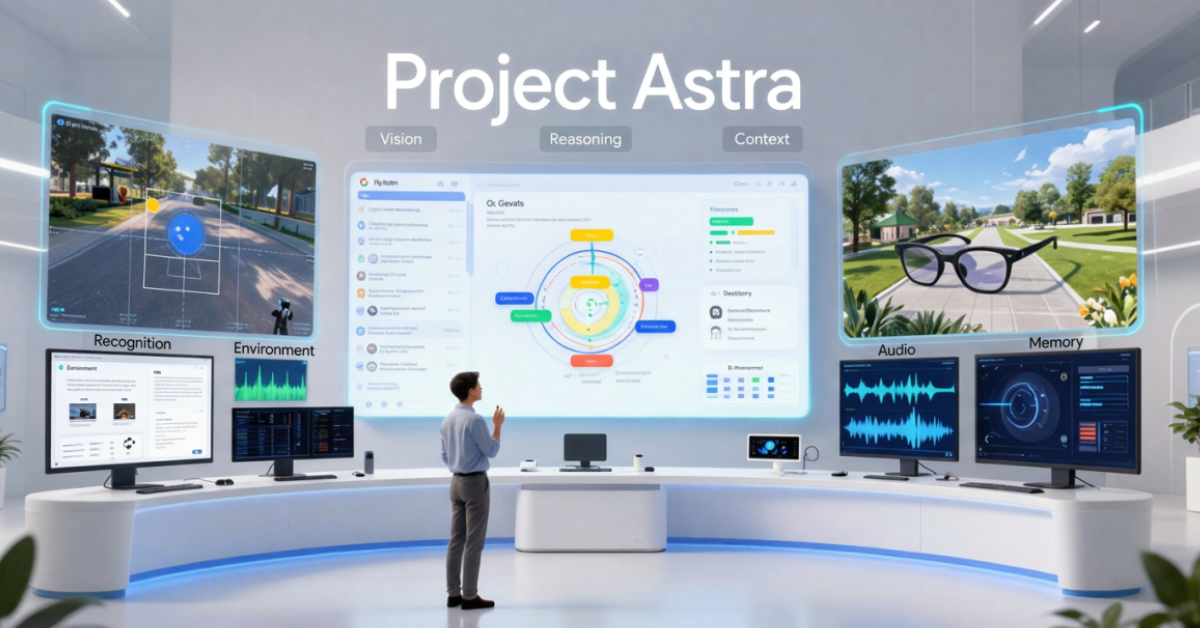
Artificial Intelligence is rapidly evolving from chatbots into intelligent companions capable of seeing, hearing, understanding, and helping users in real-world situations. At the center of this transformation is Project Astra, Google’s ambitious initiative to build the next generation of universal AI assistants.
Unlike traditional AI tools that respond only to text prompts, Project Astra combines vision, audio, memory, reasoning, and real-time contextual awareness into a single assistant experience. It represents Google’s long-term vision for an AI assistant that can interact naturally with people throughout their daily lives.
In this Project Astra Complete Guide 2026, we will explore what Project Astra is, how it works, its key technologies, real-world applications, and why it may redefine the future of human-computer interaction.
Table of Contents
What Is Project Astra?
Project Astra is a next-generation multimodal AI assistant developed by Google DeepMind.
It was introduced as Google’s vision for creating a universal AI assistant capable of:
- Seeing the world through cameras
- Understanding voice conversations
- Remembering context over time
- Interacting naturally in real-time
- Reasoning across multiple information sources
- Assisting users continuously throughout their day
Rather than functioning as a simple chatbot, Astra aims to become an intelligent companion that understands what users are seeing, hearing, doing, and asking at any moment.
The project is built on advanced Gemini models and serves as a preview of where Google’s AI ecosystem is heading in the coming years.
Why Project Astra Matters
Most AI assistants today suffer from limitations:
- Limited memory
- Text-focused interactions
- Poor real-world awareness
- Inability to understand visual context
- Fragmented user experiences
Project Astra attempts to solve these problems by combining multiple AI capabilities into a unified system.
The goal is to create an assistant that can:
- Observe surroundings
- Understand ongoing conversations
- Answer contextual questions
- Provide proactive assistance
- Maintain long-term continuity
This represents a significant leap beyond traditional digital assistants.
Core Technologies Behind Project Astra
1. Multimodal Understanding
One of Astra’s most important capabilities is multimodal intelligence.
The system can simultaneously process:
- Text
- Voice
- Images
- Video
- Environmental context
For example:
A user points a smartphone camera at a device and asks:
“What is this connector used for?”
Project Astra can:
- Analyze the image.
- Identify the connector.
- Explain its purpose.
- Provide troubleshooting guidance.
All within seconds.
2. Real-Time Video Understanding
Unlike image-based AI systems that analyze static pictures, Astra can process continuous video streams.
This allows the assistant to:
- Observe environments
- Track objects
- Understand activities
- Answer questions about ongoing events
Examples include:
- Identifying landmarks during travel
- Recognizing household objects
- Assisting with repairs
- Understanding educational demonstrations
This capability moves AI beyond screen-based interactions.
3. Advanced Voice Interaction
Project Astra supports natural voice conversations.
Key improvements include:
- Faster response times
- Reduced latency
- Natural conversational flow
- Context retention
- Interruptible dialogue
Users can interact with Astra similarly to speaking with another person.
The system maintains conversation context and adapts responses accordingly.
4. Contextual Memory
One of Astra’s most impressive innovations is memory.
The assistant can remember:
- Previously discussed topics
- Objects it has seen
- User preferences
- Ongoing tasks
For example:
A user asks Astra to remember where they placed their glasses.
Later, they can ask:
“Where did I leave my glasses?”
Astra may recall earlier observations and help locate them.
This creates a more persistent assistant experience.
5. Gemini-Powered Reasoning
Project Astra is powered by advanced Gemini models.
This provides:
- Complex reasoning
- Knowledge retrieval
- Problem solving
- Contextual understanding
- Long-context processing
The combination of Gemini reasoning and Astra’s sensory capabilities creates a significantly more capable AI assistant.
How Project Astra Works
The workflow typically follows these stages:
Step 1: Input Collection
Astra gathers information from:
- Camera feeds
- Voice input
- User interactions
- Device context
Step 2: Multimodal Processing
The Gemini model analyzes:
- Visual information
- Spoken language
- Environmental signals
Step 3: Context Building
The system combines information into a coherent understanding of the situation.
Step 4: Reasoning
Gemini performs:
- Analysis
- Interpretation
- Decision support
- Information retrieval
Step 5: Response Generation
Astra delivers assistance through:
- Voice
- Text
- Visual guidance
The process occurs almost instantly.
Key Features of Project Astra
Real-Time Visual Assistance
Users can point a camera at:
- Documents
- Products
- Equipment
- Screens
- Physical objects
Astra understands what it sees and provides guidance.
Live Problem Solving
The assistant can help users:
- Troubleshoot devices
- Learn new skills
- Follow instructions
- Complete tasks
Without requiring manual searches.
Environmental Awareness
Astra understands surroundings and context.
Examples include:
- Identifying locations
- Recognizing objects
- Understanding activities
- Providing contextual recommendations
Continuous Conversations
Users can switch topics naturally while maintaining context.
The assistant understands conversational continuity without repeatedly reintroducing information.
Memory-Based Assistance
The system can remember:
- Previous interactions
- Visual observations
- User preferences
- Personal workflows
This enables personalized experiences.
Real-World Use Cases
Education
Students can:
- Point cameras at textbooks
- Ask questions about diagrams
- Receive explanations instantly
- Get tutoring assistance
Travel
Travelers can:
- Identify landmarks
- Translate signs
- Learn local information
- Navigate unfamiliar locations
Technical Support
Users can:
- Show devices to Astra
- Diagnose problems
- Follow repair instructions
- Receive troubleshooting help
Productivity
Professionals can:
- Analyze documents
- Organize information
- Recall previous discussions
- Manage tasks more effectively
Accessibility
Project Astra has enormous potential for accessibility.
It can assist individuals by:
- Describing surroundings
- Reading text aloud
- Identifying objects
- Navigating environments
Project Astra vs Traditional AI Assistants
| Feature | Traditional Assistant | Project Astra |
| Text Chat | Yes | Yes |
| Voice Interaction | Limited | Advanced |
| Visual Understanding | Minimal | Extensive |
| Real-Time Video Analysis | No | Yes |
| Memory | Limited | Advanced |
| Context Awareness | Partial | High |
| Multimodal Intelligence | Basic | Native |
| Environmental Understanding | Weak | Strong |
The difference is comparable to moving from a search engine to a truly intelligent assistant.
Relationship Between Project Astra and Gemini
Many users assume Astra and Gemini are separate systems.
In reality, Astra acts as a showcase of what Gemini-powered assistants can become.
Gemini provides:
- Intelligence
- Reasoning
- Knowledge
- Language understanding
Project Astra adds:
- Vision
- Audio understanding
- Environmental awareness
- Real-time interaction
- Persistent memory
Together they form the foundation of Google’s future AI ecosystem.
How Project Astra Connects to Google’s AI Ecosystem
Project Astra complements several Google AI products which are listed below:
- Gemini
- Gemini Live
- Gemini Deep Think
- Gemini Gems
- NotebookLM
- Google AI Studio
- Gemini API
- Google Agent Development Kit (ADK)
- Google Veo
- Google AI Ultra
Astra represents the convergence of these technologies into a unified assistant experience.
For deeper understanding of multi-agent systems, read: Multi-Agent Systems Complete Guide 2026
Potential Future Capabilities
Future versions may include:
Wearable Integration
Smart glasses and wearable devices could provide always-on AI assistance.
Enhanced Personal Memory
Users may maintain long-term knowledge bases personalized to their activities.
Agentic Actions
Astra could perform tasks autonomously across apps and services.
Workspace Integration
Deep integration with:
- Gmail
- Docs
- Sheets
- Meet
- Calendar
could create powerful productivity workflows.
Smart Home Control
Astra may become a central intelligence layer for connected environments.
Challenges and Considerations
Despite its promise, Astra faces important challenges.
Privacy
Continuous visual and audio awareness raises privacy concerns.
Users must have strong controls over:
- Data storage
- Memory retention
- Device permissions
Accuracy
Real-world understanding requires extremely high accuracy.
Mistakes in visual interpretation could impact user trust.
Computational Requirements
Real-time multimodal processing requires significant AI infrastructure.
Balancing performance and efficiency remains a major challenge.
What Project Astra Means for the Future of AI
Project Astra signals a shift from reactive AI tools to proactive AI companions.
Future assistants will likely:
- Understand context continuously
- Remember previous interactions
- Observe environments
- Assist proactively
- Work across devices seamlessly
Instead of opening an app to ask questions, users may simply interact naturally with AI throughout the day.
This is the future Google is building toward.
Final Thoughts
Project Astra is one of the most important AI initiatives emerging from Google’s ecosystem. By combining Gemini’s reasoning abilities with real-time vision, voice, memory, and contextual awareness, Astra demonstrates what future AI assistants could become.
While many capabilities are still evolving, Astra offers a glimpse into a world where AI understands not only what users type, but also what they see, hear, and experience. As Google’s AI ecosystem continues to mature, Project Astra may become the foundation of the next generation of intelligent digital assistants.
For anyone following the future of artificial intelligence, understanding Project Astra is essential because it represents Google’s clearest vision yet for the future of human-AI interaction.
FAQs
What is Project Astra?
Project Astra is Google’s next-generation multimodal AI assistant designed to understand voice, video, images, and contextual information in real time.
Is Project Astra powered by Gemini?
Yes. Project Astra is built on Gemini models and extends their capabilities with vision, memory, and real-time environmental understanding.
Can Project Astra see through a camera?
Yes. Astra can analyze live camera feeds and answer questions based on what it observes.
How is Project Astra different from Gemini Live?
Gemini Live focuses on conversational interactions, while Project Astra expands this capability through advanced visual understanding, memory, and contextual awareness.
Will Project Astra be available on Android devices?
Google is expected to integrate Astra-inspired capabilities across Android and future AI-powered products, though availability may vary by feature and region.
References
- Google DeepMind Project Astra Overview
- Google I/O AI Announcements
- Gemini Documentation
- Google DeepMind Research
Author Bio

Amit Gupta is a UI/UX Designer and Frontend Specialist with more than 20 years of experience in product design, design systems, Angular development, frontend architecture, and emerging technologies. Through AmitGuptaBlogs.com, he shares practical insights on AI, Google technologies, design workflows, development tools, and future technology trends.