
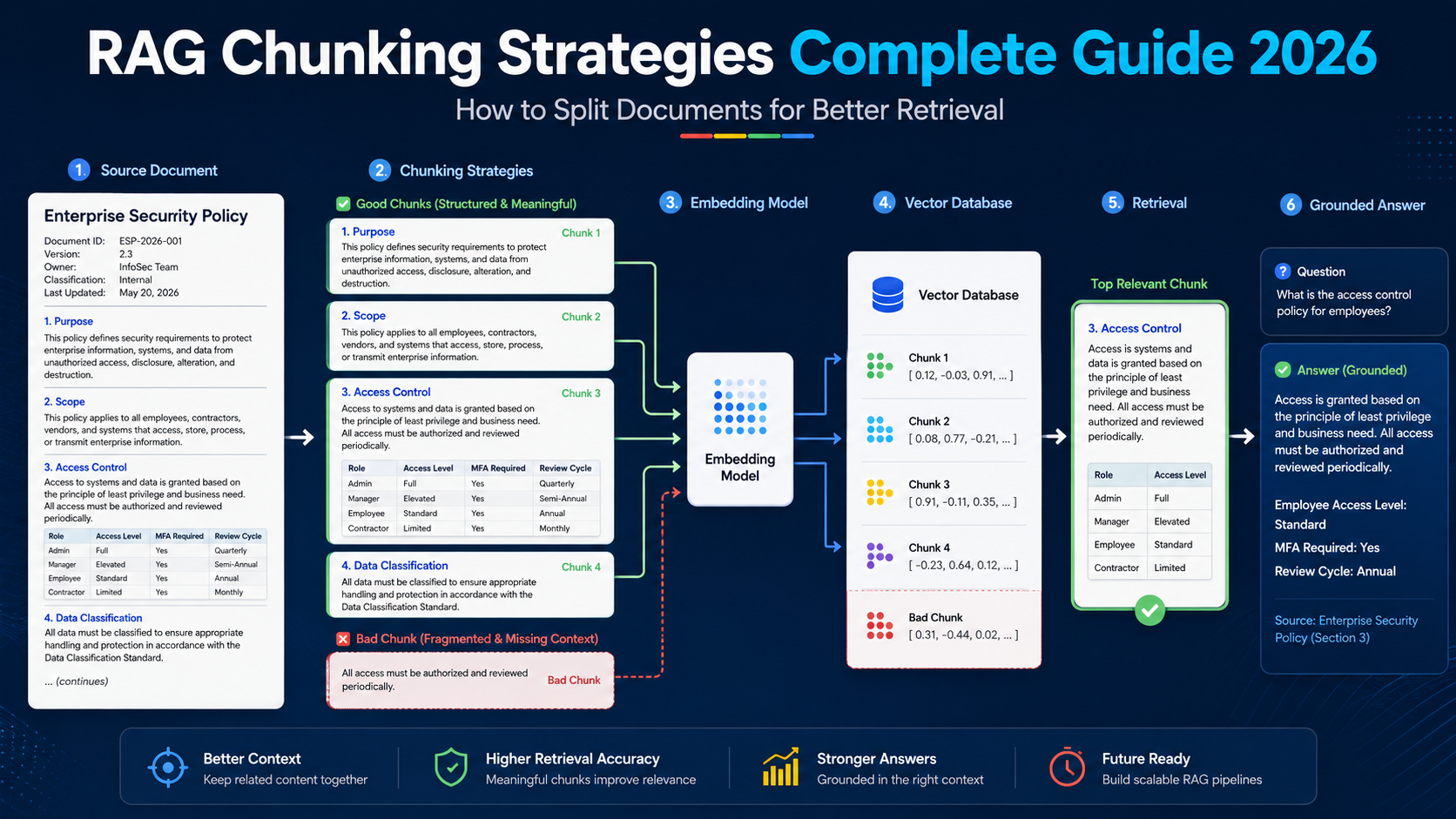
A RAG system can use a powerful language model, a capable embedding model and a well-configured vector database – and still return the wrong paragraph.
Very often, the problem began much earlier, when the source document was divided into chunks.
Imagine a leave policy where the eligibility rule appears at the bottom of one page and its exception begins on the next. If the content is split at the page boundary, retrieval may find the rule but miss the exception. The final answer can sound confident while being incomplete.
That is why RAG chunking strategies deserve more attention than they usually receive. Chunking is not simply a way to make a long document fit inside a model. It decides what the retrieval system can find, what context travels with each passage and what evidence eventually reaches the language model.
This guide explains the main chunking methods, how chunk size and overlap affect retrieval, how to handle structured documents, and how to choose a practical strategy without treating one number as a universal rule.
Table of Contents
What Is Chunking in RAG?
Chunking is the process of dividing a document into smaller, retrievable units before those units are indexed.
In a typical Retrieval-Augmented Generation system, each chunk is usually defined on the following basis:
- It is extracted from a source document;
- It is enriched with useful metadata;
- It is converted into an embedding;
- It is stored in a search index or vector database;
- It is retrieved when it matches a user query; and
- It is passed to a language model as supporting evidence.
The chunk becomes the bridge between a large document and a specific question.
If it is too broad, several unrelated ideas may be compressed into one representation. If it is too narrow, the passage may lose the heading, definition or condition that makes it understandable.
Good chunking tries to keep each unit focused enough for precise retrieval while preserving enough context for a correct answer.
Why RAG Chunking Strategies Affect Answer Quality
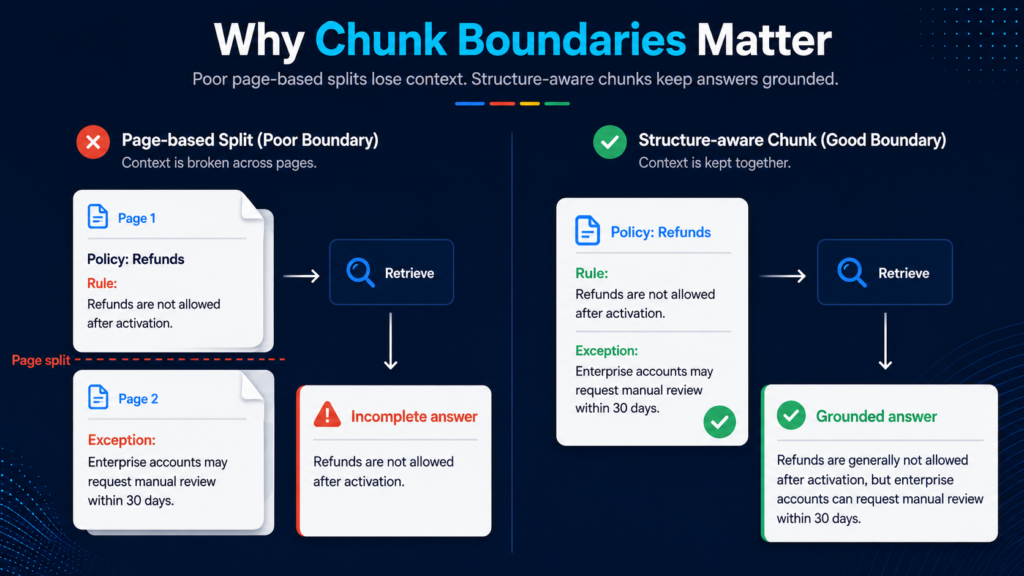
Chunking influences retrieval precision, context completeness, prompt cost and citation quality.
A focused chunk can match a specific query more accurately than a complete 40-page manual. However, it must still carry enough meaning to stand alone.
A passage saying, “This benefit is available for 90 days,” is not useful if the previous section alone identifies the benefit and eligible employees.
Oversized chunks may introduce unrelated material. Tiny fragments force the model to reconstruct relationships lost during ingestion. Well-formed chunks also make it easier to cite the correct document, section, page and version.
Main RAG Chunking Strategies
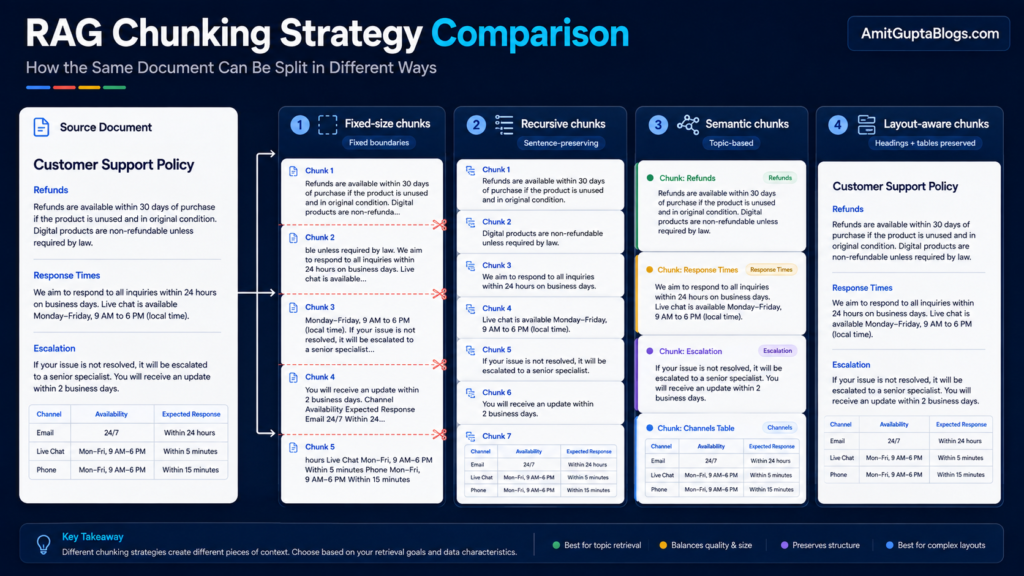
There is no single best method for every knowledge base. The right strategy depends on the shape of the content and the questions people ask.
1. Fixed-Size Chunking
Fixed-size chunking divides text after a set number of characters, words or tokens.
It is simple, fast and useful as a baseline for plain text. Its weakness is that the splitter does not know where an idea ends, so a definition or warning may be cut in half.
Keep sentence boundaries intact where possible.
2. Sentence- or Paragraph-Based Chunking
This method groups complete sentences or paragraphs until a target size is reached.
It reads more naturally than rigid character splitting and suits articles, FAQs and support content.
Paragraph length can vary, however. A one-line paragraph may lack context, while a long one may contain several ideas.
3. Recursive Chunking
Recursive splitting uses an ordered set of boundaries. It may try sections first, followed by paragraphs, sentences, words and, finally, characters when necessary.
This preserves natural structure while respecting a maximum size. It is a practical general-purpose choice for Markdown, web pages and clean text.
However, it remains rule-based and may not recognise a topic change inside a section.
4. Section- and Heading-Aware Chunking
Here, headings and subheadings guide the boundaries. The complete heading path can also be attached to every resulting chunk.
This works well for policies, technical documentation and product manuals. A passage from “Security > Password Reset > Recovery Codes” is clearer than the same paragraph returned without its hierarchy.
Google’s current Agent Search documentation describes layout-aware chunking that keeps text within layout entities such as headings, subheadings and lists. It also supports including ancestor headings to reduce context loss.
5. Semantic Chunking
Semantic chunking looks for changes in meaning rather than relying only on length or formatting.
Sentences discussing the same idea remain together, while a meaningful topic shift creates a new chunk.
This can help when headings are missing or unreliable, but it adds preprocessing, tuning and less predictable chunk sizes.
‘Semantic’ does not automatically mean ‘superior’. A 2026 comparative study found that performance was task-dependent: simple structure-based approaches remained strong in some settings, while advanced methods helped in others.
6. Layout-Aware Chunking
PDFs, presentations and reports are visual documents. Reading extracted text from top to bottom may mix columns, detach captions, remove headings or flatten a table into meaningless lines.
Layout-aware parsers identify titles, paragraphs, lists, tables, headers and footnotes before chunking.
Google explains that its Gemini layout parser can preserve ancestral headings and table headers. Microsoft’s Document Layout workflow similarly uses structure to create coherent sections before splitting and vectorisation.
For complex documents, parsing quality can matter as much as the splitter.
7. Parent–Child or Hierarchical Chunking
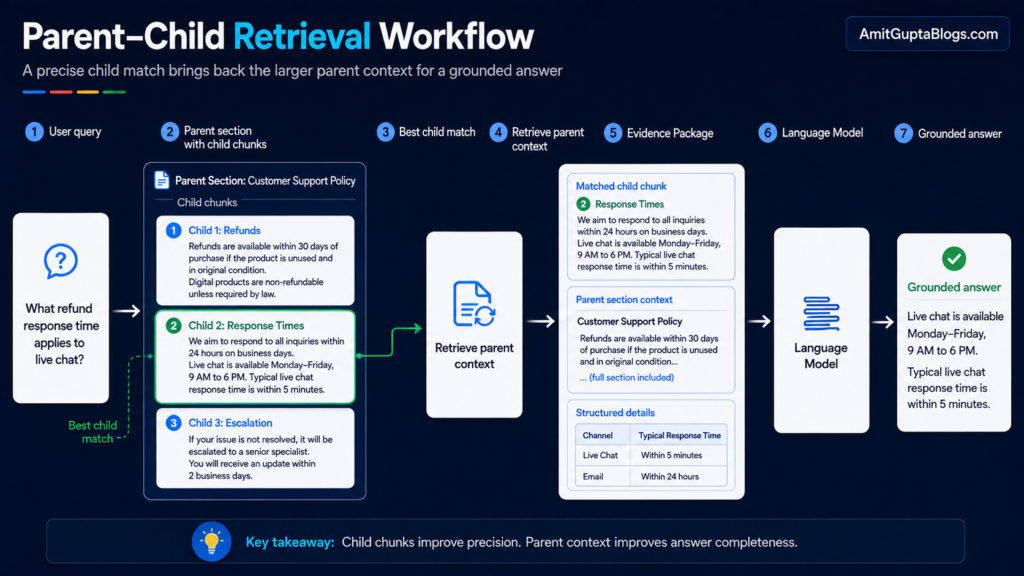
Hierarchical chunking creates smaller child chunks for precise retrieval and connects them to a larger parent section.
The system can search the smaller unit and then return its parent or neighbouring children to restore context.
This is useful when the question points to one sentence but the answer needs the surrounding definition, procedure or exception. It balances retrieval precision with answer completeness, although it requires additional identifiers and retrieval logic.
8. Contextual Chunk Enrichment
Sometimes a chunk is clear to someone reading the whole document but ambiguous when viewed alone.
Contextual enrichment adds a short description before indexing, such as:
This passage is from Acme’s Q2 2026 financial report and explains the decline in operating margin in its European retail division.
Anthropic reported that contextual embeddings reduced the top-20 retrieval failure rate by 35% in its experiments. Adding contextual BM25 reduced it by 49%.
These findings are not a guarantee for every dataset, but they demonstrate the potential value of restoring missing context. Generated context should clarify the original passage without adding unsupported claims.
9. Late Chunking
Traditional pipelines split a document first and embed each piece independently.
Late chunking reverses part of that order. A long-context embedding model processes the broader document first, and chunk-level representations are created afterward.
The Late Chunking research paper aims to preserve relationships that chunk-first embedding can lose, such as a pronoun referring to an entity introduced earlier.
It requires compatible embedding architecture and is an advanced option rather than a default starting point.
How Large Should a RAG Chunk Be?
The honest answer is ‘large enough to preserve the evidence but small enough to retrieve it precisely’.
There is no universal best chunk size.
Microsoft’s current Azure AI Search guidance gives examples such as 200 words or 600 characters with 10–15% overlap for fixed-size chunks. Its text-split documentation gives 512 tokens as a general recommendation for embedding-orientated pages.
Google Agent Search currently uses a 500-token default for one layout-aware chunking configuration. Another Google RAG Engine workflow recommends 1,024 tokens with 256-token overlap as its starting configuration.
These defaults do not contradict one another. They belong to different services, models and pipelines. They are starting points, not laws.
A practical experiment might compare 256, 512 and 1,024 tokens while keeping the embedding model, retriever and evaluation queries unchanged.
Check for each of the following settings:
- Whether it retrieves the complete evidence;
- Whether it introduces unrelated material;
- Whether it separates conditions from exceptions;
- Whether it works within the embedding model’s input limit;
- Whether it leaves room for multiple retrieved passages; and
- Whether it meets acceptable latency and cost.
How Much Chunk Overlap Should You Use?
Overlap repeats the end of one chunk at the beginning of the next to protect information near a boundary.
Too much overlap creates duplicate vectors, increases storage and may fill the prompt with repeated text.
Structure-aware chunks may need less overlap because they already respect sections and sentences. Procedures or narrative documents may require more boundary protection than independent FAQ entries.
Start modestly, measure the effect and do not use overlap as a substitute for better boundaries.
Choosing a Strategy by Content Type
| Content type | Practical starting strategy | Important treatment |
|---|---|---|
| FAQs and support answers | One answer or closely related Q&A per chunk | Preserve product, version and issue metadata |
| Policies and manuals | Heading-aware or parent–child | Attach section path, effective date and region |
| Web pages and Markdown | Recursive or heading-aware | Remove navigation, footers and repeated boilerplate |
| Research papers | Section-aware with contextual enrichment | Preserve title, abstract, section and citation details |
| Contracts and legal documents | Clause-aware and hierarchical | Keep definitions, cross-references and jurisdiction |
| Source code | Function-, class- or module-aware | Preserve file path, imports and symbol names |
| Tables and financial reports | Layout-aware with table-specific handling | Repeat headers and keep units, periods and labels |
| Scanned PDFs | OCR plus layout-aware parsing | Validate reading order and OCR accuracy |
| Chat or ticket history | Conversation-turn or issue-aware | Preserve speaker, timestamp and thread identity |
The user’s query pattern matters as much as the file format.
If employees usually search by exact policy codes, preserve those codes for lexical matching. If they ask broad natural-language questions, semantic coherence becomes more important.
In many production systems, Hybrid Search combines these exact and meaning-based signals.
There is no universally correct chunk size or chunking strategy. The better question is whether your chunks help the retriever consistently find complete, useful evidence for real user queries. Instead of choosing a strategy by intuition alone, compare retrieval recall, context precision, evidence coverage and final-answer faithfulness across representative test cases. My RAG Evaluation Complete Guide 2026 shows how to measure these signals and determine whether a chunking change actually improves the RAG pipeline.
Handling Tables, Lists, Code and Scanned Documents
Some content needs specialised treatment:
- Tables: Keep headers, row labels, units and periods with their values. Large tables may need row groups with repeated headers. Unstructured’s documentation separates tables from ordinary text and creates special table chunks when required.
- Lists and procedures: Keep numbered steps together when order matters. If a procedure must be split, repeat its name and preserve the step range.
- Source code: Split around functions, classes and modules. Include file paths and symbol names, and link dependent definitions where useful.
- Scanned documents: Validate OCR, reading order, headings and identifiers before embedding. A better parser may help more than repeated chunk-size changes.
The resulting units are converted into AI embeddings and commonly stored in a vector database, so every parsing mistake can travel downstream into retrieval.
Where applicable, each chunk should also carry its parent document ID, title, section path, source URL, page, date, region, version, status and access permissions.
Apply access rules during retrieval so restricted chunks never enter the generation context.
How to Evaluate RAG Chunking Strategies
Do not judge chunking by reading a handful of chunks. Evaluate whether real questions retrieve the correct evidence.
Build a representative test set containing factual and paraphrased questions, boundary-crossing answers, exact codes, tables, lists, version-sensitive requests and known failures.
For every query, identify the expected source passage. Then compare chunking configurations using the same embeddings, index and retrieval method.
Useful measurements include:
- Recall at K: Did the required evidence appear in the top K results?
- Precision at K: How many retrieved chunks were useful?
- Mean Reciprocal Rank: How high did the first correct chunk appear?
- Context completeness: Did the passage include the necessary condition, exception and heading?
- Redundancy: How much repeated text entered the retrieved set?
- Grounded-answer accuracy: Did the final response use the evidence correctly?
- Latency and cost: Did the improvement justify the additional processing and storage?
Retrieval should be tested separately from generation. Otherwise, a fluent language model may hide weak retrieval during demonstrations.
Common Chunking Mistakes
| Mistake | What goes wrong | Better approach |
|---|---|---|
| Copying one default size everywhere | Different documents and queries need different contexts | Treat defaults as baselines and evaluate alternatives |
| Splitting only by page | Ideas and tables can cross page boundaries | Use structural or layout-aware parsing |
| Creating tiny fragments | Headings, definitions and references disappear | Merge related sentences and attach section context |
| Creating very large chunks | Embeddings represent too many subjects | Split by a coherent topic or subsection |
| Using excessive overlap | Storage and prompt repetition increase | Use modest overlap and improve boundaries |
| Flattening tables into plain text | Headers, units and row relationships are lost | Use table-aware extraction and repeat essential labels |
| Dropping metadata | Filtering, citations and governance weaken | Preserve source, version, dates and permissions |
| Evaluating only final answers | Retrieval failures remain hidden | Measure retrieval and generation separately |
| Re-chunking without version control | Old and new chunks may coexist | Rebuild or version the index deliberately |
What Is Changing in RAG Chunking in 2026?
Platforms increasingly support layout parsing, semantic boundaries, ancestor headings, table and image annotations, and pipelines designed for agentic retrieval.
Contextual enrichment and late chunking aim to preserve information that independent chunks lose. Multimodal retrieval also treats visual position and charts as evidence rather than disposable formatting.
Yet no advanced method wins in every setting. The practical 2026 pattern is as follows:
Parse carefully, preserve structure, start with a clear baseline, and improve only when evaluation shows a real gain.
Practical RAG Chunking Checklist
Before indexing a knowledge base:
- inspect the document types and real user questions;
- remove boilerplate and preserve headings, lists, tables and reading order;
- confirm model limits and test more than one chunk size;
- use overlap only where boundaries need protection;
- attach source, version, date and permission metadata;
- preserve parent and neighbouring relationships where useful;
- compare configurations against expected source passages; and
- version and rebuild the index when sources or strategies change.
Final Thoughts
Chunking may look like a small preprocessing decision, but it shapes everything that follows.
A good chunk gives search a focused unit and gives the model enough evidence to answer responsibly. A poor one hides the correct passage inside too much text or separates it from the context that makes it true.
The strongest RAG chunking strategies are those that match your documents, users’ questions and evaluation results.
Start simple, preserve structure and let measured retrieval failures show you what to improve.
Frequently Asked Questions (FAQs)
What is chunking in RAG?
It divides documents into smaller units that can be embedded, retrieved and supplied to a language model as evidence.
What is the best chunk size for RAG?
There is no universal best size. It depends on document structure, queries, model limits and how much context an answer needs.
Is 512 tokens a good chunk size?
It is a useful baseline in some workflows, but not a rule for every platform or dataset.
How much overlap should RAG chunks have?
A modest overlap can protect boundary information, but measure whether it improves retrieval without excessive duplication.
What is semantic chunking?
It groups text by meaning and creates a boundary when the topic changes. It can improve coherence but should be tested against simpler methods.
What is parent–child chunking?
It retrieves a precise child passage and links it to a larger parent section, combining precision with surrounding context.
Does chunking still matter with long-context models?
Yes. Long context does not guarantee precise retrieval. Chunking can reduce noise and improve passage-level matching and citations.
Should tables be chunked like paragraphs?
Usually not. Headers, units, labels and periods must remain attached to their values, so table-aware processing is safer.
References
- Google Cloud: Parse and chunk documents
- Google Document AI: Gemini layout parser and layout-aware chunking
- Microsoft Learn: Chunk large documents for RAG and vector search
- Microsoft Learn: Text Split skill
- Anthropic: Contextual Retrieval
- Unstructured: Chunking concepts
- Late Chunking research paper
- Beyond Chunk-Then-Embed: 2026 chunking evaluation
Author Bio

Amit Gupta is a UI/UX Designer and Frontend Specialist with more than 20 years of experience in product design, design systems, Angular development, frontend architecture, and emerging technologies. Through AmitGuptaBlogs.com, he shares practical insights on AI, Google technologies, design workflows, development tools, and future technology trends.