
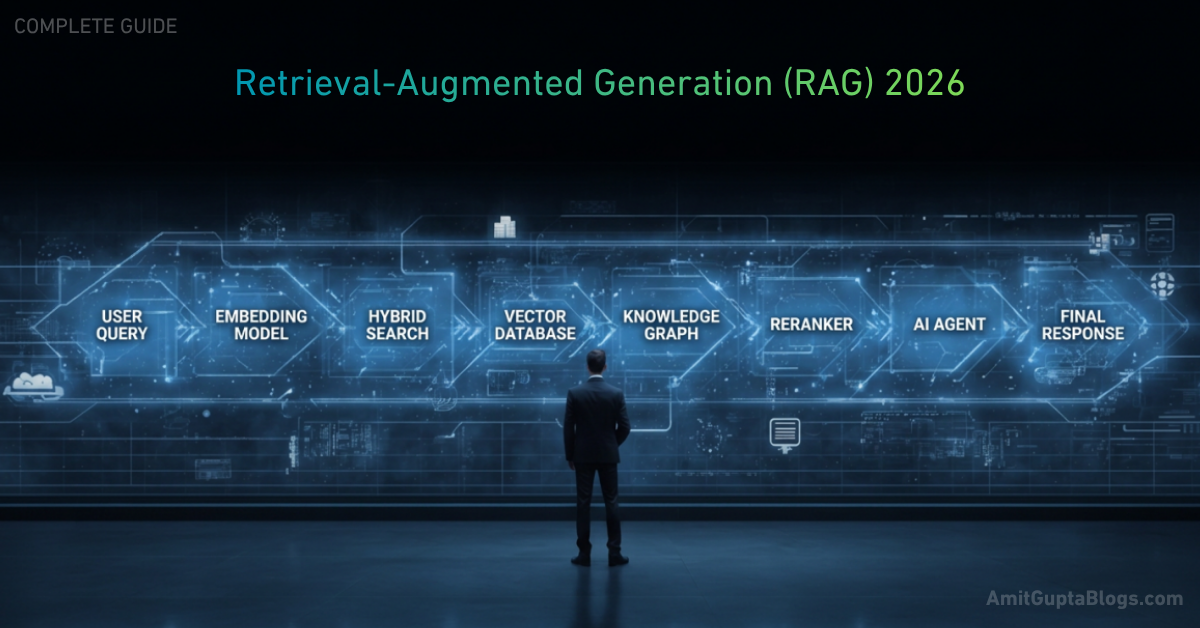
Imagine This…
It’s Monday morning. An employee opens the company’s AI assistant and asks:
“What’s our latest remote work policy for international employees?”
The policy was updated just three days ago. The AI model was trained months earlier.
Yet it responds with the latest policy, cites the correct internal document, and even links to the HR portal. How?
The AI didn’t magically know the answer. It retrieved it. That single capability has transformed Generative AI from an impressive chatbot into a practical business tool.
Welcome to the world of Retrieval-Augmented Generation (RAG).
Table of Contents
Quick Overview
If you’re short on time, here’s the essence of RAG:
- Large Language Models have fixed knowledge after training.
- Retraining models whenever information changes is expensive and impractical.
- RAG allows AI to retrieve relevant information in real time before generating a response.
- This significantly reduces hallucinations while improving accuracy and freshness.
- Modern enterprise AI assistants, knowledge bots, customer support systems, and document search platforms increasingly rely on RAG rather than model retraining.
- In 2026, RAG has evolved well beyond simple vector search into Hybrid RAG, GraphRAG, and Agentic RAG architectures that combine retrieval, reasoning, and orchestration for more reliable enterprise AI.
Who Should Read This Guide?
This guide is designed for:
- AI beginners
- Developers
- Solution Architects
- Product Managers
- UX Designers working on AI products
- Enterprise Technology Leaders
- Students learning modern AI architecture
- Anyone curious about how ChatGPT-like systems answer questions using private or up-to-date information
No prior knowledge of machine learning is required.
Why RAG Became One of the Most Important AI Technologies
When ChatGPT launched, people were amazed.
- It could write.
- Explain.
- Summarize.
- Translate.
- Generate code.
But after the excitement came an important realization.
AI doesn’t actually “know” today’s information.
Every Large Language Model has a knowledge cutoff. Anything that happened afterward simply doesn’t exist inside its trained parameters unless the model can access external information.
Imagine asking:
- Today’s stock price
- Yesterday’s sales report
- Your company’s leave policy
- Last week’s legal document
- A newly published research paper
Traditional LLMs struggle because this information wasn’t part of their original training. That created three major challenges:
1. Hallucinations
Instead of admitting uncertainty, AI may confidently generate an incorrect answer.
2. Outdated Knowledge
Models cannot automatically learn newly created documents, policies, or events.
3. Private Information
Your organization’s internal documents were never included in public model training.
RAG solves all three by letting AI look up relevant information first and answer second.
The Library Analogy
Imagine a student taking an open-book examination. There are two possibilities.
Student A
- Relies entirely on memory.
- Sometimes accurate.
- Sometimes forgets details.
- Sometimes guesses.
Student B
- Walks into the exam carrying an organized library.
- Before answering every question, the student quickly finds the relevant chapter, reads it, and then writes the answer.
Which student would you trust more? That’s essentially what RAG does.
Instead of relying only on the model’s memory, it first searches an external knowledge source and then generates an answer using that retrieved information.
What Is Retrieval-Augmented Generation?
Retrieval-Augmented Generation (RAG) is an AI architecture that combines two powerful capabilities:
- Information Retrieval — finding the most relevant information from external knowledge sources.
- Text Generation — using an LLM to produce a natural-language answer grounded in the retrieved content.
Unlike traditional language models, RAG does not depend solely on the information stored in model weights. Instead, it augments every query with fresh, relevant context before generating a response.
Why Not Simply Retrain the AI?
A common question is: “If information changes, why not retrain the model?”
Because retraining modern LLMs is:
- extremely expensive
- time-consuming
- computationally intensive
- unnecessary for frequent document updates
Imagine updating your company’s HR handbook every week. Would you retrain a multi-billion-parameter model each Friday?
Of course not. Instead, you update the document repository. The AI retrieves the latest version whenever someone asks a related question.
This separation between model intelligence and knowledge storage is one of RAG’s greatest strengths.
Traditional LLM vs RAG
| Traditional LLM | RAG System |
| Knowledge frozen after training | Retrieves current knowledge at runtime |
| Can hallucinate | Grounds answers using retrieved evidence |
| Difficult to update | Knowledge base updates instantly |
| Limited to training data | Uses enterprise documents, databases, websites, PDFs, APIs |
| Poor with proprietary information | Excellent for private organizational knowledge |
The Four Building Blocks of Every RAG System
Although enterprise implementations vary, almost every RAG solution follows four core stages.
Step 1 — User Asks a Question
Example: “What are the new reimbursement rules for business travel?”
Step 2 — Retrieve Relevant Information
Instead of answering immediately, the system searches:
- PDFs
- Word documents
- SharePoint
- Google Drive
- Wikis
- Databases
- Knowledge bases
- APIs
It identifies the most relevant content.
Step 3 — Augment the Prompt
The retrieved information is inserted into the prompt sent to the language model.
The model now has current, relevant context instead of relying only on its internal memory.
Step 4 — Generate the Answer
The LLM produces a response grounded in the retrieved evidence, often including citations or references.
This simple retrieve-then-generate pipeline made RAG the foundation of countless enterprise AI applications. However, by 2026, production systems increasingly enhance this baseline with query rewriting, hybrid search, reranking, and even multi-step retrieval orchestrated by AI agents for improved accuracy and reliability.
Real-World Example
Imagine you’re building an AI assistant for a hospital.
The hospital stores:
- treatment guidelines
- insurance policies
- medical procedures
- patient documentation
- regulatory manuals
A doctor asks: “What’s the latest protocol for diabetic patient discharge?”
Without RAG: The AI may answer based on outdated medical knowledge.
With RAG: The system retrieves the latest approved hospital protocol, uses it as context, and generates a grounded response aligned with current practice.
This illustrates why RAG has become such a cornerstone for enterprise AI in healthcare, finance, legal services, and customer support, where accuracy, governance, and up-to-date information are critical.
Once a RAG pipeline is working, the next challenge is knowing whether it is actually working well. Looking only at the final answer can hide problems in retrieval, ranking or grounding. A proper evaluation process measures these layers separately using metrics such as Recall@K, context precision, faithfulness and answer correctness. I cover this process in detail in my RAG Evaluation Complete Guide 2026, including a practical workflow for diagnosing where a RAG pipeline is failing.
How Does AI Search Millions of Documents in Seconds?
Imagine your company has:
- 8 million PDF pages
- 50,000 Word documents
- 15 years of email archives
- Product manuals
- Technical specifications
- Knowledge base articles
- Support tickets
- Meeting notes
Now someone asks:
“What changed in our cybersecurity policy after the latest compliance audit?”
- The AI doesn’t read millions of pages.
- It doesn’t search like Google.
- It uses a completely different approach.
- It doesn’t search like Google.
This is where embeddings, vector databases, and semantic search come into play.
Step 1: Breaking Documents into Chunks
Large Language Models cannot process an entire 500-page PDF at once. Instead, documents are divided into smaller sections called chunks.
For example, a company handbook may become:
- Chunk 1 – Introduction
- Chunk 2 – Employee Benefits
- Chunk 3 – Leave Policy
- Chunk 4 – Travel Reimbursement
- Chunk 5 – Remote Work
Each chunk becomes an independent unit that can later be searched and retrieved.
Why Chunking Matters
Imagine searching a library, you don’t borrow every book. You only need the few pages that answer your question.
Chunking works the same way. It enables the system to retrieve only the most relevant information instead of loading entire documents into the model.
Choosing the Right Chunk Size
One of the most overlooked aspects of RAG is chunking strategy.
If chunks are too small:
- important context is lost
- answers become fragmented
If chunks are too large:
- irrelevant information is included
- retrieval accuracy decreases
- prompt costs increase
Modern enterprise RAG systems often combine semantic chunking, overlapping windows, and document-aware boundaries to preserve context while keeping retrieval efficient.
Step 2: What Are Embeddings?
Humans understand language through meaning while computers understand numbers. An embedding converts text into a mathematical representation – a vector – that captures semantic meaning.
For example:
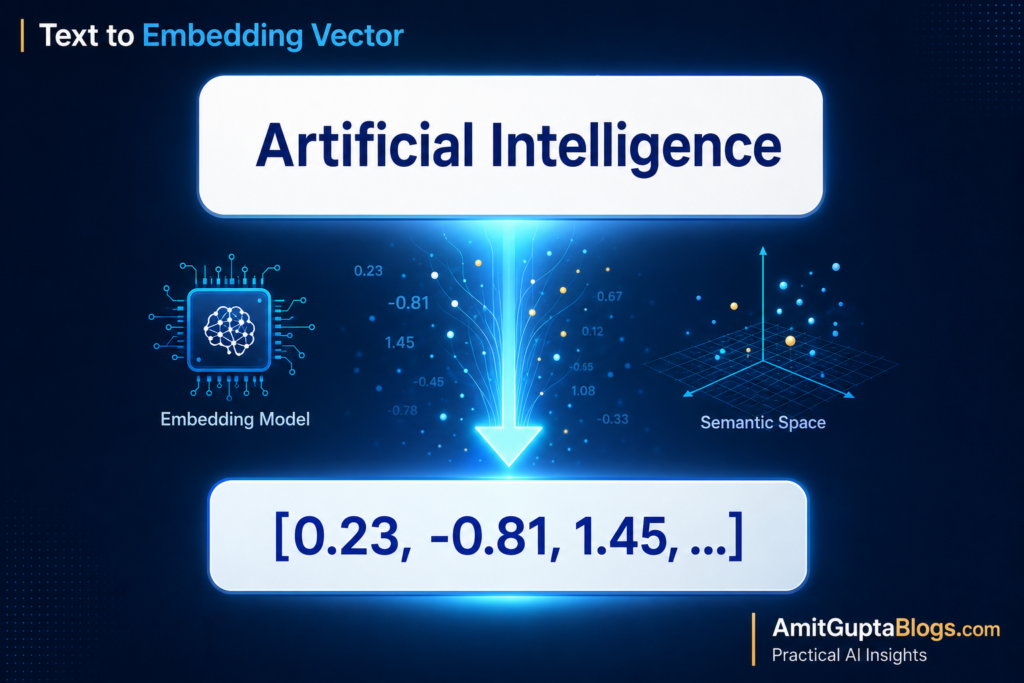
The numbers themselves are not important. What matters is that similar ideas are represented by vectors that are close together.
For example:
| Text | Relationship |
|---|---|
| Artificial Intelligence | Similar |
| Machine Learning | Very Similar |
| Deep Learning | Similar |
| Pizza Recipe | Completely Different |
Instead of matching exact words, embeddings allow AI to match meaning.
Why Keyword Search Isn’t Enough
Traditional search engines depend heavily on exact words.
Suppose you search: “How do I reset my password?”
The documentation might actually say: “Credential recovery process”
Keyword search may miss it. Semantic search recognizes that both refer to the same concept. This is one of the biggest reasons RAG feels much more intelligent than traditional document search.
Vector Databases: The Memory Library of RAG
Once embeddings are created, they need to be stored somewhere. That is the job of a Vector Database.
Instead of storing rows and columns like a traditional SQL database, a vector database stores millions (or even billions) of embedding vectors and quickly finds those most similar to a user’s query.
Popular vector databases include:
- Vertex AI Vector Search
- Pinecone
- Weaviate
- Milvus
- Qdrant
- Chroma
- pgvector (PostgreSQL)
- Elasticsearch/OpenSearch vector capabilities
The database doesn’t search for identical words, it searches for nearest meanings.
Semantic Search in Action
Suppose the knowledge base contains this sentence:
“Employees may work remotely for up to three days each week.“
A user asks: “How many days can I work from home?“
No words match exactly. Yet semantic search identifies the correct document because the intent is the same.
This ability to understand concepts instead of literal keywords is what makes modern RAG systems so effective.
The Retrieval Pipeline
A simplified RAG pipeline looks like this:
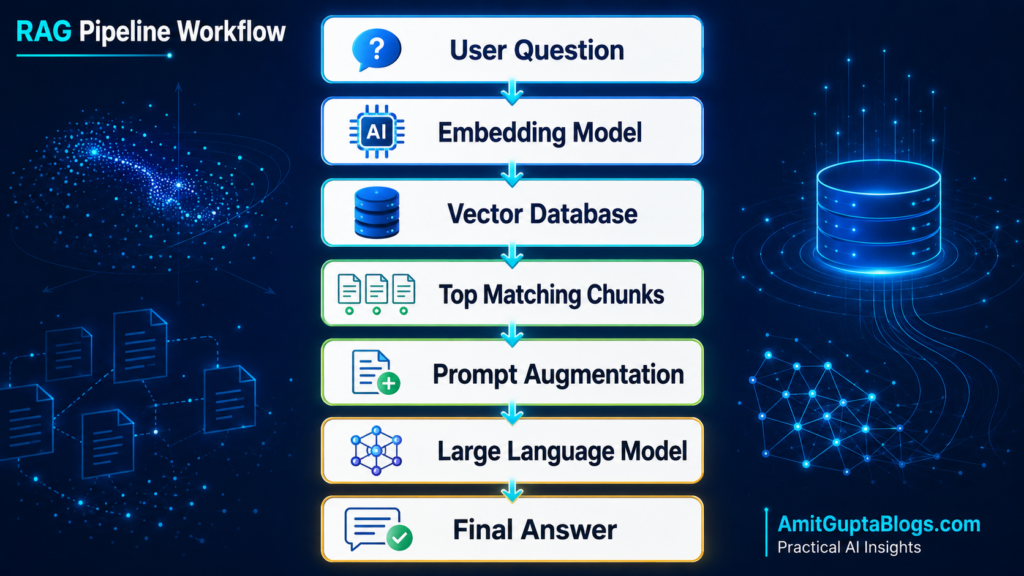
Every step contributes to the quality of the final response.
Why Retrieval Quality Matters More Than Model Size
Many newcomers assume: Better AI model = Better answers
In production, that’s often not true.
There are two scenarios as mentioned below:
Scenario A
- Excellent LLM
- Poor retrieval
The model receives irrelevant documents. Even a powerful model cannot invent the correct answer from the wrong evidence.
Scenario B
- Mid-sized LLM
- Excellent retrieval
The model receives highly relevant context and produces an accurate answer. This is why experienced AI engineers often say:
“Retrieval quality is the real intelligence behind RAG.“
From Simple RAG to Advanced RAG
Early RAG systems followed a straightforward flow:
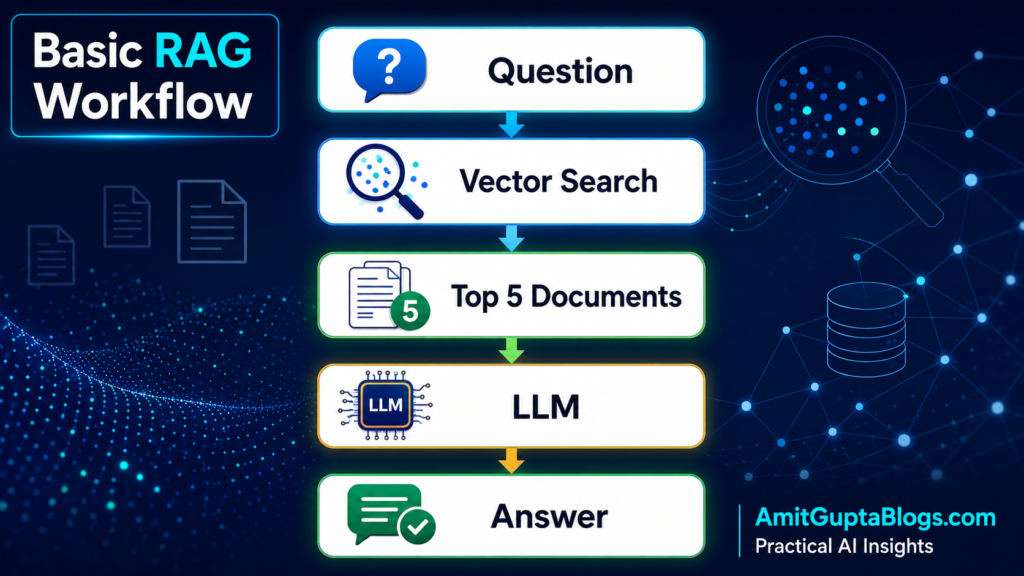
It worked–but not always well. Typical issues included:
- missing important documents
- retrieving irrelevant chunks
- poor handling of technical terminology
- weak performance on multi-step questions
These limitations led to the emergence of Advanced RAG.
Hybrid Search: Best of Both Worlds
Semantic search is powerful, but sometimes exact keywords matter.
Imagine searching for: “Invoice #847291” or “Error Code ERR-5021“
Vector search may overlook exact identifiers, whereas Keyword search excels here.
Modern RAG systems, therefore, combine the following:
- Semantic vector search
- Keyword search (such as BM25)
This combination is known as Hybrid Search and has become a production standard because it improves both recall and precision.
Reranking: Choosing the Best Evidence
Hybrid retrieval may return dozens of potentially relevant chunks. Not all deserve equal importance.
A reranking model performs a second evaluation, comparing the user’s question with each retrieved passage and assigning a more precise relevance score.
For example:
Initial retrieval:
- Travel Policy
- Expense Claims
- Remote Work
- Employee Benefits
- Security Policy
After reranking:
- Remote Work
- Travel Policy
- Expense Claims
Only the highest-quality evidence is sent to the LLM. This additional step often improves answer quality without changing the language model itself.
Metadata Filtering
Large organizations often organize documents using metadata such as:
- Department
- Region
- Language
- Product
- Version
- Date
- Security classification
Suppose an employee asks:
“What’s the refund policy for Europe?”
Instead of searching every document ever created, the system first filters for:
- Region = Europe
- Document Type = Policy
- Status = Current
Only then does semantic retrieval begin. This dramatically improves both speed and relevance.
Why Basic RAG Sometimes Fails
Even with vector search, production systems encounter difficult questions.
For example:
“Which suppliers are indirectly affected by the cybersecurity regulation introduced after last year’s audit?”
Answering this requires:
- connecting multiple documents
- understanding relationships
- reasoning across entities
- synthesizing evidence
Traditional vector retrieval struggles because it retrieves isolated chunks rather than understanding how information is connected.
That challenge paved the way for the next generation of RAG architectures.
Meet GraphRAG
GraphRAG enhances traditional retrieval by incorporating knowledge graphs. Instead of treating documents as isolated text, it models relationships among entities such as:
- People
- Products
- Departments
- Policies
- Technologies
- Events
For example:
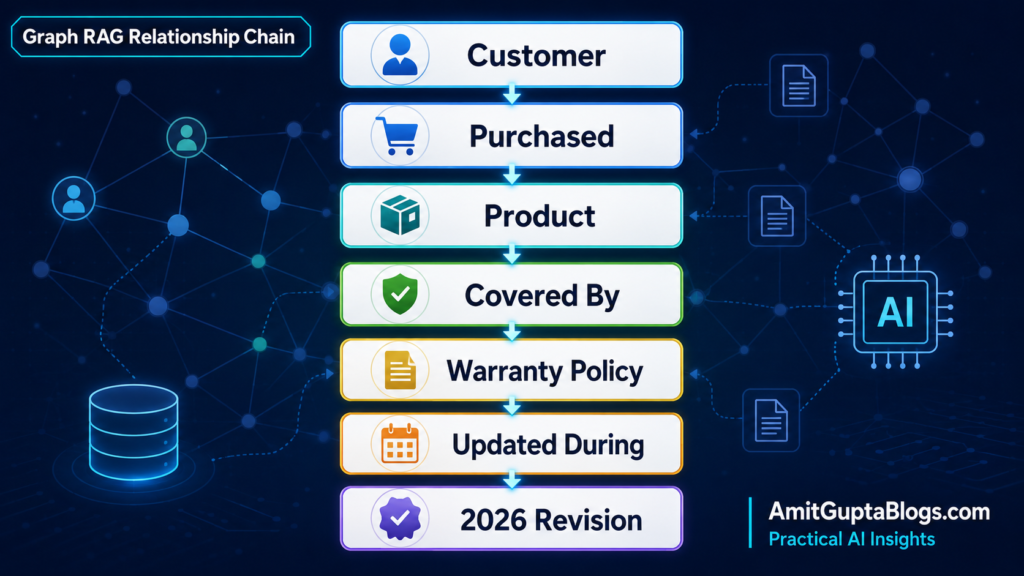
When a question spans multiple related concepts, GraphRAG can traverse these relationships before generating an answer, making it particularly valuable for enterprise knowledge management and complex reasoning tasks.
Looking Ahead
So far we’ve explored how modern RAG systems:
- split documents into chunks
- create embeddings
- perform semantic retrieval
- use vector databases
- combine keyword and vector search
- rerank evidence
- leverage metadata
- evolve into GraphRAG
But one major evolution is still missing. Modern AI doesn’t just retrieve information once. Increasingly, it plans, searches again if needed, uses tools, and decides when enough evidence has been gathered before answering.
That’s the world of Agentic RAG – and it’s where Retrieval-Augmented Generation is heading.
The Next Evolution: Agentic RAG
Traditional RAG follows a simple sequence:
Retrieve → Generate → Answer
For many questions, that’s sufficient.
But what happens when a user asks:
“Compare our current cybersecurity policy with last year’s version, identify the major changes, summarize the impact on European offices, and tell me whether any departments still need compliance training.”
This isn’t a single retrieval problem.
The AI must:
- break the task into smaller questions
- retrieve multiple documents
- compare different versions
- reason across departments
- possibly call external tools
- verify its findings
- generate a grounded response
This is where Agentic RAG comes in.
Instead of retrieving once, an AI agent plans its approach, retrieves iteratively, decides when more evidence is needed, uses tools where appropriate, and validates results before responding. In enterprise environments, this significantly improves performance on complex, multi-step workflows.
Traditional RAG vs Agentic RAG
| Traditional RAG | Agentic RAG |
|---|---|
| One retrieval pass | Multiple retrieval cycles |
| Fixed workflow | Dynamic planning |
| Answers questions | Solves complex tasks |
| Limited reasoning | Multi-step reasoning |
| No tool orchestration | Uses APIs, databases and tools |
| Best for FAQs | Best for enterprise assistants |
Think of it this way:
Traditional RAG is like asking a librarian for one book.
Agentic RAG is like hiring a research assistant who can:
- search multiple libraries
- interview experts
- compare reports
- verify facts
- return with a complete research summary.
RAG + AI Agents
One of the biggest architectural shifts in 2026 is that RAG is no longer viewed as a standalone application. Instead, it has become one capability within an AI agent.
A modern enterprise AI agent may:
- Understand the request
- Plan the workflow
- Retrieve relevant knowledge
- Query internal databases
- Call external APIs
- Perform calculations
- Generate the final response
- Ask follow-up questions if confidence is low
Retrieval is no longer the destination. It’s one step in intelligent problem-solving.
RAG and the Model Context Protocol (MCP)
If RAG gives an AI access to knowledge, the Model Context Protocol (MCP) gives it a standardized way to access tools, applications, databases, and enterprise systems.
A useful way to think about them is:
| Technology | Primary Role |
|---|---|
| RAG | Retrieve relevant knowledge |
| MCP | Connect securely to external tools and data sources |
| AI Agent | Decide what to retrieve, which tools to use, and how to complete the task |
For example:
An employee asks: “Prepare my quarterly sales summary and email it to my manager.”
The AI agent might:
- use RAG to retrieve reporting guidelines
- use MCP to access the CRM
- calculate sales metrics
- generate the summary
- draft the email
Each technology complements the others rather than replacing them. This convergence is becoming a defining pattern in enterprise AI architectures.
A Modern Enterprise RAG Architecture
A production-grade RAG system typically consists of five logical layers:
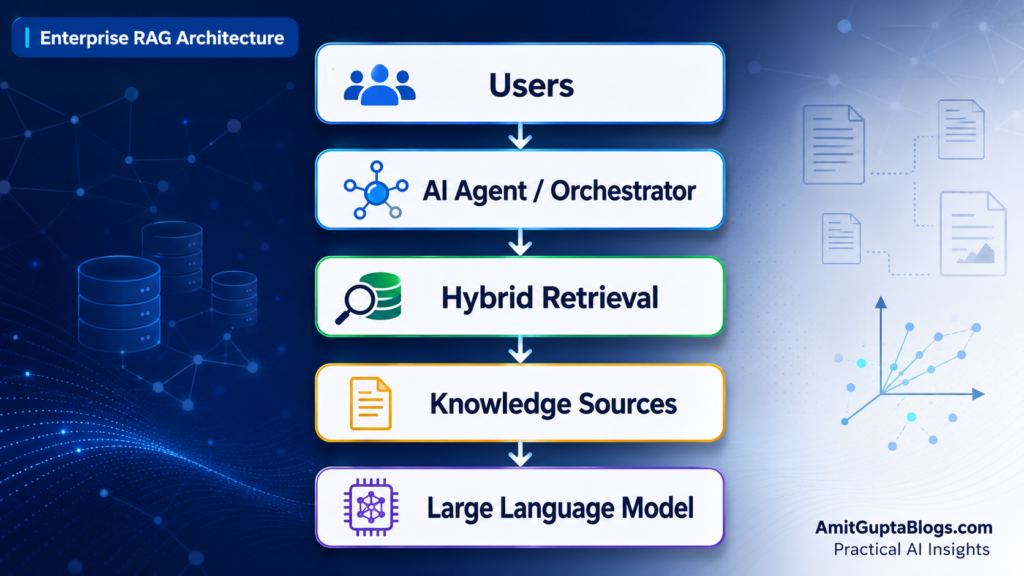
Behind these layers sit supporting services such as:
- Embedding models
- Vector databases
- Keyword indexes
- Metadata stores
- Access control
- Monitoring
- Evaluation pipelines
- Logging
- Human review
Modern RAG systems are infrastructure – not just chatbots.
Enterprise Use Cases
Customer Support
Instead of memorizing thousands of support articles, the AI retrieves following contetns before responding.:
- product manuals
- troubleshooting guides
- warranty policies
Healthcare
Doctors can query for following items using the latest approved documentation.
- treatment guidelines
- clinical protocols
- hospital procedures
Banking & Financial Services
Before generating any recommendations, AI assistants retrieve:
- compliance manuals
- regulatory updates
- investment policies
- risk frameworks
Legal Research
Law firms use RAG to search following documents while providing evidence-backed summaries:
- contracts
- legal precedents
- legislation
- case law
Software Development
Developer assistants, before suggesting implementations, retrieve:
- API documentation
- architecture decisions
- coding standards
- internal design documents
Common Mistakes When Building RAG
Many first-generation RAG projects failed–not because the language model was weak, but because the retrieval layer was poorly designed.
Avoid these pitfalls:
❌ Poor Chunking
Splitting documents arbitrarily can separate related ideas and reduce retrieval quality.
❌ Ignoring Metadata
Without metadata such as document version, department, or publication date, outdated or irrelevant information may be retrieved.
❌ Using Only Vector Search
Hybrid retrieval usually performs better because it combines semantic understanding with exact keyword matching.
❌ Skipping Reranking
Sending every retrieved chunk directly to the LLM increases noise and reduces answer quality.
❌ No Access Control
An AI assistant should never retrieve documents the user is not authorized to access.
❌ No Evaluation
If you don’t measure retrieval accuracy, citation quality, latency, and answer faithfulness, it’s impossible to know whether the system is actually improving.
How Should You Evaluate a RAG System?
Unlike traditional software, RAG systems require evaluation across multiple dimensions.
Consider tracking:
| Metric | Why It Matters |
| Retrieval Precision | Are the right documents being found? |
| Recall | Are important documents being missed? |
| Citation Accuracy | Are answers backed by correct evidence? |
| Faithfulness | Does the answer stay grounded in retrieved content? |
| Latency | Is retrieval fast enough for users? |
| Cost | Are token usage and infrastructure efficient? |
| User Satisfaction | Do users trust the answers? |
Leading organizations increasingly treat evaluation as a continuous process rather than a one-time test.
Is RAG Replacing Fine-Tuning?
No. They solve different problems.
Use RAG when:
- knowledge changes frequently
- documents must remain current
- citations are required
- private enterprise data is involved
Use Fine-Tuning when:
- changing writing style
- teaching structured output
- improving domain-specific behavior
- adapting model tone
In many enterprise deployments, the two techniques are used together.
The Future of RAG
RAG has evolved rapidly. The progression looks something like this:
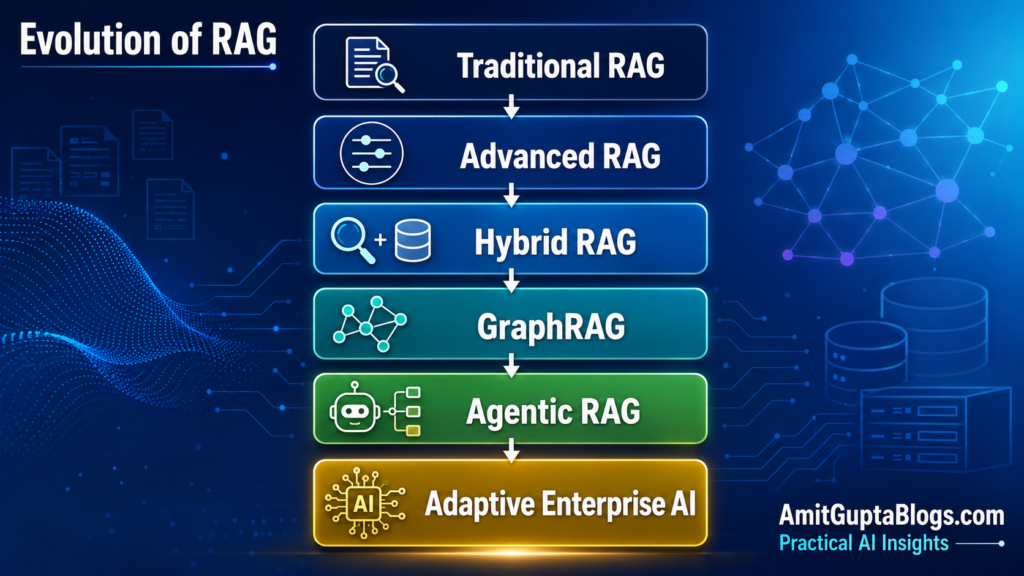
The future isn’t about retrieving more documents. It’s about retrieving the right evidence at the right time with the right level of reasoning and governance.
Research is also showing that more complex architectures are not always better; organizations should choose the simplest approach that meets their accuracy, latency, and cost requirements.
Key Takeaways
- Retrieval-Augmented Generation allows AI to access external knowledge before answering.
- RAG significantly reduces hallucinations and keeps responses current.
- Embeddings and vector databases enable semantic retrieval rather than simple keyword matching.
- Hybrid search, reranking, and metadata filtering improve retrieval quality.
- GraphRAG supports relationship-aware and multi-hop reasoning.
- Agentic RAG introduces planning, iterative retrieval, and tool use for complex enterprise workflows.
- RAG, AI Agents, and MCP are complementary technologies that together form the foundation of modern enterprise AI systems.
- The retrieval layer is becoming strategic infrastructure for production AI, not just an add-on feature.
Frequently Asked Questions (FAQs)
What is Retrieval-Augmented Generation (RAG)?
RAG is an AI architecture that retrieves relevant external information before a Large Language Model generates its response, improving accuracy and reducing hallucinations.
Why is RAG better than relying only on an LLM?
A standalone LLM depends on information learned during training. RAG supplements that knowledge with current or private data retrieved at query time.
Does RAG eliminate hallucinations completely?
No. It reduces them significantly by grounding responses in retrieved evidence, but retrieval quality, prompt design, and model behavior still influence the final output.
What is the difference between RAG and GraphRAG?
Traditional RAG retrieves relevant text passages. GraphRAG incorporates knowledge graphs to understand relationships between entities, making it better for complex, multi-hop reasoning.
What is Agentic RAG?
Agentic RAG extends traditional RAG by allowing AI agents to plan tasks, retrieve information iteratively, use external tools, and verify answers before responding.
Can RAG work with private company documents?
Yes. This is one of its biggest strengths. Organizations can connect RAG to internal knowledge bases while enforcing permissions and governance.
Is RAG useful only for enterprises?
No. While enterprises benefit greatly, RAG is also valuable for educational assistants, research tools, developer documentation, healthcare, legal research, and customer support.
References
- IBM – Retrieval-Augmented Generation (RAG)
- Google Cloud – Retrieval-Augmented Generation Overview
- Microsoft Research – GraphRAG
- Anthropic – Contextual Retrieval
- LangChain Documentation
- LlamaIndex Documentation
- Pinecone Documentation
- Qdrant Documentation
- Weaviate Documentation
- Milvus Documentation
- arXiv – Agentic Retrieval-Augmented Generation: A Survey on Agentic RAG
Final Thoughts
If AI Agents are the decision-makers and Large Language Models are the reasoning engines, then Retrieval-Augmented Generation is the knowledge layer that keeps them grounded in reality.
As enterprise AI matures, success will depend less on building ever-larger language models and more on designing intelligent retrieval, governance, and orchestration layers that deliver accurate, trustworthy, and explainable answers.
In that sense, RAG is no longer just a technique–it’s a foundational architectural pattern for modern AI systems.
Author Bio

Amit Gupta is a UI/UX Designer and Frontend Specialist with more than 20 years of experience in product design, design systems, Angular development, frontend architecture, and emerging technologies. Through AmitGuptaBlogs.com, he shares practical insights on AI, Google technologies, design workflows, development tools, and future technology trends.