
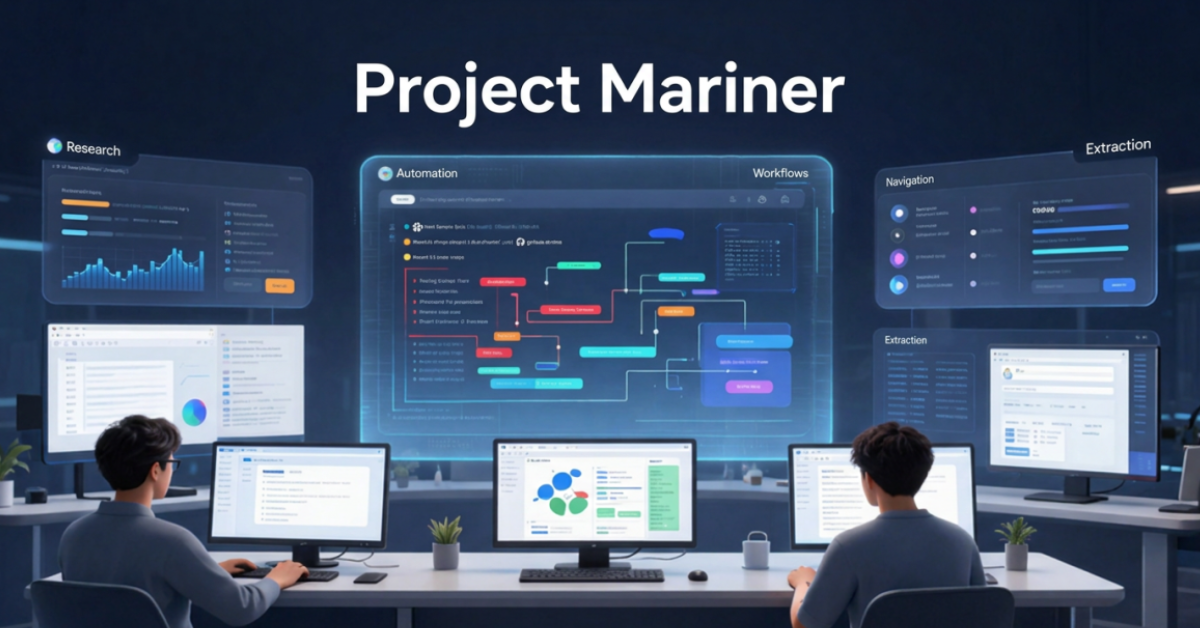
Artificial intelligence is rapidly evolving from answering questions to performing real-world tasks on behalf of users. One of the most exciting developments in this direction is Project Mariner, Google’s experimental AI agent designed to understand websites, interact with browser interfaces, and automate complex online workflows.
As AI systems become more capable, the future is shifting from chat-based assistance toward autonomous agents that can browse the web, conduct research, fill forms, compare products, and complete multi-step tasks with minimal human intervention.
In this Project Mariner Complete Guide 2026, we’ll explore what Project Mariner is, how it works, its capabilities, use cases, benefits, limitations, and how it fits into Google’s broader AI agent ecosystem.
Table of Contents
What Is Project Mariner?
Project Mariner is Google’s experimental AI-powered browser agent developed by Google DeepMind.
Unlike traditional AI chatbots that simply provide answers, Project Mariner can:
- Understand webpage content
- Navigate websites
- Interact with buttons and forms
- Execute multi-step workflows
- Perform online research
- Complete tasks on behalf of users
In simple terms:
Project Mariner aims to transform AI from an information provider into an action-taking digital assistant.
The project was initially introduced as part of Google’s broader vision for AI agents that can operate directly within web environments.
Why Google Created Project Mariner
Traditional AI systems require users to:
- Search information manually
- Open websites
- Compare results
- Fill forms
- Complete actions themselves
Project Mariner attempts to eliminate these repetitive steps.
Google’s vision is to create AI agents capable of:
- Understanding user intent
- Browsing websites intelligently
- Performing tasks autonomously
- Reducing digital friction
- Improving productivity
This aligns closely with Google’s long-term AI strategy focused on intelligent agents.
How Project Mariner Works
Project Mariner operates inside a browser environment and uses advanced AI reasoning models to understand webpage elements.
The workflow typically follows these steps:
Step 1: User Provides a Goal
Example:
“Find the best budget smartphones under $500 and compare specifications.”
Step 2: AI Understands the Task
The system breaks the objective into smaller actions.
Step 3: Web Navigation
Project Mariner navigates relevant websites.
Step 4: Information Extraction
The agent gathers relevant data.
Step 5: Reasoning
AI evaluates information and makes comparisons.
Step 6: Task Completion
The final result is presented to the user.
Key Capabilities of Project Mariner
1. Autonomous Web Browsing
Project Mariner can:
- Open websites
- Navigate menus
- Scroll pages
- Access information
- Follow links
This enables AI to interact with the web similarly to a human user.
2. Online Research Automation
Research tasks can consume significant time.
Project Mariner can:
- Visit multiple websites
- Gather information
- Compare sources
- Summarize findings
- Present conclusions
This capability complements tools like NotebookLM and Gemini Deep Research.
3. Form Filling Assistance
Many online tasks involve repetitive form entries.
Examples include:
- Travel bookings
- Registration forms
- Service requests
- Application submissions
Project Mariner can assist by understanding form structures and entering information under user supervision.
4. Product Comparison
Shopping research becomes significantly easier.
The AI can:
- Visit multiple stores
- Compare specifications
- Analyze pricing
- Evaluate reviews
- Create summaries
Instead of opening ten browser tabs, users can rely on the agent to perform much of the research.
5. Multi-Step Task Execution
One of Project Mariner’s most powerful features is handling complex workflows.
Example:
“Find a flight to Mumbai, compare options, and prepare the booking page.”
This requires:
- Search
- Comparison
- Decision-making
- Navigation
Project Mariner can coordinate these actions as a single workflow.
6. Contextual Understanding
Unlike traditional automation scripts, Project Mariner uses AI reasoning.
It understands:
- Page layouts
- User instructions
- Navigation paths
- Context changes
This flexibility makes it more adaptable than rule-based automation systems.
For deeper understanding of multi-agent systems, read: Multi-Agent Systems Complete Guide 2026
Project Mariner vs Traditional Browser Automation
| Feature | Traditional Automation | Project Mariner |
| Fixed Rules | Yes | No |
| AI Reasoning | No | Yes |
| Context Awareness | Limited | High |
| Dynamic Adaptation | Limited | Strong |
| Natural Language Instructions | No | Yes |
| Multi-Step Planning | Limited | Advanced |
Project Mariner represents a major evolution beyond conventional browser automation tools.
Real-World Use Cases
Research Professionals
Researchers can automate:
- Data gathering
- Competitive analysis
- Market research
- Information aggregation
Students
Students can:
- Collect learning resources
- Compare references
- Conduct topic research
- Summarize findings
Business Users
Business professionals can automate:
- Competitor monitoring
- Product analysis
- Vendor comparisons
- Industry research
Online Shoppers
Consumers can:
- Compare prices
- Analyze reviews
- Discover alternatives
- Evaluate product specifications
Administrative Teams
Routine tasks may include:
- Data entry
- Website navigation
- Information collection
- Form processing
The Role of Gemini in Project Mariner
Project Mariner relies heavily on Google’s Gemini models.
Gemini provides:
- Reasoning capabilities
- Task planning
- Language understanding
- Decision making
- Workflow execution
Without advanced Gemini reasoning, autonomous browser agents would struggle with dynamic web environments.
This demonstrates how Google’s AI ecosystem components work together.
Project Mariner and Google’s AI Agent Strategy
Project Mariner is not an isolated project.
It is part of Google’s larger AI agent ecosystem that includes:
Together, these technologies are creating a future where AI systems can:
- Observe
- Reason
- Plan
- Act
This progression is often described as moving from AI assistants to AI agents.
Project Mariner vs Project Astra
Many people confuse Project Mariner with Project Astra.
Project Astra
Focuses on:
- Real-time multimodal understanding
- Cameras and voice interaction
- Environmental awareness
- Universal AI assistant experiences
Project Mariner
Focuses on:
- Browser interactions
- Web navigation
- Task execution
- Online workflow automation
In simple terms:
Astra understands the world.
Mariner acts on the web.
Together they represent complementary parts of Google’s future AI vision.
Benefits of Project Mariner
Increased Productivity
Users spend less time performing repetitive digital tasks.
Reduced Manual Effort
The AI handles navigation and information gathering.
Faster Research
Multiple websites can be analyzed quickly.
Intelligent Task Automation
Complex workflows become easier to manage.
Better User Experience
Users focus on goals rather than procedures.
Current Limitations
Despite its potential, Project Mariner still faces challenges.
Website Variability
Every website behaves differently.
Security Concerns
Task automation requires strong safety controls.
Accuracy Requirements
Incorrect actions may have real-world consequences.
Permission Management
Users must remain in control of critical actions.
Regulatory Considerations
AI agents operating online must comply with privacy and security requirements.
The Future of Project Mariner
Google’s long-term vision appears to involve increasingly capable AI agents.
Future versions may support:
- More autonomous workflows
- Better reasoning
- Cross-application actions
- Personalized task execution
- Enterprise integrations
- Multi-agent collaboration
As AI agents become mainstream, systems like Project Mariner may fundamentally change how people interact with the internet.
Instead of manually navigating websites, users may simply describe goals and allow AI agents to perform the necessary actions.
Why Project Mariner Matters
Project Mariner represents a significant milestone in AI evolution.
The shift from:
“Answer my question”
to
“Complete my task”
is one of the biggest transitions occurring in artificial intelligence today.
By combining advanced Gemini reasoning with browser-based task execution, Google is building technology that could redefine digital productivity across personal, educational, and enterprise environments.
For anyone following the future of AI agents, Project Mariner is one of the most important Google AI initiatives to watch in 2026.
FAQs
What is Project Mariner?
Project Mariner is Google’s experimental AI browser agent designed to navigate websites, perform research, and automate online tasks.
Is Project Mariner available to everyone?
Availability may vary depending on Google’s testing and rollout programs. Features continue to evolve as the project develops.
How is Project Mariner different from Gemini?
Gemini provides AI reasoning capabilities, while Project Mariner uses those capabilities to perform actions within web environments.
Can Project Mariner automate web tasks?
Yes. It is specifically designed to help automate browsing, research, navigation, and multi-step workflows.
Is Project Mariner part of Google’s AI agent ecosystem?
Yes. It complements initiatives such as Gemini, Project Astra, Google AI Agents, and the Agent Development Kit.
Will AI agents replace traditional web browsing?
AI agents are likely to augment rather than completely replace traditional browsing by helping users complete tasks more efficiently.
References
Author Bio

Amit Gupta is a UI/UX Designer and Frontend Specialist with more than 20 years of experience in product design, design systems, Angular development, frontend architecture, and emerging technologies. Through AmitGuptaBlogs.com, he shares practical insights on AI, Google technologies, design workflows, development tools, and future technology trends.