
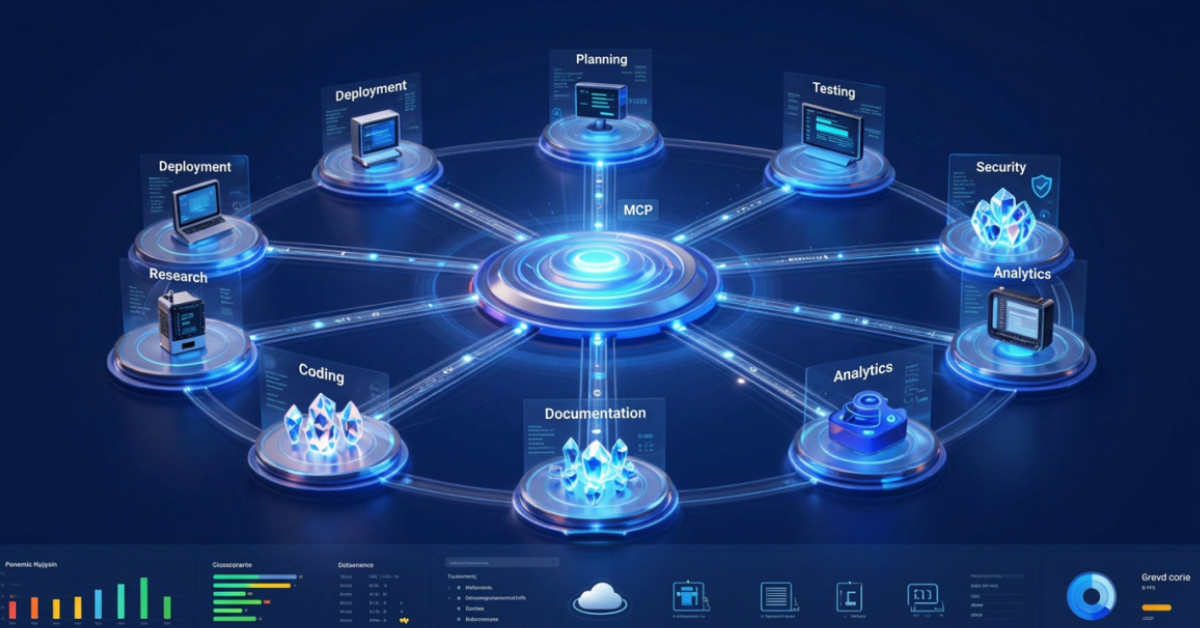
AI Agent Orchestration Complete Guide 2026
Artificial Intelligence has evolved far beyond simple chatbots and isolated AI assistants. Modern enterprises are increasingly deploying teams of AI agents that collaborate, communicate, and coordinate to complete sophisticated business workflows. Behind this coordinated intelligence lies a critical capability known as AI Agent Orchestration.
Rather than relying on a single large language model to solve every problem, organizations are building ecosystems where specialized AI agents work together under an orchestration layer that manages task distribution, communication, execution order, memory, tool access, and governance.
Whether you’re building enterprise automation platforms, intelligent customer support systems, software engineering assistants, research copilots, or autonomous business workflows, understanding AI Agent Orchestration has become an essential skill in 2026.
This guide explains how AI Agent Orchestration works, why it matters, the architectures behind it, leading orchestration frameworks, enterprise implementation strategies, and how it connects with technologies such as Agentic AI, Multi-Agent Systems, Model Context Protocol (MCP), and Agent2Agent (A2A).
Table of Contents
What is AI Agent Orchestration?
AI Agent Orchestration is the process of coordinating multiple AI agents, tools, APIs, memory systems, and business workflows so they work together as a unified intelligent system.
Instead of asking one AI model to perform every task, orchestration distributes work among specialized agents.
For example:
- Planning Agent
- Research Agent
- Coding Agent
- Testing Agent
- Documentation Agent
- Review Agent
- Deployment Agent
An orchestration engine determines:
- which agent should execute next,
- what information should be shared,
- when approvals are required,
- how failures should be handled,
- when workflows are complete.
The orchestrator acts as the central coordinator, ensuring each AI component contributes effectively toward a common objective.
Why AI Needs Orchestration
Single AI assistants perform well for isolated tasks but struggle with complex, multi-step objectives that require planning, reasoning, collaboration, and state management.
Consider the objective:
“Design, build, test, document, deploy, and monitor a web application.”
Completing this request requires many coordinated activities:
- Requirements gathering
- Research
- Architecture design
- UI generation
- Backend development
- API integration
- Unit testing
- Security validation
- Documentation
- Deployment
- Monitoring
No single prompt can reliably execute this entire workflow.
AI Agent Orchestration enables specialized agents to handle different responsibilities while maintaining coordination across the entire process.
Evolution of AI Agent Architectures
AI systems have rapidly evolved over the past decade.
Generation 1: Standalone Chatbots
Characteristics:
- Single conversation
- Stateless interactions
- Limited reasoning
- No workflow coordination
Examples:
- Early chatbots
- FAQ assistants
- Rule-based virtual assistants
Generation 2: AI Assistants
Capabilities expanded to include:
- Tool usage
- File analysis
- Code generation
- Web browsing
- Image understanding
Examples include modern conversational AI assistants capable of handling a broad range of user tasks.
Generation 3: AI Agents
AI agents introduced autonomy.
They can:
- plan tasks,
- use tools,
- remember previous work,
- execute actions,
- adapt strategies,
- interact with external systems.
Generation 4: Multi-Agent Systems
Instead of one intelligent assistant, organizations deploy multiple specialized agents working together.
Examples include:
- Developer agents
- QA agents
- Data analysts
- Security reviewers
- Financial analysts
- Customer service specialists
Generation 5: AI Agent Orchestration
Modern enterprise systems coordinate dozens or even hundreds of AI agents simultaneously.
The orchestration layer manages communication, execution, memory, governance, observability, and resource optimization across the entire ecosystem.
Core Components of AI Agent Orchestration
Successful orchestration platforms typically include several foundational components.
1. Orchestrator
The orchestrator serves as the central control system.
Responsibilities include:
- scheduling tasks,
- assigning agents,
- managing dependencies,
- coordinating workflows,
- resolving conflicts,
- monitoring execution.
2. AI Agents
Each agent specializes in a specific domain.
Examples include:
- Research Agent
- Planner Agent
- Coding Agent
- Documentation Agent
- Testing Agent
- Financial Agent
- Legal Review Agent
- Marketing Agent
Specialization improves quality, scalability, and reliability.
3. Shared Memory
Agents require access to common context.
Memory systems may include:
- conversation history,
- vector databases,
- structured databases,
- long-term organizational knowledge,
- retrieval systems,
- document repositories.
Without shared memory, collaboration quickly breaks down.
4. Tool Integration
Modern AI agents interact with external systems such as:
- CRM platforms
- ERP systems
- Git repositories
- Cloud services
- Email platforms
- Calendar applications
- Databases
- APIs
- Search engines
- Analytics dashboards
The orchestrator controls secure access to these tools.
5. Communication Layer
Agents exchange information through structured communication protocols.
Typical communication includes:
- task assignments,
- intermediate results,
- approvals,
- status updates,
- execution logs,
- error reports,
- completion notifications.
Efficient communication prevents duplicated work and improves collaboration.
6. Policy & Governance
Enterprise deployments require governance mechanisms to ensure AI systems operate safely and consistently.
Governance includes:
- access control,
- approval workflows,
- compliance policies,
- audit logging,
- security validation,
- execution limits,
- human review checkpoints.
These controls help organizations meet regulatory, security, and operational requirements while maintaining trust in autonomous workflows.
AI Agent Orchestration Architecture
Although implementations vary across platforms, most enterprise AI orchestration systems follow a layered architecture that separates user interaction, workflow management, intelligent agents, tools, and infrastructure.
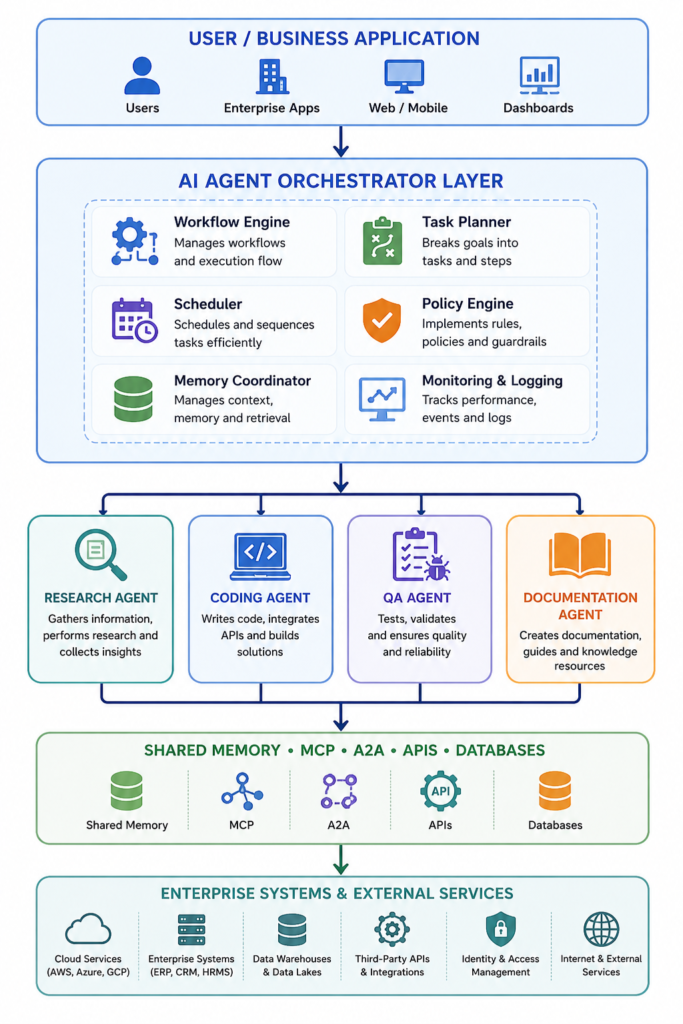
The orchestration layer is responsible for ensuring every agent receives the correct context, executes at the appropriate time, and returns outputs that can be consumed by subsequent agents.
Unlike traditional automation pipelines, orchestrators continuously adapt workflows based on intermediate results rather than following a fixed sequence.
Lifecycle of an Orchestrated AI Workflow
A typical enterprise workflow progresses through several stages:
Step 1: Goal Understanding
The orchestrator receives a business objective.
Example:
Build a customer support chatbot integrated with the company’s CRM.
Instead of directly invoking a language model, the orchestrator decomposes the objective into manageable subtasks.
Step 2: Task Planning
The workflow planner creates an execution graph.
Example:
- Gather requirements
- Research existing documentation
- Design conversation flow
- Generate architecture
- Build APIs
- Write chatbot logic
- Execute tests
- Prepare documentation
- Deploy application
Each task is assigned dependencies and execution conditions.
Step 3: Agent Assignment
Specialized agents receive individual responsibilities.
For example:
Research Agent
- Analyze CRM documentation
- Identify APIs
- Extract authentication methods
Developer Agent
- Build chatbot
- Generate backend APIs
Testing Agent
- Execute functional testing
- Validate integrations
Documentation Agent
- Create user manuals
- Produce API documentation
Step 4: Tool Execution
Agents invoke tools such as:
- Git repositories
- Cloud platforms
- Search engines
- Database queries
- Documentation portals
- Code interpreters
- Enterprise APIs
Modern orchestration systems treat tools as first-class resources rather than hardcoded functions.
Step 5: Validation
Before continuing, outputs are validated.
Validation may include:
- syntax checking
- security scanning
- policy verification
- quality scoring
- human approval
- compliance checks
Only validated results proceed to downstream agents.
Step 6: Completion
The orchestrator combines outputs into a unified deliverable while preserving execution history, traceability, and audit records.
Centralized vs Decentralized Orchestration
Organizations generally adopt one of two orchestration models.
Centralized Orchestration
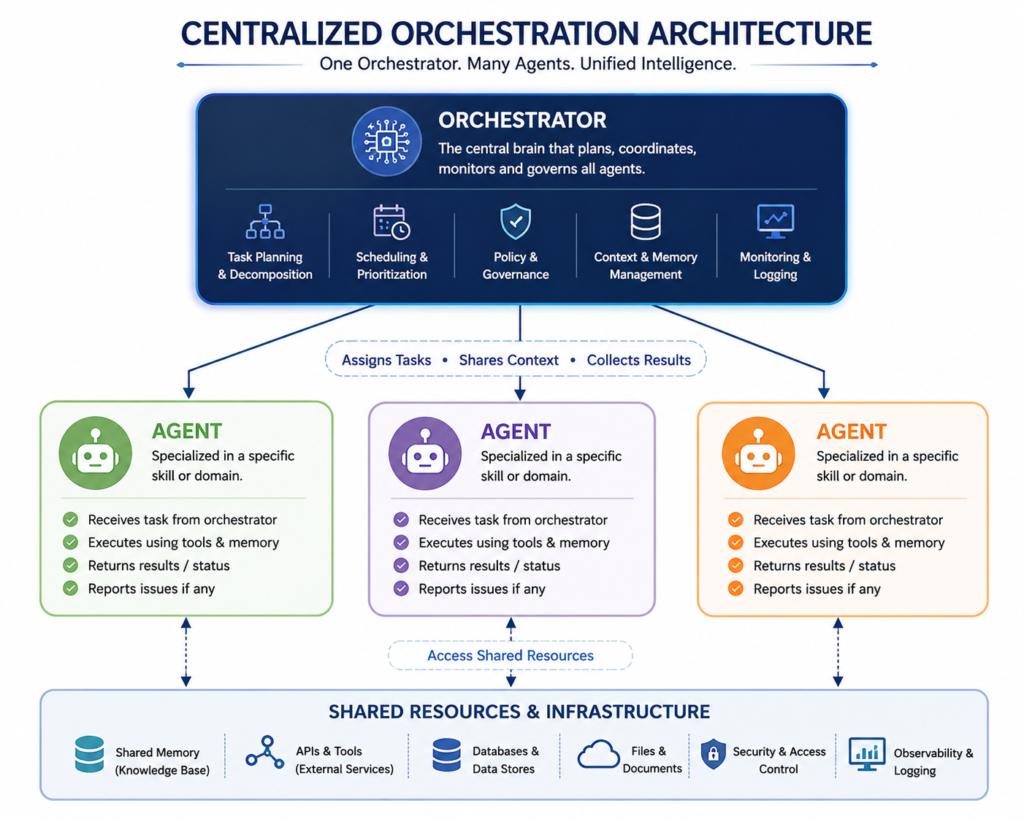
Characteristics
- Single decision maker
- Easier governance
- Better monitoring
- Simpler debugging
- Strong policy enforcement
Advantages
- Consistent workflows
- Easier compliance
- Predictable execution
- Centralized security
Disadvantages
- Single point of failure
- Scalability limitations
- Potential bottlenecks
Best suited for:
- Enterprise applications
- Banking
- Healthcare
- Government
- Regulated industries
Decentralized Orchestration
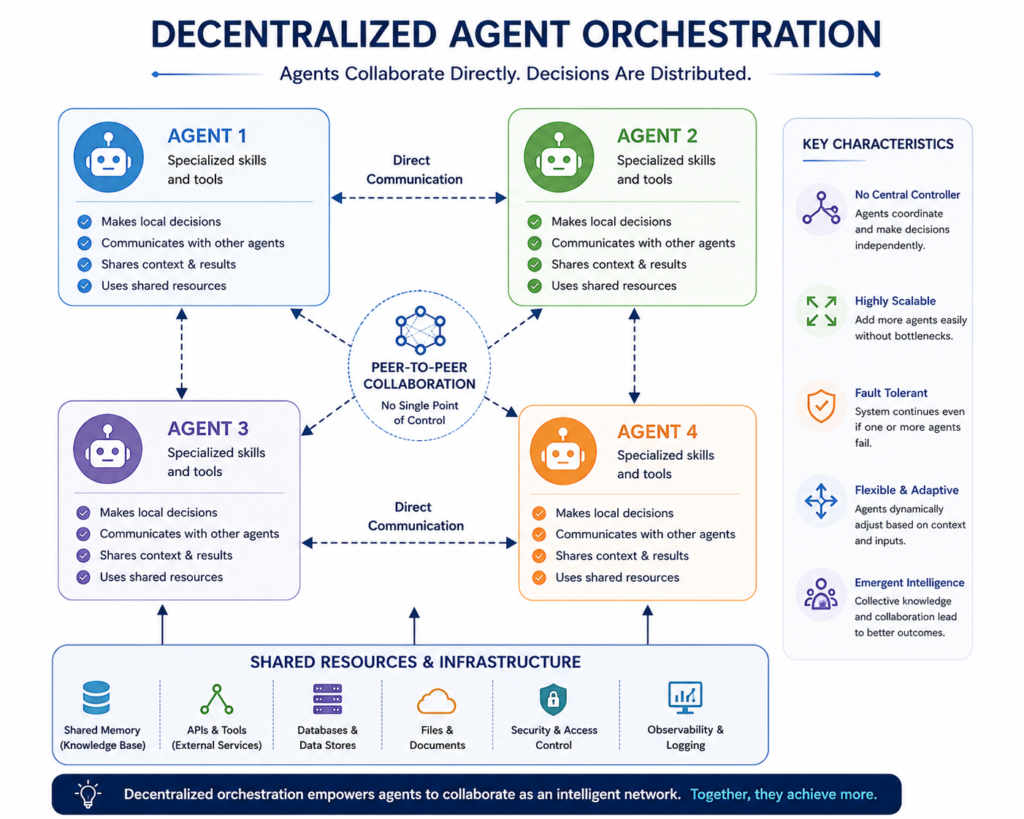
Agents collaborate directly while collectively determining execution order.
Advantages
- Highly scalable
- Fault tolerant
- Faster parallel execution
- Greater flexibility
Challenges
- More difficult governance
- Increased communication complexity
- Conflict resolution
- Distributed decision-making
Common use cases include:
- Swarm intelligence
- Scientific simulations
- Distributed robotics
- Autonomous systems
Human-in-the-Loop (HITL) Orchestration
Despite rapid advances, enterprises rarely allow unrestricted autonomous execution.
Instead, they insert human approval checkpoints into critical workflows.
Example:
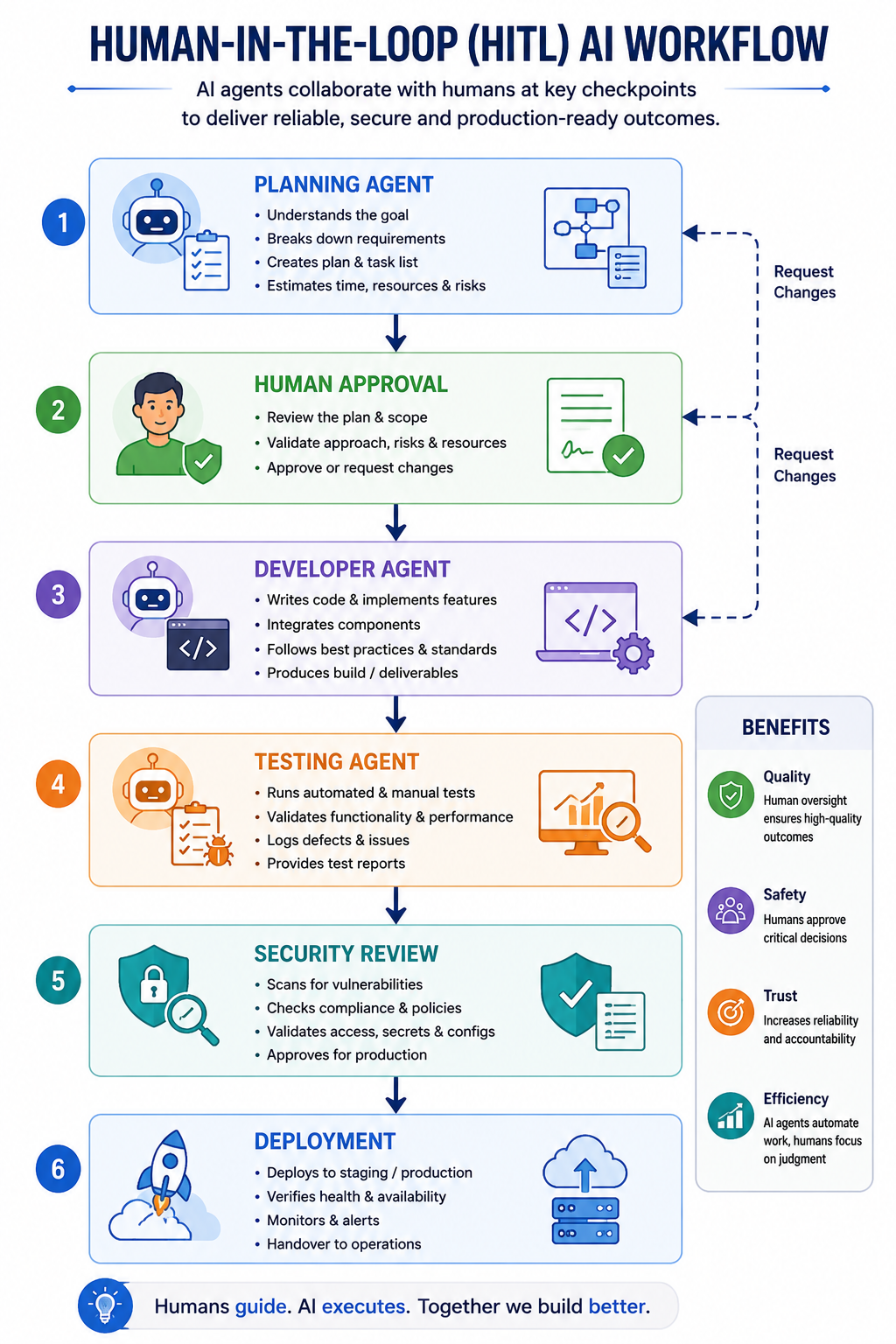
Typical approval stages include:
- Budget approvals
- Legal reviews
- Security assessments
- Production deployments
- Financial transactions
- Medical recommendations
Human oversight reduces operational risk while allowing AI agents to automate routine work.
AI Agent Communication During Orchestration
For orchestration to succeed, agents must exchange structured information efficiently.
Common communication includes:
Context Sharing
Agents inherit relevant information from previous tasks.
Example:
Research findings become input for architecture generation.
Status Updates
Agents continuously report:
- Running
- Waiting
- Completed
- Failed
- Retrying
This allows orchestrators to make dynamic scheduling decisions.
Intermediate Outputs
Agents rarely wait until completion.
Instead they stream:
- summaries
- partial code
- extracted data
- generated diagrams
- validation reports
Downstream agents can begin work immediately, improving overall throughput.
Error Handling
When failures occur, orchestrators may:
- retry automatically
- invoke backup agents
- request human intervention
- modify execution plans
- skip optional tasks
Robust recovery mechanisms are essential for enterprise reliability.
Enterprise Use Cases
Software Development
AI agents collaborate to:
- Gather requirements
- Design architecture
- Generate code
- Write tests
- Review pull requests
- Deploy applications
- Monitor production
Customer Support
Coordinated agents manage:
- customer identification
- sentiment analysis
- knowledge retrieval
- ticket routing
- escalation
- follow-up communication
Financial Services
Banks increasingly orchestrate AI agents for:
- fraud detection
- risk analysis
- compliance monitoring
- transaction review
- investment research
- customer onboarding
Healthcare
Healthcare organizations use orchestration for:
- patient triage
- clinical documentation
- medical coding
- imaging analysis
- treatment recommendations
- appointment coordination
Human clinicians remain responsible for final medical decisions.
Research & Knowledge Work
Research organizations coordinate agents that:
- search scientific literature
- summarize findings
- compare evidence
- generate reports
- identify knowledge gaps
- recommend future investigations
Marketing Operations
Marketing teams orchestrate agents for:
- audience research
- SEO analysis
- content creation
- campaign planning
- performance analytics
- A/B testing
- reporting
This reduces manual coordination while accelerating campaign execution.
Benefits of AI Agent Orchestration
Organizations adopting AI Agent Orchestration gain advantages that extend well beyond simple task automation.
Improved Specialization
Instead of relying on a single general-purpose AI model, enterprises can deploy specialized agents for planning, coding, analytics, legal review, security, finance, customer support, or documentation. This division of responsibilities generally improves accuracy and maintainability.
Greater Scalability
As workloads grow, organizations can add new agents without redesigning the entire system. Orchestration enables parallel execution, dynamic task allocation, and workload balancing across multiple agents.
Higher Reliability
Production orchestrators can automatically:
- Retry failed tasks
- Switch to backup agents
- Validate intermediate outputs
- Escalate exceptions
- Recover from transient failures
These capabilities make enterprise AI systems significantly more resilient than standalone assistants.
Better Governance
Every action can be monitored and audited.
Organizations can define policies such as:
- Which tools an agent may access
- Spending limits
- Approval requirements
- Data access restrictions
- Compliance checkpoints
Modern enterprise AI increasingly treats governance as part of the orchestration layer rather than an afterthought.
Faster Business Automation
Rather than automating isolated tasks, orchestration enables complete end-to-end workflows across departments.
Examples include:
- Customer onboarding
- Loan processing
- Insurance claims
- Software releases
- Marketing campaigns
- Research automation
Challenges of AI Agent Orchestration
Despite its benefits, implementing orchestration at enterprise scale introduces new engineering challenges.
Agent Coordination
As the number of agents increases, communication overhead also grows.
Poor coordination may lead to:
- Duplicate work
- Conflicting decisions
- Circular dependencies
- Deadlocks
- Resource contention
Context Management
Every agent requires the correct information at the right time.
Challenges include:
- Context synchronization
- Memory freshness
- Token limitations
- Version control
- Long-running workflows
Security
Autonomous agents frequently interact with:
- Internal databases
- Enterprise APIs
- Financial systems
- Customer information
- Cloud infrastructure
Zero-trust permissions, identity management, and least-privilege access are becoming standard practices for production deployments.
Cost Optimization
Multiple agents often invoke several large language models, external APIs, and tools.
Organizations therefore monitor:
- Model costs
- Tool usage
- API consumption
- Compute utilization
- Latency
- Token consumption
The orchestrator plays an important role in balancing performance with operational cost.
Observability
Traditional application monitoring is insufficient for autonomous AI systems.
Modern AI observability focuses on:
- Agent reasoning traces
- Tool-call history
- Memory access
- Task completion rates
- Quality evaluation
- Cost per workflow
- Policy violations
Observability has emerged as one of the most important capabilities for production-grade multi-agent systems.
AI Agent Orchestration Best Practices
Organizations deploying AI orchestration should consider the following practices.
Design Specialized Agents
Avoid creating one “super agent.”
Smaller, focused agents are easier to maintain, evaluate, and improve.
Keep Workflows Modular
Separate:
- Planning
- Execution
- Validation
- Review
- Deployment
Modularity allows independent upgrades without disrupting the entire system.
Use Shared Memory Carefully
Only expose the context required for each task.
Avoid unnecessary information sharing between agents.
Implement Human Approval
Require human review for:
- Financial transactions
- Production deployments
- Legal decisions
- Healthcare recommendations
- High-risk operations
Add Comprehensive Monitoring
Track:
- Task success rates
- Tool failures
- Execution latency
- Cost per workflow
- User satisfaction
- Hallucination rates
- Policy compliance
Build Governance from Day One
Successful enterprises treat governance, observability, and orchestration as one integrated platform rather than separate initiatives.
The Future of AI Agent Orchestration
AI Agent Orchestration is rapidly becoming the operational backbone of enterprise AI.
Several trends are shaping the next generation of orchestrated systems.
Agent-Native Enterprises
Organizations are moving from isolated AI assistants toward business processes built around coordinated AI agents.
Open Standards
Protocols such as Model Context Protocol (MCP) and Agent2Agent (A2A) are improving interoperability between agents, tools, and enterprise platforms, reducing vendor lock-in and enabling richer collaboration across ecosystems.
Smarter Orchestrators
Future orchestration engines will optimize workflows dynamically by selecting:
- the most appropriate model,
- the best available agent,
- the right tool,
- the optimal execution strategy,
based on cost, latency, accuracy, and business priorities.
Autonomous Control Planes
Many enterprises are building centralized AI control planes that combine orchestration, governance, policy enforcement, identity management, and observability into a unified management layer.
Production-Grade Reliability
As AI agents become business-critical, engineering priorities are shifting toward:
- deterministic workflows,
- runtime guardrails,
- continuous evaluation,
- traceability,
- auditability,
- resilience,
- responsible autonomy.
Frequently Asked Questions (FAQs)
What is AI Agent Orchestration?
AI Agent Orchestration is the coordination of multiple AI agents, tools, memory systems, and workflows so they collaborate efficiently to accomplish complex objectives.
How is AI Agent Orchestration different from Multi-Agent Systems?
A Multi-Agent System describes multiple collaborating agents.
AI Agent Orchestration is the coordination layer that manages those agents, assigns work, monitors execution, and governs the overall workflow.
Is AI Agent Orchestration only for enterprises?
No. While large organizations gain the greatest benefits, startups and developers also use orchestration frameworks to automate software development, research, customer support, and content generation.
Which frameworks support AI Agent Orchestration?
Popular frameworks include:
– LangGraph
– CrewAI
– AutoGen
– Semantic Kernel
– Google Agent Development Kit (ADK)
The appropriate framework depends on the complexity, governance, and deployment requirements of the project.
Why is observability important?
Observability enables developers to understand how AI agents reason, which tools they use, where failures occur, and whether policies are being followed. It is essential for debugging, compliance, and production reliability.
Conclusion
AI Agent Orchestration represents the transition from isolated AI assistants to coordinated intelligent systems capable of executing complex, multi-step business workflows.
As organizations adopt autonomous agents across engineering, customer service, finance, healthcare, research, and operations, orchestration becomes the control layer that ensures collaboration, governance, security, and reliability.
The future belongs not to a single powerful AI agent, but to well-orchestrated ecosystems where specialized agents work together under intelligent supervision. Organizations that invest early in orchestration architecture, shared context, governance, and observability will be better positioned to scale trustworthy AI and unlock long-term enterprise value.
References
- Google Cloud — Model Context Protocol (MCP)
- Anthropic — Model Context Protocol Documentation
- Microsoft — Semantic Kernel Documentation
- Google — Agent Development Kit (ADK)
- CrewAI Documentation
- LangGraph Documentation
- Microsoft AutoGen Documentation
- OpenTelemetry Documentation
- NVIDIA AI Enterprise
- IBM Think — AI Agent Governance
Author Bio

Amit Gupta is a UI/UX Designer and Frontend Specialist with more than 20 years of experience in product design, design systems, Angular development, frontend architecture, and emerging technologies. Through AmitGuptaBlogs.com, he shares practical insights on AI, Google technologies, design workflows, development tools, and future technology trends.