
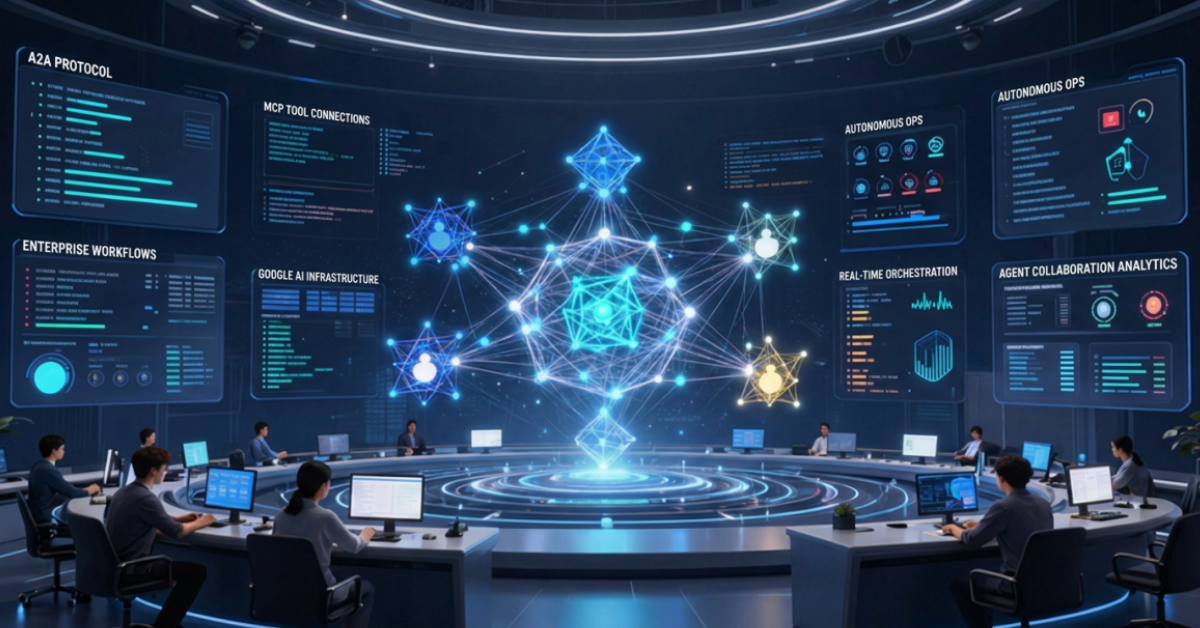
Artificial Intelligence is entering a new phase.
For the past few years, AI assistants and copilots have helped users generate content, answer questions, write code, and automate individual tasks. However, enterprises are now moving beyond isolated AI assistants toward networks of autonomous agents that collaborate to complete complex business workflows.
This evolution is driving the rise of Multi-Agent Systems (MAS).
In 2026, many technology leaders describe this shift as the transition from AI tools to Agentic AI ecosystems, where multiple specialized agents work together, share context, access tools, and coordinate decisions across enterprise environments. Google and other major AI providers increasingly refer to this transformation as the emergence of the “Agentic Enterprise.”
For developers, designers, business leaders, and AI enthusiasts, understanding Multi-Agent Systems is becoming essential because they are rapidly evolving into the operational foundation of next-generation AI applications.
Table of Contents
What Are Multi-Agent Systems?
A Multi-Agent System (MAS) is a collection of intelligent agents that interact with each other to achieve shared or individual goals.
Each agent can:
- Observe information
- Make decisions
- Execute actions
- Communicate with other agents
- Access tools and resources
- Adapt to changing situations
Instead of one AI model attempting to solve every problem, a Multi-Agent System distributes responsibilities among specialized agents.
According to industry definitions, a Multi-Agent System consists of multiple AI agents working collectively to perform tasks on behalf of users or other systems while coordinating their activities toward desired outcomes.
Why 2026 Is the Year of Multi-Agent Systems
The AI industry is experiencing a major shift.
Organizations are discovering that a single AI agent struggles to manage:
- Long-running workflows
- Multiple business systems
- Large-scale coordination
- Cross-functional tasks
- Dynamic enterprise environments
As a result, enterprises are increasingly adopting multi-agent architectures where specialized AI agents collaborate to solve problems more efficiently. Reports across the industry highlight the transition from experimental AI copilots to orchestrated multi-agent execution models.
The focus is no longer:
“Which AI model should we use?”
The focus is becoming:
“How should multiple AI agents collaborate?”
Why Single AI Agents Are No Longer Enough
Single AI agents work well for:
- Content generation
- Coding assistance
- Research
- Customer support
However, enterprise operations require much more.
Consider a software release process:
A single agent would need to:
- Gather requirements
- Analyze code
- Generate software
- Perform testing
- Review security
- Create documentation
- Deploy applications
This quickly becomes inefficient.
A Multi-Agent System can assign each responsibility to a specialized agent, enabling parallel execution and better outcomes.
This shift toward specialization is becoming a defining characteristic of Agentic AI architectures.
Understanding Multi-Agent Systems Through a Simple Example
Imagine a company launching a new product.
The system could include:
Research Agent
Collects market intelligence.
Analytics Agent
Studies customer behavior.
Strategy Agent
Creates positioning recommendations.
Content Agent
Develops marketing materials.
Design Agent
Generates creative assets.
Project Manager Agent
Coordinates tasks.
Reporting Agent
Tracks progress and outcomes.
Each agent focuses on a specific role while collaborating toward a common objective.
The Three-Layer Architecture Behind Modern Multi-Agent Systems
One of the most important developments in 2026 is the emergence of a three-layer architecture for Agentic AI systems.
Layer 1: Intelligence Layer
This layer contains foundation models such as:
- Gemini
- GPT
- Claude
- Other LLMs
These models provide reasoning and decision-making capabilities.
Layer 2: Communication Layer
This layer enables agent-to-agent collaboration.
Examples include:
- A2A Protocol
- Agent communication frameworks
- Event-driven messaging systems
This layer allows agents to discover, coordinate, negotiate, and delegate work.
Layer 3: Tool Access Layer
This layer connects agents to external systems.
Examples include:
- MCP servers
- APIs
- Databases
- Enterprise applications
- Knowledge repositories
MCP is increasingly viewed as the standard mechanism for connecting AI agents to tools and data sources.
Core Components of a Multi-Agent System
Agents
Autonomous entities responsible for reasoning and action.
Environment
The digital ecosystem in which agents operate.
Examples:
- CRM platforms
- ERP systems
- Cloud infrastructure
- Enterprise applications
Communication Infrastructure
Enables agents to exchange information.
Shared Knowledge
Provides common context through:
- Memory systems
- Vector databases
- Knowledge graphs
Orchestration Layer
Coordinates agent activities and workflow execution.
How AI Agents Collaborate
Agent collaboration is the defining feature of Multi-Agent Systems.
Agents commonly collaborate through:
Task Delegation
One agent assigns work to another.
Negotiation
Agents discuss possible solutions.
Shared Memory
Agents access common knowledge sources.
Event-Driven Coordination
Agents react to system events in real time.
Consensus-Based Decision Making
Multiple agents evaluate and validate outcomes before execution.
These coordination mechanisms enable scalable and reliable enterprise workflows.
Types of Multi-Agent Architectures
Centralized Architecture
A master coordinator controls all activities.
Benefits:
- Simpler management
- Easier monitoring
Challenges:
- Single point of failure
Decentralized Architecture
Agents communicate directly.
Benefits:
- Scalability
- Flexibility
Challenges:
- Increased coordination complexity
Hierarchical Architecture
Agents operate within structured layers.
Example:
Executive Agent → Manager Agents → Worker Agents
This approach is increasingly used in enterprise deployments.
Swarm Architecture
Inspired by natural systems such as:
- Ant colonies
- Bee swarms
- Bird flocks
Useful for large-scale distributed tasks.
Federated Architecture
A rapidly emerging model where independent agent ecosystems collaborate securely across organizational boundaries. Recent research highlights federated orchestration as an important direction for future agent ecosystems.
Why Multi-Agent Orchestration Is Becoming More Important Than Models
One of the biggest trends in 2026 is the growing importance of orchestration.
Organizations increasingly view competitive advantage as coming from:
- Workflow design
- Agent coordination
- Context management
- Governance
- Security
- Tool integration
rather than simply selecting the most powerful AI model.
As a result, orchestration platforms are becoming a critical part of enterprise AI infrastructure.
Multi-Agent Systems and Agentic AI
Agentic AI refers to systems capable of:
- Planning
- Reasoning
- Acting autonomously
- Completing multi-step objectives
Multi-Agent Systems extend these capabilities through collaboration.
Instead of one autonomous agent:
- Multiple agents reason together
- Multiple agents share tasks
- Multiple agents validate outcomes
Many modern Agentic AI implementations are increasingly built on Multi-Agent architectures.
Multi-Agent Systems and A2A Protocol
As organizations deploy agents from different vendors, interoperability becomes essential.
The Agent2Agent (A2A) Protocol enables:
- Agent discovery
- Structured communication
- Secure task delegation
- Cross-platform interoperability
A2A is emerging as a critical standard for enabling collaboration across heterogeneous agent ecosystems.
Multi-Agent Systems and MCP
While A2A enables agent-to-agent communication, MCP solves a different problem.
MCP standardizes how AI agents access:
- Tools
- APIs
- Databases
- Enterprise systems
- External services
Together:
- MCP enables tool connectivity.
- A2A enables agent collaboration.
Most scalable Multi-Agent Systems are expected to use both technologies together.
Google’s Multi-Agent Ecosystem
Google is becoming one of the most important players in Agentic AI.
Key components include:
Gemini
Provides reasoning and intelligence capabilities.
Agent Development Kit (ADK)
Supports development of sophisticated multi-agent applications.
A2A Protocol
Enables standardized communication between agents.
Project Mariner
Explores autonomous web interaction.
Project Astra
Advances real-time multimodal AI assistance.
Vertex AI
Provides enterprise infrastructure for agent deployment.
Together, these technologies form an increasingly comprehensive ecosystem for building Multi-Agent Systems.
Enterprise Use Cases
Software Engineering
Agents perform:
- Planning
- Coding
- Testing
- Security reviews
- Documentation
Customer Support
Agents manage:
- Ticket classification
- Knowledge retrieval
- Escalation
- Resolution
Financial Services
Agents assist with:
- Risk management
- Fraud detection
- Compliance monitoring
Healthcare
Agents coordinate:
- Diagnostics
- Scheduling
- Medical record analysis
Supply Chain Operations
Agents optimize:
- Procurement
- Inventory
- Logistics
- Forecasting
Marketing Operations
Agents automate:
- Campaign planning
- Content creation
- Audience analysis
- Performance reporting
Security, Governance, and Observability
This has become one of the most important discussions surrounding Multi-Agent Systems.
As agents gain autonomy, organizations must address:
Agent Identity
Verifying agent authenticity.
Authorization Controls
Defining what agents can access.
Audit Trails
Tracking actions and decisions.
Memory Isolation
Protecting sensitive information.
Governance Frameworks
Ensuring responsible operation.
Security experts increasingly warn that autonomous agents create new attack surfaces that require specialized governance, monitoring, and access control mechanisms.
Challenges of Multi-Agent Systems
Despite their advantages, Multi-Agent Systems face several challenges.
Communication Overhead
More agents mean more coordination requirements.
Resource Consumption
Large agent networks can be expensive.
Governance Complexity
Organizations must manage permissions and oversight.
Security Risks
Agent collaboration introduces new vulnerabilities.
Debugging Difficulty
Identifying failures across multiple agents can be challenging.
The Future of Multi-Agent Systems
The future of AI is increasingly collaborative.
Industry forecasts suggest rapid growth in Agentic AI adoption, with a significant increase in enterprise applications incorporating autonomous agents and agent-driven workflows over the coming years.
Future developments may include:
- Autonomous digital workforces
- Agent marketplaces
- Cross-company agent collaboration
- Agent economies
- Federated AI ecosystems
- Self-organizing agent networks
The long-term vision is not a single super-agent.
It is an ecosystem of specialized agents working together intelligently.
FAQs
What is a Multi-Agent System?
A Multi-Agent System is a collection of intelligent AI agents that collaborate, communicate, and coordinate actions to achieve goals.
How is a Multi-Agent System different from a single AI agent?
A single AI agent operates independently, while a Multi-Agent System distributes responsibilities across multiple specialized agents.
What is the relationship between Multi-Agent Systems and Agentic AI?
Agentic AI focuses on autonomous decision-making. Multi-Agent Systems are a collaborative implementation of Agentic AI where multiple autonomous agents work together.
Why are A2A and MCP important for Multi-Agent Systems?
A2A enables communication between agents, while MCP enables agents to access tools, APIs, and data sources.
Are Multi-Agent Systems becoming important in enterprises?
Yes. Enterprises are increasingly moving from isolated AI assistants toward orchestrated agent ecosystems capable of handling complex workflows.
What industries are adopting Multi-Agent Systems?
Software development, healthcare, finance, customer support, manufacturing, logistics, and marketing are among the leading adopters.
Conclusion
Multi-Agent Systems are rapidly becoming the architectural foundation of Agentic AI. As organizations move beyond standalone assistants and copilots, the focus is shifting toward collaborative networks of intelligent agents capable of reasoning, coordinating, and executing complex workflows.
Technologies such as A2A and MCP are providing the interoperability layers needed for large-scale agent ecosystems, while platforms from Google and other AI leaders are making enterprise deployment increasingly practical.
For anyone seeking to understand the future of AI, Multi-Agent Systems are no longer a niche concept – they are becoming the operating model for the next generation of intelligent software.
Author Bio

Amit Gupta is a UI/UX Designer and Frontend Specialist with more than 20 years of experience in product design, design systems, Angular development, frontend architecture, and emerging technologies. Through AmitGuptaBlogs.com, he shares practical insights on AI, Google technologies, design workflows, development tools, and future technology trends.